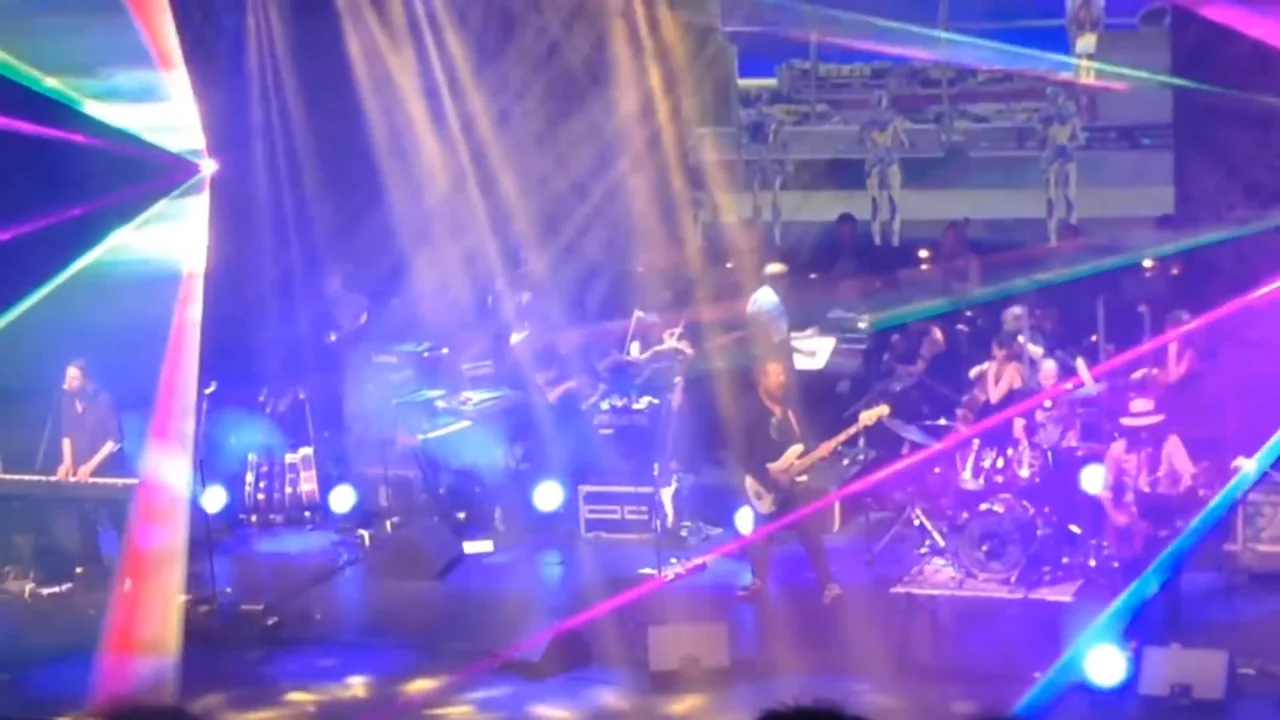
Hawkwind joined the open-ended repetition of late-1960s psychedelia to hard-rock weight, electronic noise and science-fiction imagery. The result became known as space rock, but the band’s identity was never simply decorative: sustained riffs, saxophone, audio generators and spoken texts turned concerts into continuous environments rather than strings of separate songs.
Formed in London in 1969 and led throughout by guitarist and singer Dave Brock, Hawkwind have survived unusually frequent personnel changes without becoming a nostalgia act. Their official site was advertising a 2026 tour when this guide was reviewed, while the 2025 studio album There Is No Space for Us showed that the catalogue was still expanding.
Hawkwind performing in 2018.Photo: Geemeff / Wikimedia Commons · Licensed under CC BY 3.0. Converted to WebP for this page.
Formation & History
Hawkwind formed in the Notting Hill area of London in 1969, with Dave Brock and saxophonist and flautist Nik Turner among the musicians who established the group. The debut album appeared on Liberty in 1970; In Search of Space followed on United Artists in October 1971 and became their first UK Top 20 album. Electronic operators Dik Mik and Del Dettmar were central to the early sound alongside Brock, Turner and a changing rhythm section.
Lemmy Kilmister joined on bass and Simon King on drums in 1971, and both first appeared on a Hawkwind studio album with Doremi Fasol Latido in 1972. Lemmy remained through Warrior on the Edge of Time in 1975—not merely for a brief cameo. Robert Calvert contributed poetry and performance to the Space Ritual presentation, then became a more prominent writer and frontman during the streamlined late-1970s phase. Brock remained the continuous figure as later lineups carried the band through new-wave, metal and electronic contexts.
Sound & Style
The classic Hawkwind engine begins with repeated bass and guitar figures rather than harmonic display. Drums keep the pulse physical while saxophone, flute, synthesizers and homemade or modified audio generators smear the edges of the riff. Instead of using electronics as a separate solo voice, the band often treats them as pressure, weather and spatial depth.
That method changes meaning from record to record. In Search of Space moves between long communal jams and acoustic contrast; Doremi Fasol Latido gains a heavier low end from Lemmy and a more forceful rhythmic attack from Simon King; Space Ritual removes most studio distance by linking songs with Robert Calvert’s recitations, dancers and Liquid Len’s light show. The spectacle was not an accessory to the music—it completed the same idea of immersion.
Essential Albums
1973
Space Ritual
United Artists · Original 1973 release
Recorded at three concerts on Hawkwind’s December 1972 UK tour, this double live album preserves the show as a continuous sequence rather than a conventional greatest-hits set. “Born to Go” and “Orgone Accumulator” ride Lemmy and Simon King’s hard-driving rhythm section, while Robert Calvert’s recitations bridge songs drawn largely from In Search of Space and Doremi Fasol Latido. The original production and sequencing translate a multimedia event—complete with dancers and Liquid Len’s light show—into an album whose transitions are as important as its individual tracks.
Key tracks: Born to Go · Orgone Accumulator · Master of the Universe
Recorded at Rockfield and Olympic studios in September and October 1972, this was the first Hawkwind studio album to feature Lemmy on bass and vocals and Simon King on drums. Their arrival makes “Brainstorm” and “Lord of Light” heavier and more direct, yet “Space Is Deep” retains acoustic guitar, chanting voices and slowly accumulating electronics. The record converts the looser drift of the previous album into a seven-track studio statement and supplied much of the material for the Space Ritual tour.
Key tracks: Brainstorm · Space Is Deep · Lord of Light
Released in October 1971, Hawkwind’s second album became their first UK Top 20 LP. The sixteen-minute “You Shouldn’t Do That” turns a small riff into a collective process of guitar, saxophone, percussion and electronic interference; “Master of the Universe” compresses that method into a durable concert staple. “We Took the Wrong Step Years Ago” introduces acoustic space and a more reflective lyric, preventing the six-track record from becoming one unbroken wall of sound.
Key tracks: You Shouldn’t Do That · Master of the Universe · We Took the Wrong Step Years Ago
Hawkwind carried psychedelic practice beyond the 1960s by making repetition compatible with hard-rock volume, portable electronics and the communal culture of British free festivals. Their early records supplied a practical vocabulary for later space rock, stoner rock and heavy psychedelic music without requiring virtuoso solos or elaborate harmonic systems.
Their longevity matters just as much as their influence. Dave Brock has maintained a recognisable method while lineups, technologies and musical climates changed around it; the band’s announced 2026 performances make “1969–present” a verifiable continuing history, not a ceremonial status attached to an inactive catalogue.
RetroForge Records publishes original music and independent editorial guides. This historical band guide is not affiliated with the artist, labels or rights holders. No unlicensed album artwork is reproduced.