Vanilla Fudge treated a cover version as an act of reconstruction. The classic quartet could take a compact contemporary song, reduce its tempo, enlarge its transitions and rebuild it around Hammond organ, vocal harmony and a rhythm section designed to fill a room. Their 1967 recording of “You Keep Me Hangin’ On” is the clearest example, but the method shaped an entire run of Atco albums.
The group’s first phase moved unusually quickly: a covers-based debut, producer Shadow Morton’s experimental collage The Beat Goes On, the predominantly self-written Renaissance, and two further studio albums all appeared between 1967 and 1969. Each record redirects the group’s method, tracing its changing balance of arrangement, authorship and heavy ensemble playing.
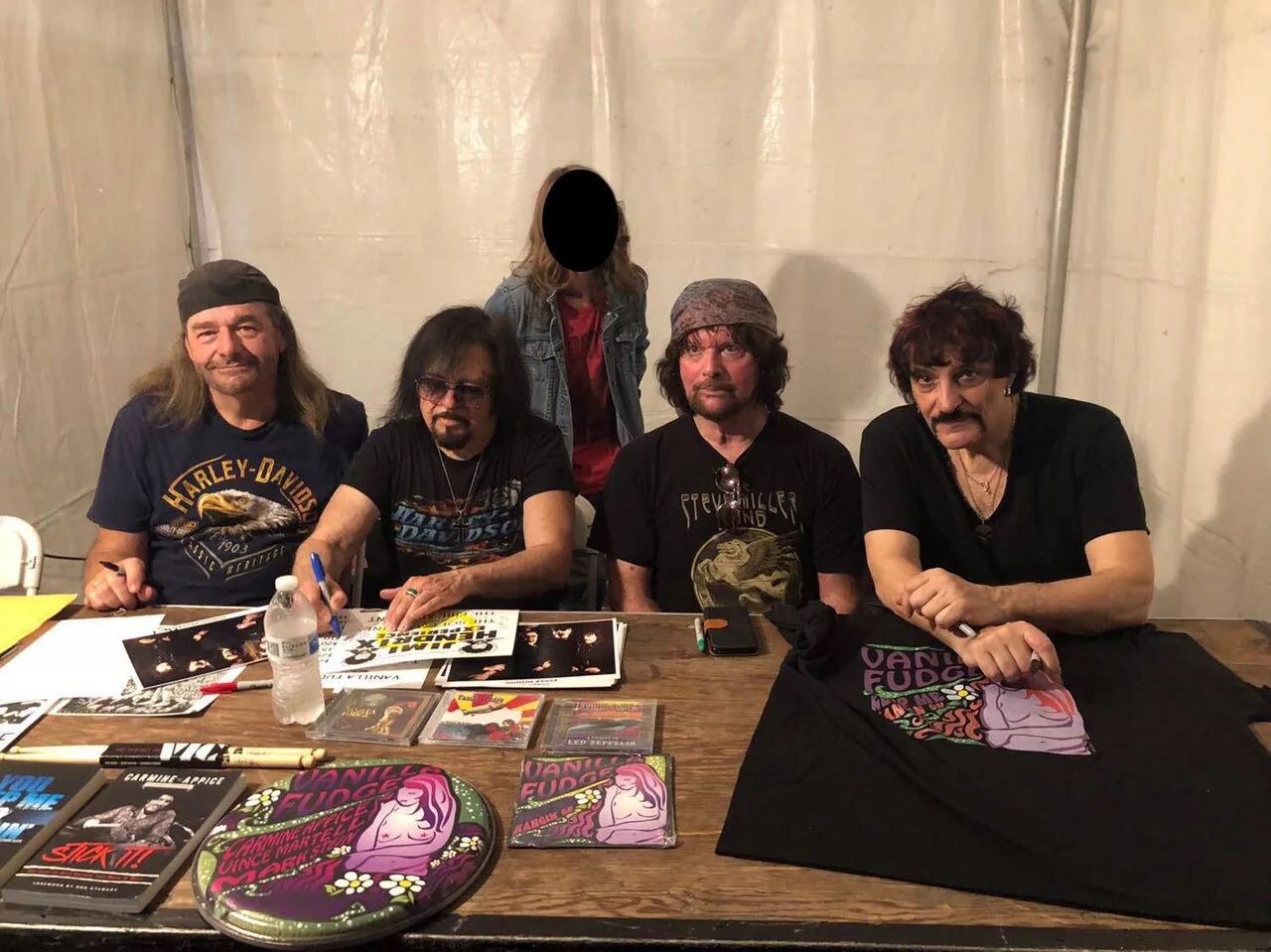
Vanilla Fudge in a licensed band photograph.Photo: CarterLennon / Wikimedia Commons · Licensed under CC BY-SA 4.0. Converted to WebP for this page.
Formation & History
The group developed from the Pigeons, an East Coast club band built around organist and singer Mark Stein, bassist and singer Tim Bogert and guitarist and singer Vince Martell. Carmine Appice replaced drummer Joey Brennan in late 1966. Producer George “Shadow” Morton heard the group perform its radically slowed arrangement of the Supremes’ “You Keep Me Hangin’ On” in early 1967, recorded it and helped secure an Atco deal; the label required a new name, and the Pigeons became Vanilla Fudge.
The self-titled debut reached the US Top 10, and a shorter single edit of “You Keep Me Hangin’ On” became a Top 10 hit when Atco reissued it in 1968. The quartet followed its debut with The Beat Goes On and Renaissance in 1968, then Near the Beginning and Rock & Roll in 1969. Constant touring and internal strain preceded the original group’s breakup in early 1970.
Bogert and Appice next formed Cactus and later played together in Beck, Bogert & Appice. Vanilla Fudge reunited in several configurations from the 1980s onward. Tim Bogert retired from touring in 2009 and died in 2021; Pete Bremy subsequently covered the bass role alongside Stein, Martell and Appice, and the band’s official site continues to list performances by that lineup.
Sound & Style
The arrangements depend on scale and contrast rather than distortion alone. Stein’s Hammond can sustain chords like an orchestral bed and then turn abrasive through Leslie amplification. Bogert’s bass is an independent, highly audible voice; Appice answers it with forceful fills, cymbal swells and an oversized bass-drum sound. Martell supplies guitar colour, riffs and melodic responses while all four musicians contribute to the layered vocals.
Appice has described the group’s club arrangements as “production numbers”: songs were slowed and divided into sections whose lighting, dynamics and instrumental gestures followed the lyric. That explains why “You Keep Me Hangin’ On” does more than stretch the Supremes’ recording. The suspended organ opening, near-silences, vocal exchanges and sudden full-band entries convert the plea for release into a sequence of tension and impact. On later records, the same ensemble could move toward tape collage, original songwriting or a more direct hard-rock attack.
Essential Albums
1967
Vanilla Fudge
Atco · Original 1967 release
The debut applies one group identity to songs associated with the Beatles, the Zombies, the Impressions, the Supremes, Evie Sands and Cher. Short “Illusions of My Childhood” interludes help bind the sequence, while “You Keep Me Hangin’ On” turns a compact Motown song into an extended drama of organ suspense, vocal counterpoint and rhythm-section impact. “Ticket to Ride” and “Eleanor Rigby” show that the method is not one fixed tempo: the quartet reshapes phrasing and dynamics according to each source song.
Key tracks: Ticket to Ride · You Keep Me Hangin’ On · Eleanor Rigby
This is not a conventional set of long-form cover arrangements. Shadow Morton organized it as a continuous historical collage around fragments of Sonny Bono’s title phrase, with spoken voices, tape effects, quotations from Beethoven and brief references to earlier popular music. The band performs inside that design, but its members later described the project as Morton’s concept and an interruption to the album they had begun making. Its value is documentary and experimental; it is the least representative starting point for the quartet’s core method.
Key passages: The Beat Goes On · Beethoven’s Moonlight Sonata · Voices in Time
After the producer-led collage of The Beat Goes On, the third album restores the quartet to the centre and makes original writing the rule rather than the exception: five of the original LP’s seven pieces carry band-member credits. “The Sky Cried – When I Was a Boy” moves between a compact song and a darker instrumental frame, while “Thoughts” gives Stein’s organ and the group vocals room to build. Donovan’s “Season of the Witch” remains the large-scale reinterpretation, incorporating lyrics from Essra Mohawk’s “We Never Learn.”
Key tracks: The Sky Cried – When I Was a Boy · Thoughts · Season of the Witch
Near the Beginning (1969) puts four pieces on the original LP. The studio side includes the Junior Walker-associated “Shotgun”; much of side two is occupied by “Break Song,” an extended live performance that opens space for individual instrumental features. It documents how much of the group’s identity depended on stage dynamics rather than the studio alone.
Rock & Roll (1969), produced by Adrian Barber, is the fifth and final studio album of the original run. Its shorter song forms and more direct attack make it a useful counterweight to the collage of The Beat Goes On and the elaborate debut. The record preceded the group’s early-1970 breakup rather than launching a stable new phase.
Vanilla Fudge made heaviness a matter of arrangement before heavy rock had settled into a standard vocabulary. Appice’s large drums, Bogert’s foregrounded bass and Stein’s amplified organ could produce weight without depending on fast riffs, while the four-part vocal writing kept the music connected to soul and pop.
The catalogue is also a compact study in interpretation. The debut demonstrates how tempo and dynamics can change a lyric’s emotional meaning; The Beat Goes On records the risks of handing that identity to a producer’s concept; Renaissance tests whether the group can transfer its arranging intelligence to original songs. That sequence is more revealing than a simple list of later bands claimed as influences.
RetroForge Records publishes original music and independent editorial guides. This historical band guide is not affiliated with the artist, labels or rights holders. No unlicensed album artwork is reproduced.