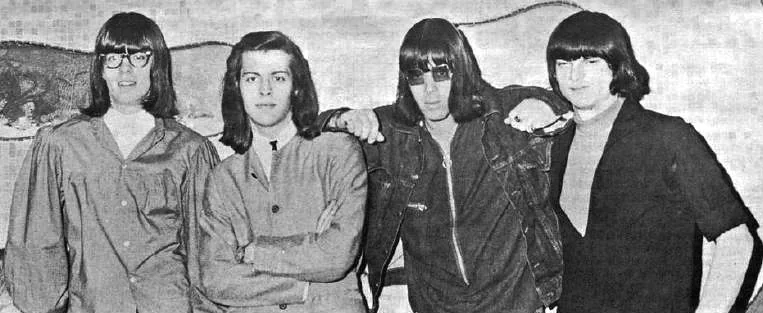
The Seeds formed in Los Angeles in 1965 and turned a deliberately narrow musical vocabulary into one of American garage rock’s most recognisable signatures. Sky Saxon’s tense, nasal lead voice, Daryl Hooper’s electric keyboards, Jan Savage’s clipped guitar figures and Rick Andridge’s forceful drumming made repetition feel physical rather than rudimentary.
Their first two singles, “Can’t Seem to Make You Mine” and “Pushin’ Too Hard,” were recorded before either became a national success. That matters: the 1966 debut was not assembled around a sudden hit but captured a working band with an already coherent method. A Web of Sound stretched that method, while Future surrounded it with the expanded studio colours of 1967 psychedelia.
The Seeds in 1966: Rick Andridge, Daryl Hooper, Sky Saxon and Jan Savage.Photo: Montgomery Ward / Wikimedia Commons · Licensed under Public domain. Converted to WebP for this page.
Formation & History
The classic quartet coalesced in Los Angeles in 1965. Local musician and producer Jimmie Maddin recorded their early sessions and helped bring them to Gene Norman’s GNP Crescendo label. “Can’t Seem to Make You Mine” appeared as their debut single in July 1965; the second single, “Pushin’ Too Hard,” took close to a year to gather momentum, moving from local radio play to a national Top 40 breakthrough late in 1966.
The Seeds issued both their self-titled debut and A Web of Sound in 1966. Manager Lord Tim Hudson’s publicity tied the group to “flower power,” but the ornate Future met a cooler response in the summer of 1967. A blues set recorded earlier was subsequently released as A Full Spoon of Seedy Blues under the Sky Saxon Blues Band name. Savage and Andridge left in 1968; Saxon and Hooper continued with replacements, and Saxon used versions of the Seeds name into the early 1970s.
The original lineup briefly reunited for live dates in 1989. Saxon later led new versions of the group until his death in 2009. In 2017 Hooper, late-period drummer Don Boomer, vocalist Paul Kopf, guitarist Jeff Prentice and archivist-bassist Alec Palao formed a new lineup with the blessing of Saxon’s heirs, extending the band’s performance history without pretending it was the 1966 quartet.
Sound & Style
Hooper’s organ and electric piano are the centre of gravity, cycling through compact figures while Savage’s guitar supplies fuzz, sharp single-note answers and little harmonic clutter. Andridge keeps the arrangements moving with direct snare accents and tom-heavy fills. Saxon’s voice does not float above this framework: his repeated phrases push against it, turning desire and frustration into rhythm.
The debut applies that ensemble sound to concise R&B-shaped songs, then lets “Evil Hoodoo” expand into a darker, longer performance. A Web of Sound preserves the attack of “Mr. Farmer” and “Rolling Machine” but devotes much of its second side to the roughly fourteen-minute “Up in Her Room,” where repetition becomes duration. Future adds orchestration, echo, vocal layers and more elaborate transitions; Ace’s archival work shows that the group’s hard rock-and-roll core remained audible underneath those overdubs.
Essential Albums
1966
The Seeds
GNP Crescendo · Original 1966 release
The twelve-song debut defines the quartet before chart success could reshape it. “Can’t Seem to Make You Mine” sets Saxon’s pleading vocal against Hooper’s chiming keyboard line; “No Escape” tightens the attack; “Pushin’ Too Hard” makes a cyclical riff and refusal to resolve into its entire argument. “Evil Hoodoo” is the counterweight, extending the band’s minimal language into a longer, more ominous performance. The result is cohesive because its limitations belong to the ensemble, not to a production formula imposed after the fact.
Key tracks: Can’t Seem to Make You Mine · Pushin’ Too Hard · No Escape
The second album arrives with more pop-art confidence without abandoning the first record’s machinery. “Mr. Farmer” turns a blunt organ figure and coded subject into a compact single; “Rolling Machine” keeps the rhythm hard and circular. Side two is dominated by “Up in Her Room,” a roughly fourteen-minute piece that sustains tension through repetition rather than conventional development. It is the clearest demonstration that the Seeds could make scale from persistence alone.
Key tracks: Mr. Farmer · Rolling Machine · Up in Her Room
Future is the group’s conscious move into the ornate language of 1967 psychedelia. “March of the Flower Children” functions as an entrance into a sequenced album world; “Travel with Your Mind” and “A Thousand Shadows” retain the quartet’s pulse beneath orchestration, effects and layered voices. The record is less immediate than its predecessors and was divisive on release, yet its tension is historically revealing: a minimalist garage band trying to inhabit the scale and continuity expected of the psychedelic album.
Key tracks: Travel with Your Mind · March of the Flower Children · A Thousand Shadows
A Full Spoon of Seedy Blues was recorded in 1966 but released late in 1967 under the Sky Saxon Blues Band name, with liner notes credited to Muddy Waters. Its slow blues and expanded personnel make it a side road rather than a fourth step in the garage-to-psychedelia sequence. Raw & Alive followed in 1968: despite its concert billing, the performances were recorded in a studio and audience screams were overdubbed. Heard without the marketing fiction, it remains valuable for the harder arrangements and for the otherwise unreleased “Hubbly Bubbly Love.”
The non-album and later singles complete the transition. “The Wind Blows Your Hair” belongs to the richly coloured Future period, while “Satisfy You” returns to a more compact band attack. By the 1970 MGM singles the classic lineup had already fragmented, so they document Saxon and Hooper carrying the name forward rather than a stable continuation of the original quartet.
The Seeds demonstrate that musical economy can be an identity rather than a deficiency. “Pushin’ Too Hard” entered the 1972 Nuggets compilation and reached listeners far beyond the band’s original audience; later admirers and interpreters included Alex Chilton, Johnny Thunders and the Ramones. What travelled forward was not simply fuzz guitar, but the conviction that a short repeated figure could carry an entire song.
The first three albums also map a useful Los Angeles story. The debut captures a self-contained club band, A Web of Sound enlarges its method from within, and Future tests that method against studio psychedelia and “flower power” publicity. Their differences make the catalogue more instructive than a single-hit narrative: they show how quickly garage rock’s local language was being repackaged, expanded and contested in 1966–67.
RetroForge Records publishes original music and independent editorial guides. This historical band guide is not affiliated with the artist, labels or rights holders. No unlicensed album artwork is reproduced.