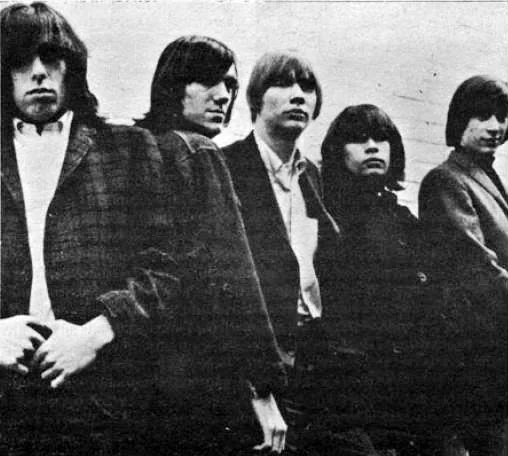
Blues Magoos carried the economy of a working New York club band into the first commercial wave of American psychedelia. Psychedelic Lollipop put the new vocabulary directly in its title, but the record's identity comes from the interaction of Ralph Scala's electric organ, Peppy Castro and Mike Esposito's guitars, Ron Gilbert's bass and Geoff Daking's drums.
That lineup made three Mercury albums between 1966 and 1968. Across them, fuzz, abrupt edits and colourful packaging grow around concise songs rather than replacing them. The result belongs as much to garage rock and rhythm and blues as it does to psychedelia.
The Blues Magoos in a 1967 KRLA Beat photograph.Photo: KRLA Beat / Beat Publications / Wikimedia Commons · Public domain. Converted to WebP for this page.
Formation & History
Ralph Scala and Ron Gilbert formed the Trenchcoats in the Bronx in 1964 with guitarist and singer Emil “Peppy” Thielhelm, lead guitarist Dennis LePore and drummer Jon Finnegan. The group worked Greenwich Village clubs, changed its spelling from the Bloos Magoos to the Blues Magoos and made an early Verve Folkways single before Mercury signed it. By the Mercury sessions, Mike Esposito had replaced LePore and Geoff Daking had replaced Finnegan.
Psychedelic Lollipop appeared in 1966, and “(We Ain’t Got) Nothin’ Yet” reached the US top five. Electric Comic Book followed in 1967 and Basic Blues Magoos in 1968, after which the classic five ceased working together. Management subsequently used the name for a new ABC lineup led by Castro; its Latin-influenced Never Goin’ Back to Georgia and Gulf Coast Bound should not be mistaken for a continuation of the Mercury quintet's sound.
Scala, Castro and Daking reunited for performances in 2008. In 2014 those three, joined by guitarist Mike Ciliberto and bassist Peter Stuart Kohman, released Psychedelic Resurrection, combining new material with fresh recordings of early songs.
Sound & Style
Scala's Vox organ supplies both bass-like pulse and bright melodic hooks, while the two guitars divide rhythm, fuzz and short lead figures. Gilbert and Daking keep the arrangements compact; group vocals and call-and-response prevent the heavier textures from turning into extended jams. On “(We Ain’t Got) Nothin’ Yet,” the recurring organ pattern is the song's engine rather than background colour.
The second album makes presentation part of the listening experience: “Intermission” interrupts the sequence, a six-minute “Gloria” expands the group's club repertoire, and the brief “That's All Folks” closes the record like a cartoon sign-off. Basic Blues Magoos reduces the novelty framing, increases the share of band-written material and lets harmony and arrangement carry more of the colour.
Essential Albums
1966
Psychedelic Lollipop
Mercury · Original 1966 release
The debut balances band originals with material drawn from the group's rhythm-and-blues and folk-rock repertoire. “(We Ain’t Got) Nothin’ Yet” concentrates the organ-led attack into a hit single; “Tobacco Road” turns John D. Loudermilk's song into a dynamic studio performance; “Love Seems Doomed” shows how Scala and Gilbert could write within the same compact language.
The follow-up keeps the original quintet and producers Bob Wyld and Art Polhemus but gives the band more original material. “Pipe Dream” and “There's a Chance We Can Make It” lead with short, tightly arranged songs; “Gloria” stretches past six minutes, while “Intermission” and “That's All Folks” turn the album's comic-book framing into structure.
Key tracks: Pipe Dream · There’s a Chance We Can Make It · Albert Common Is Dead
The third Mercury album is the classic lineup's most self-directed record, with the group taking production credit on most tracks. “Sybil Green” opens with denser harmony, their version of the Move's “I Can Hear the Grass Grow” links two branches of 1967 psychedelia, and “President's Council on Psychedelic Fitness” preserves the band's satirical edge without repeating the previous album's cartoon devices.
Key tracks: Sybil Green (Of the In Between) · I Can Move a Mountain · President’s Council on Psychedelic Fitness
The 1966 Verve Folkways single “The People Had No Faces” / “So I'm Wrong and You Are Right,” issued as the Bloos Magoos, preserves the group before its Mercury breakthrough.
Never Goin’ Back to Georgia (1969) introduces Castro's entirely new, Latin-influenced lineup; approach it as a separate chapter rather than a fourth album by the famous quintet.
Psychedelic Resurrection (2014) reunites Scala, Castro and Daking and documents how three members chose to revisit the catalogue decades later.
Blues Magoos demonstrate that early American psychedelia was not confined to long improvisation or the West Coast. Their strongest records use short forms, familiar covers and a club-trained rhythm section while allowing organ timbre, fuzz and sequencing to change how those forms are heard.
The chronology also exposes the speed of the market around the word “psychedelic”: three Mercury albums arrived in under two years, each negotiating the gap between a promoted image and the musicians' growing authorship. That documented change is more revealing than claiming the band invented a term or a genre.
RetroForge Records publishes original music and independent editorial guides. This historical band guide is not affiliated with the artist, labels or rights holders. No unlicensed album artwork is reproduced.