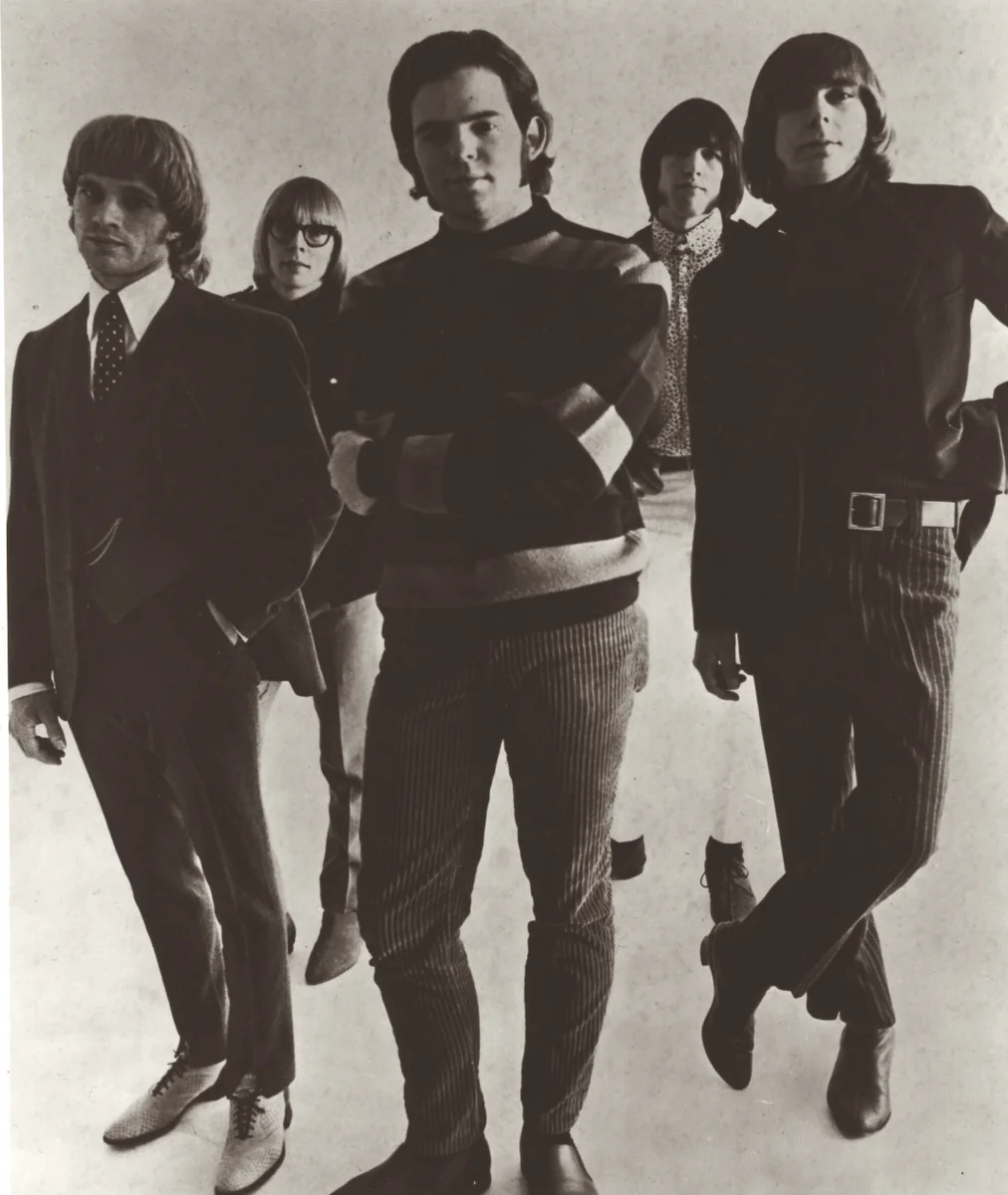
The Chocolate Watchband were a South Bay garage-rock group with an unusually difficult recorded history. The best-known 1966–67 lineup — David Aguilar, Mark Loomis, Sean Tolby, Bill Flores and Gary Andrijasevich — built its reputation on hard-edged live performances, British rhythm-and-blues covers and Aguilar's harmonica and confrontational lead voice.
The three Tower albums cannot be treated as straightforward documents of that group. Producer Ed Cobb and engineer Richie Podolor used outside musicians, instrumentals and session singer Don Bennett alongside Watchband performances; the third album features a re-formed lineup with Danny Phay rather than Aguilar. That distinction is the key to hearing the catalogue accurately.
The Chocolate Watchband around 1966.Photo: Unknown author / Wikimedia Commons · Licensed under Public domain. Converted to WebP for this page.
Formation & History
Guitarists Mark Loomis and Ned Torney formed the first Chocolate Watchband at Foothill College in Los Altos Hills in 1965. That short-lived group made no commercial records. Loomis assembled the better-known lineup in 1966 with Aguilar, Tolby, Flores and Andrijasevich. They became a strong regional attraction, signed with management connected to Green Grass Productions and began recording in Los Angeles with Cobb.
The group appeared in the 1967 films Riot on Sunset Strip and The Love-Ins, but its internal continuity did not survive the year. Loomis left, Aguilar returned to his studies and a temporary lineup filled existing bookings. A re-formed Watchband with original vocalist Danny Phay made One Step Beyond and continued into 1970. Interest in the 1960s recordings eventually brought Aguilar, Flores and Andrijasevich back together in 1999; later activity included Get Away, a live album and the 2019 studio release This Is My Voice.
Sound & Style
The Aguilar-era band favoured clipped rhythm guitar, overdriven lead guitar, blunt bass-and-drum patterns, maracas and harmonica. Aguilar could suggest Mick Jagger's phrasing, but performances such as "I'm Not Like Everybody Else", "I Ain't No Miracle Worker" and "It's All Over Now, Baby Blue" depend on the whole group's tight, aggressive attack rather than vocal imitation alone.
The producer-built material uses a different palette: sitar, flute, saxophone, studio effects and extended instrumental passages. On The Inner Mystique, that contrast is literal — the original first side was made without the Watchband, while the second side draws on the Aguilar lineup's recordings. One Step Beyond changes again, replacing the earlier garage snarl with Danny Phay's voice and a looser folk-rock direction.
Essential Albums
1967
No Way Out
Tower · Original 1967 release
No Way Out is an album of several authorships. The Watchband's own rhythm section and guitars drive "Come On", "Gone and Passes By", "Are You Gonna Be There (At the Love-In)" and the title track, but Cobb replaced Aguilar's guide vocal with Don Bennett on several recordings, including "Let's Talk About Girls". Podolor-led studio musicians supplied the instrumentals "Dark Side of the Mushroom" and "Expo 2000". The clash between direct garage performances and constructed psychedelia is therefore not an aesthetic accident; it is how the record was made.
Key tracks: Come On · Gone and Passes By · Are You Gonna Be There (At the Love-In) · No Way Out
The Inner Mystique makes the split visible in its running order. The original first side — the instrumentals "Voyage of the Trieste" and "Inner Mystique", with Don Bennett singing "In the Past" between them — contains no Watchband performance. The second side draws on the Aguilar lineup: "I'm Not Like Everybody Else" and "I Ain't No Miracle Worker" show its live force, while Bennett's replacement vocals on "Medication" and "Let's Go, Let's Go, Let's Go" complicate the picture again.
Key tracks: I'm Not Like Everybody Else · It's All Over Now, Baby Blue · I Ain't No Miracle Worker · In the Past
One Step Beyond documents a re-formed Watchband rather than the Aguilar lineup. Danny Phay sings, Sean Tolby and Mark Loomis play guitar, Bill Flores and Gary Andrijasevich supply the rhythm section, and most of the seven original LP tracks were written within that circle. "I Don't Need No Doctor" is the sole outside composition; Moby Grape guitarist Jerry Miller contributes to "Devil's Motorcycle". The album is more relaxed and folk-rock-oriented than its predecessors, but its personnel are less deceptive than the studio-built side of The Inner Mystique.
Key tracks: Uncle Morris · Devil's Motorcycle · I Don't Need No Doctor · Flowers
The first Uptown single pairs Cobb's "Sweet Young Thing" with the group's treatment of Dylan's "It's All Over Now, Baby Blue". The latter survives in more than one mix and remains one of the clearest examples of how the Aguilar lineup could recast a familiar song through tense rhythm guitar, harmonica and vocal phrasing.
For the film Riot on Sunset Strip, the band recorded Aguilar's "Don't Need Your Lovin'" and "Sitting There Standing" and appeared on screen. Those compact performances are useful companions to the Tower albums because their authorship is less ambiguous. Later compilations, especially the Ace/Big Beat collection Melts in Your Brain… Not on Your Wrist!, help separate original vocals, alternate versions and studio constructions.
The Watchband's recorded history exposes two different kinds of 1960s music-making. Regional clubs and film appearances preserve the identity of a working South Bay garage band; the Tower albums show how producers and labels could reshape that identity with replacement vocals, outside musicians and material assembled after a lineup had already collapsed.
That history does not make the records disposable. It makes careful attribution essential. The Aguilar lineup's strongest performances retain their physical force, while the studio pieces document another branch of commercial psychedelia. Hearing both — and knowing which is which — turns a confusing catalogue into a revealing case study in authorship, image and control.
RetroForge Records publishes original music and independent editorial guides. This historical band guide is not affiliated with the artist, labels or rights holders. No unlicensed album artwork is reproduced.