

Edition timeline
A troubled plan reaches Alex Cooley
The Atlanta promoter takes a central production role as permissions and local relationships remain uncertain.
An injunction threatens the event
Holy Week opposition, permit questions and narcotics concerns bring the festival before a judge.
The festival proceeds
About 25,000–30,000 people encounter a broad programme, difficult access, rain and coastal camping.
Atlantic releases Mar y Sol
The live double album preserves selected performances even though the festival was not professionally filmed.
Why this event matters
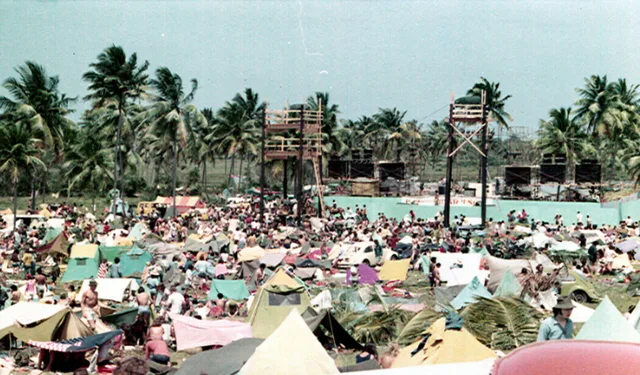
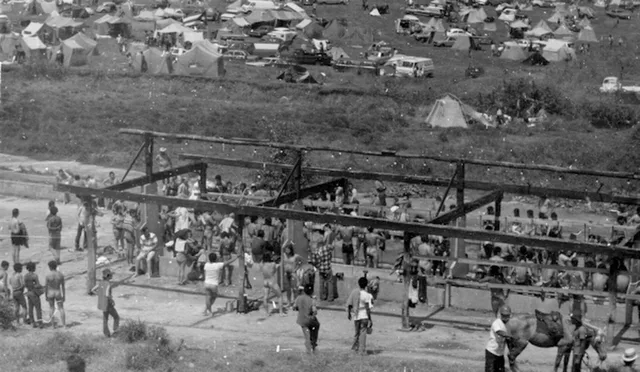
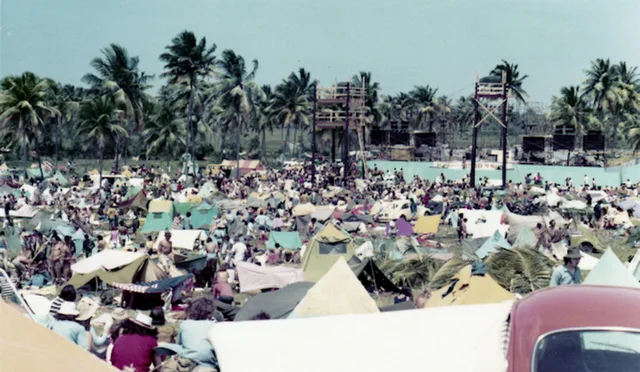
Mar y Sol placed a remarkably broad international programme in Puerto Rico rather than treating the island as a picturesque extension of the mainland touring circuit. Progressive rock, jazz fusion, blues, soul, African diasporic rhythm and hard rock shared the stage. The event also exposed unequal relations between an imported production and local political, religious and legal authority. Its beauty, danger, musical range and recorded afterlife belong together; separating them would make the festival easier to celebrate but much harder to understand. Earlier planning struggled before Atlanta promoter Alex Cooley became the key producer. The chosen Easter weekend brought the event into direct conflict with Holy Week observance. Questions over permits and narcotics sales produced an injunction only days before opening; the Rock Hall catalogue records that the order was ultimately lifted. Cooley later described being smuggled away to avoid arrest. These details show a production negotiating in crisis rather than smoothly importing an established American festival model. The site lay near Los Tubos and the Tortuguero lagoon area, close to the Manatí–Vega Baja boundary. Archival cataloguing uses Manatí while some period and participant sources use Vega Baja; proximity explains the competing labels. Beach, wet ground, access roads and coastal exposure shaped camping and equipment movement. Contemporary reusable photographs on this page document the landscape, showers, audience and stage, allowing the setting to remain historical evidence rather than a tropical backdrop. Emerson, Lake & Palmer and Mahavishnu Orchestra represented different routes through virtuosity and extended form. Dave Brubeck with Gerry Mulligan and Herbie Mann connected jazz institutions to festival culture. B. B. King and Dr. John grounded the bill in blues and New Orleans traditions; Faces, Alice Cooper and Allman Brothers Band brought hard rock, theatre and improvisation. Osibisa widened the rhythmic field. The confirmed list matters because several advertised artists cancelled or could not reach the site.

What the audience experienced
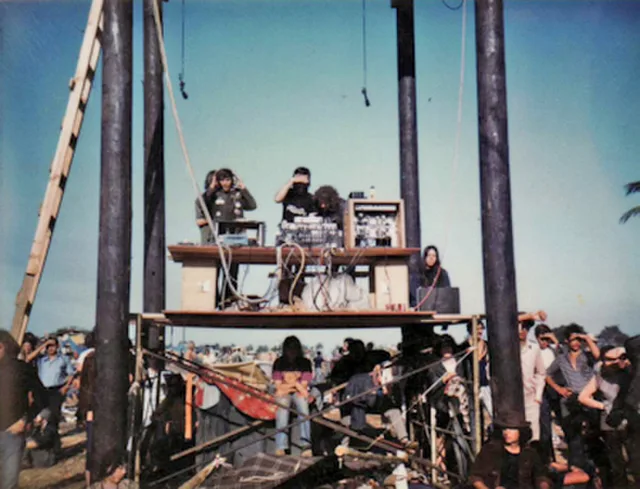
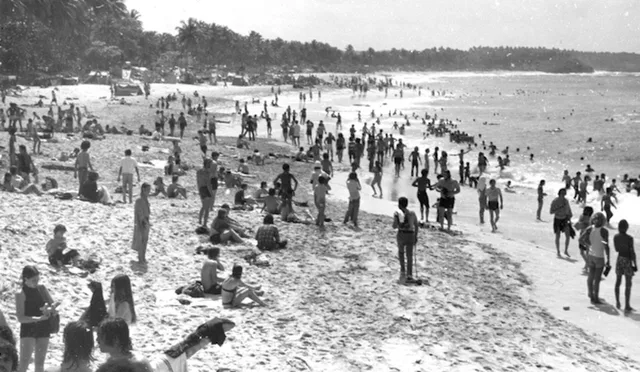
The audience encountered rain, mud, blocked roads and the practical demands of a coastal camp. Showers and beach access were not marginal comforts; they shaped how people remained through three days. Attendance is best described as roughly 25,000–30,000 depending on source, not inflated into a record claim. The site could feel open and beautiful while movement and supply remained difficult. Contemporary photographs make that contradiction visible without converting hardship into exotic spectacle. The surviving soundboard photograph offers rare evidence of the technical system. Sound reinforcement had to serve acoustic jazz detail, amplified progressive rock, blues dynamics and heavy stage volume through the same outdoor infrastructure. Roads and weather complicated artist access; Black Sabbath, according to the Rock Hall catalogue, could not reach the site from its hotel. Yet enough sets were recorded professionally for Atlantic’s double album, proof that a strained wider operation could still produce valuable audio. Mar y Sol’s Easter timing made the festival a public argument about who could use Puerto Rican land and attention during Holy Week. Religious criticism overlapped with permit disputes, narcotics enforcement and suspicion of an imported counterculture economy. These were not merely conservative obstacles placed around music; they expressed real questions of authority and local consent. The event proceeded, but legal jeopardy remained active enough to shape the promoter’s departure and the festival’s later reputation. There was no second Mar y Sol. Financial loss, legal conflict and production strain made repetition unattractive, while the event’s musical memory moved into records and specialist archives. Billy Joel’s appearance later acquired breakout mythology, but the broader legacy belongs to the whole cross-genre bill and the Puerto Rican setting. The lack of a recurring institution means local memory, participant photography and archival cataloguing carry more weight than a promoter-controlled anniversary narrative.

Recordings and surviving documents
Atlantic released Mar y Sol as a double live album late in 1972, selecting performances rather than reproducing the timetable. The Rock Hall preserves poster material and a detailed administrative history, including dates, attendance, legal conflict, cancellations and the statement that the event was not filmed. Participant photographs on Commons document stage and daily life under reusable licences. These layers should remain distinct: an official album is musical evidence, a poster is intention and a photograph records one viewpoint. Mar y Sol cannot be described adequately as an American festival that happened to use Puerto Rico. The island’s municipal geography, Holy Week, courts, roads, audiences and political response shaped every production decision. At the same time, the international bill and Atlantic release tied the weekend to a global recording industry. Its history lives in the friction between those systems. The coastal setting offered visual identity, but it never made local authority or cultural difference disappear. The programme links naturally to Montreux through jazz-rock crossover, to Atlanta through Alex Cooley’s production history and to British progressive festivals through Emerson, Lake & Palmer and Faces. Its exposed site and access problems invite comparison with Isle of Wight, while the official live album places it beside festivals remembered through selective recordings. Internal routes across these subjects show that progressive live culture moved through jazz, blues, soul and regional politics rather than a single English rock lineage. Mar y Sol’s legacy is unusually balanced between sound and place. The Atlantic album lets listeners hear selected performances, while contemporary photographs restore the stage, beach, showers and production landscape that audio cannot preserve. Rock Hall documentation corrects myths about filming, dates and confirmed appearances. The event remains significant not because it achieved a stable model, but because it briefly assembled a musically adventurous international festival whose contradictions reveal how mainland industry, Puerto Rican authority and audience culture met on unequal but productive ground.


Follow the festival beyond the field
Timeline
Related genres
More routes will be connected as the archive grows.
Related band guides
Explore by sound
More routes will be connected as the archive grows.
Essential listening
Sources and further reading
- Mar y Sol Pop Festival Poster collectionRock & Roll Hall of Fame Library & Archives · accessed 23 July 2026
- A Festival Under the SunThe Last Seat in the House / JSTOR · accessed 23 July 2026
- Mar y Sol live albumDiscogs release documentation · accessed 23 July 2026
- Mar y Sol Festival media categoryWikimedia Commons · accessed 23 July 2026
- Los Tubos Beach site contextWikimedia Commons · accessed 23 July 2026
Image credits5 licensed images
Mar y Sol in daylight, showing the temporary performance landscape on Puerto Rico's north coast — Puyapr — Wikimedia Commons — CC BY-SA 3.0 · source record · CC BY-SA 3.0
Converted to WebP and resized; no generative or compositional alterations.
The Mar y Sol soundboard, a rare contemporary view of the production system behind the official live recordings — Puyapr — Wikimedia Commons — CC BY-SA 3.0 · source record · CC BY-SA 3.0
Converted to WebP and resized; no generative or compositional alterations.
Shower facilities at Mar y Sol. The photograph records the practical life of the temporary settlement as clearly as the advertised music — Puyapr — Wikimedia Commons — CC BY-SA 3.0 · source record · CC BY-SA 3.0
Converted to WebP and resized; no generative or compositional alterations.
The beach during Mar y Sol, where the coastal setting shaped audience movement, camping and the festival's visual identity — Puyapr — Wikimedia Commons — CC BY-SA 3.0 · source record · CC BY-SA 3.0
Converted to WebP and resized; no generative or compositional alterations.
A wide view of the Mar y Sol stage, documenting the scale of the production against the exposed coastal landscape — Puyapr — Wikimedia Commons — CC BY-SA 3.0 · source record · CC BY-SA 3.0
Converted to WebP and resized; no generative or compositional alterations.