

Why this event matters
The 1970 Isle of Wight Festival was the third event organised by the Foulk brothers and the point at which their experiment outgrew every stable category. It was longer than a normal concert weekend, larger than the island's infrastructure comfortably allowed and musically broader than the word “pop” suggested. British progressive rock, American psychedelia, singer-songwriters, hard rock and electric jazz occupied the same stage across five days.
Its scale did not produce a single mood. The festival contained extraordinary performances, long waits, arguments about payment and access, pressure from people gathered outside the ticketed arena, and an increasingly public conflict between organisers and parts of the counterculture. It sits at the edge of an era because the ideal of the giant open gathering was no longer innocent. Everyone could see the cost of building one.

Before the gates opened
The Isle of Wight festivals had grown quickly. The 1968 event was comparatively small; the 1969 edition attracted international attention through Bob Dylan's return to major live performance. For 1970, the organisers moved to Afton Down near Freshwater and assembled a bill capable of drawing an audience from Britain and beyond. Ferries and island roads became part of the production before anyone reached the field.
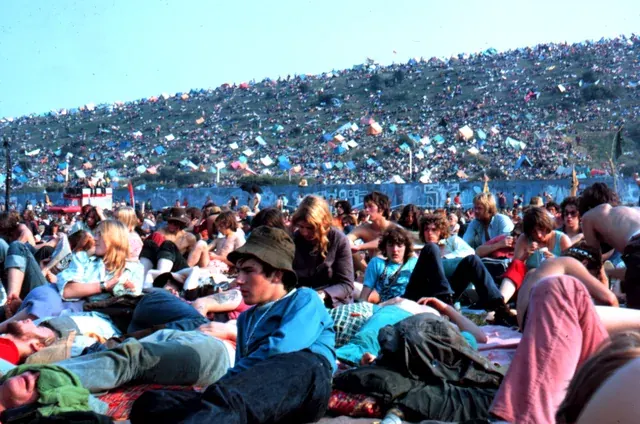
The site was exposed and expansive. Its geography offered a natural arena but also complicated sound, access and control. People could gather on surrounding ground without entering through the official gates. That physical fact fed the political argument over whether the festival should be free. It was not an abstract debate conducted in newspapers. It was visible in the relationship between the fenced arena, the hillside and thousands outside.
The place and the people
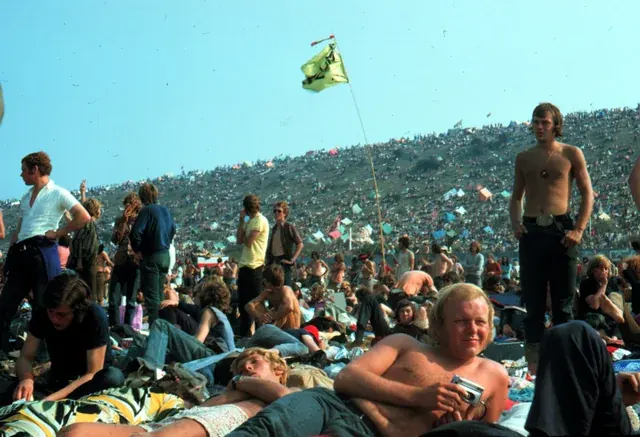
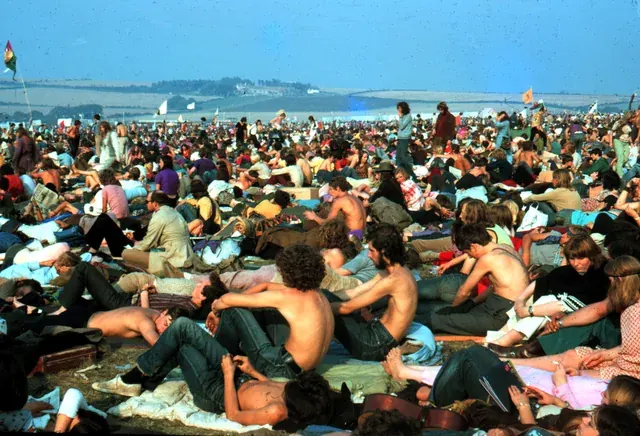
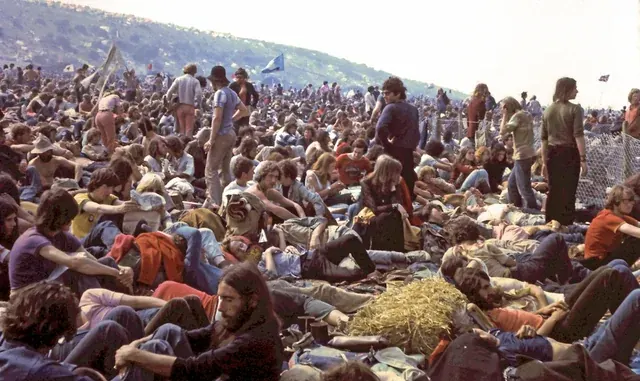
Roland Godefroy's photographs show the event as landscape. The stage is a distant structure against a broad field; bodies fill slopes and pathways; temporary living spreads beyond the area where a single camera can count. These are valuable documents precisely because they do not reduce the festival to a famous face. They show what mass attendance did to space.
Attendance remains disputed. “More than half a million” is widely repeated by the official festival history, tourism bodies and museum accounts, while other estimates move higher or lower. Exact counting was compromised by people outside the paid area and by the porous relationship between island, campsite and arena. A range is more responsible than declaring a record. What matters is that the population temporarily rivalled or exceeded several times the island's normal population.

The musical programme
The bill connected established stars to new progressive formations. The Who arrived as one of the world's most forceful live rock bands. The Doors appeared near the end of their life with Jim Morrison. Jimi Hendrix played his final major UK performance less than three weeks before his death. Joni Mitchell and Leonard Cohen brought songwriting that depended on concentration rather than volume. Miles Davis carried electric jazz into a rock-festival environment.
British progressive music was not represented by one sound. Jethro Tull's flute-led hard rock, the newly formed Emerson, Lake & Palmer, the Moody Blues, Family, Procol Harum, Pentangle and Free approached structure, improvisation and dynamics differently. Hawkwind appeared in the wider festival environment, associated with the free stage outside the main arena. The programme demonstrates why “progressive” in 1970 worked better as a field of motion than as a fixed genre box.
Defining performances
Hendrix's performance carries an unavoidable retrospective weight. It was his last major appearance in Britain, but audiences on the night did not know it would become part of a final chapter. Recordings preserve a set marked by technical strain as well as moments of extraordinary playing. Treating it only as a tragic farewell makes the music serve a story written afterward.
The Who delivered a long, powerful set that became one of the event's major surviving recordings. Emerson, Lake & Palmer's appearance helped introduce the group to a mass audience at a very early point in its existence. Joni Mitchell's set exposed the tension between intimate music and a restless festival field; the surviving film shows her negotiating interruption rather than performing inside a sealed recital space. Leonard Cohen appeared in the final hours, when exhaustion had changed both audience and site.

What the audience experienced
Five days altered the meaning of attendance. A listener had to manage sleep, food, weather, distance and information as well as musical choice. There was one principal stage, so the problem was not choosing between simultaneous headline sets. It was remaining physically present through delays and dramatic shifts of style. A quiet song could follow amplified spectacle; daylight could turn to darkness while changeovers continued.
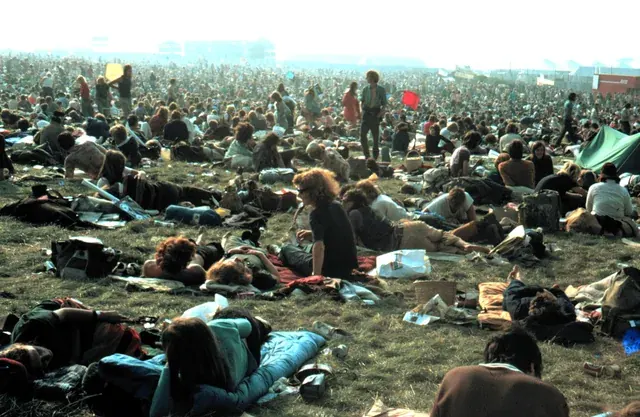
The camera often finds people resting because rest was central to the event. Blankets, makeshift camps and bodies on the ground are not decorative signs of hippie freedom. They are the infrastructure individuals carried for themselves. The audience created a parallel layer of production simply by finding ways to remain on the site.
Stage, sound and production
Sound at Afton Down had to contend with distance and wind across an exposed site. Contemporary and technical accounts differ in emphasis, but no evidence supports the fantasy of uniformly perfect listening. A system large enough to be heard by a mass audience could still produce uneven results according to position. Monitoring and radio interference affected performers; long changeovers and equipment needs pressed against the schedule.
Murray Lerner's film crew created another kind of continuity. Message to Love, completed and released much later, combines performances with arguments and scenes around the grounds. Like every festival film, it selects. Its value lies partly in preserving the conflict over what the event was for: a ticketed production that paid artists and suppliers, a communal gathering, a political platform, or some unstable combination of all three.

The free-festival conflict
People gathered on the hillside outside the arena, and activists challenged the legitimacy of charging for access to music and land. Sections of fencing were breached. The organisers eventually announced free entry late in the event, but describing this as a simple victory of generosity ignores the financial structure already under collapse. Artists, workers, ferries, equipment and safety did not become free because a gate opened.
The surviving film includes confrontation, yet the most dramatic exchange should not be allowed to represent every attendee. Many people came to hear music, waited, slept and left without becoming part of an ideological argument. The conflict matters because it made the economic contradiction of countercultural festivals explicit. Large-scale freedom required resources; demanding those resources without a workable means of paying for them transferred the burden elsewhere.
What happened afterward
The original festival did not return in 1971. Parliament subsequently passed the Isle of Wight County Council Act 1971, giving local authorities powers over large overnight assemblies. The legislation is often described as a direct answer to the 1970 event. Whatever the wider context, the connection shows how festival culture had become a question for law and local government rather than music promotion alone.
The festival name returned in 2002 under a different organisation and production model. Dimbola Museum and Galleries near Freshwater maintains an exhibition about the original event, while the Afton site remains a destination for visitors. This local memory is important: it anchors the festival to island history instead of allowing global rock mythology to float free of the people and landscape that carried it.
Films, recordings and surviving documents
Message to Love was assembled from extensive footage but released in its familiar form decades after the festival. That distance matters. The film combines immediate observation with later editorial knowledge of which performers became legendary and which conflicts appeared to define the age. Individual concert releases by The Who, Hendrix, Miles Davis and others offer fuller musical documents while narrowing the social frame.
Godefroy's still photographs do something different. Wide views restore the scale between stage, field and horizon. Museum exhibitions at Dimbola add local recollection and physical memorabilia. The archive is strongest when these forms remain distinct rather than being blended into one seamless retrospective story.
Legacy
Isle of Wight 1970 demonstrated both the artistic promise and administrative exhaustion of the giant countercultural festival. It offered one of the period's broadest programmes and produced recordings that remain significant. It also made clear that crowd scale could overwhelm admission, communication and local consent.
The event did not “end the sixties” in one theatrical weekend. Historical periods do not close when a stage is dismantled. It did, however, expose a transition. Festival culture would continue, but recurring events increasingly required negotiated licences, stronger infrastructure, professional security and clearer relations with local authorities. The enormous field at Afton Down helped make that future unavoidable.
Follow the festival beyond the field
Timeline
Related genres
Related band guides
Explore by sound
Essential listening
RetroForge Echo
Hear a Fictional Archive Response
These modern RetroForge releases echo part of the festival’s musical vocabulary; they are not historical festival recordings.
Sources and further reading
- 1970 festival history and line-upIsle of Wight Festival · accessed 23 July 2026
- 1970 Isle of Wight Festival SiteVisit Isle of Wight · accessed 23 July 2026
- Experience Hendrix: Isle of Wight Festival 1970Dimbola Museum / Visit Isle of Wight · accessed 23 July 2026
- Isle of Wight festival soundSound On Sound · accessed 23 July 2026
- Isle of Wight Festival 1970 image archiveWikimedia Commons · accessed 23 July 2026
Image credits5 licensed images
The festival field at Afton Down in 1970, where the scale of the audience transformed a rural site into a temporary city — Roland Godefroy — Wikimedia Commons — CC BY 3.0 · source record · CC BY 3.0
Converted to WebP and resized; no generative or compositional alterations.
Festivalgoers at Afton Down — Roland Godefroy — Wikimedia Commons — CC BY-SA 4.0 · source record · CC BY-SA 4.0
Converted to WebP and resized; no generative or compositional alterations.
The audience at the 1970 Isle of Wight Festival, photographed across a long event whose timetable stretched from 26 to 30 August — Roland Godefroy — Wikimedia Commons — CC BY-SA 4.0 · source record · CC BY-SA 4.0
Converted to WebP and resized; no generative or compositional alterations.
A view across the crowded festival site — Roland Godefroy — Wikimedia Commons — CC BY-SA 4.0 · source record · CC BY-SA 4.0
Converted to WebP and resized; no generative or compositional alterations.
Life on the grounds at the 1970 festival: the event was not only a bill of performers but a prolonged social and logistical experiment — Roland Godefroy — Wikimedia Commons — CC BY-SA 4.0 · source record · CC BY-SA 4.0
Converted to WebP and resized; no generative or compositional alterations.