

Edition timeline
Promoters negotiate for the fairgrounds
Officials are presented with expectations far below the population that ultimately arrives.
Sedalia begins to swell
Roads, gates and the fairground’s ordinary service systems absorb a rapidly growing audience.
A temporary rock city forms
The stage continues while sanitation, water, traffic and public order operate under immense pressure.
A state investigation reports
The Missouri Senate committee examines the lease, planning, representations and consequences.
Why this event matters
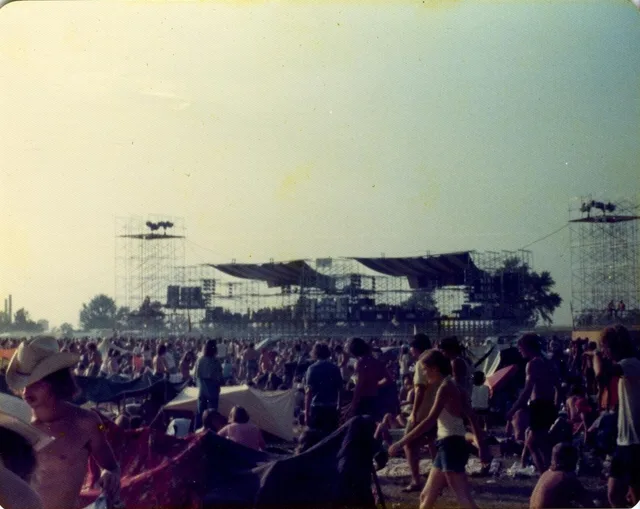
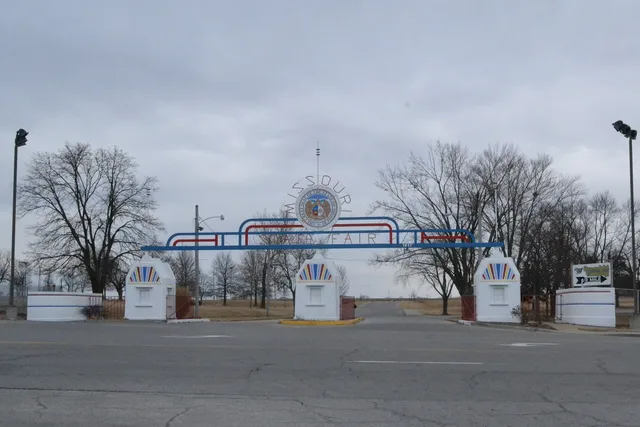
Ozark is a study in the difference between a venue’s normal capacity and the population a festival can mobilise. The Missouri State Fairgrounds already possessed grandstands, gates, utilities and civic legitimacy, yet none of those systems was designed for the audience that arrived in July 1974. Attendance was not reliably counted, making precision impossible. What is certain is that Sedalia became a temporary rock city and that the state later investigated how promoters had secured the grounds under expectations radically smaller than the event. Musical Productions, Inc. organised the festival, with promoter Chris Fritz as president and Robert Shaw associated with advertising and production. Accounts indicate that officials expected a much smaller, more manageable gathering, with folk and bluegrass elements helping frame the proposal. National advertising and a broad rock bill created a different demand. The gap between representations made during approval and the scale encouraged by promotion became a central subject of the later Missouri Senate inquiry. The fairgrounds were permanent civic infrastructure built for scheduled annual flows, not continuous occupation by a mass countercultural audience. Grandstands, exhibition areas, roads and gates could support performance, but water, sanitation, shade and circulation were strained. The modern entrance photograph used here is clearly labelled as site context. Contemporary stage views show how the festival audience filled the working landscape, turning facilities associated with regulated state events into an improvised settlement. The bill ranged across hard rock, southern rock, country-rock, blues and emerging arena sounds. Eagles, Bob Seger, Joe Walsh and the Nitty Gritty Dirt Band appeared alongside Blue Öyster Cult, Aerosmith, Lynyrd Skynyrd, REO Speedwagon and Ted Nugent’s Amboy Dukes. Printed advertisements and later lineup lists require comparison with contemporary reports because billing does not guarantee performance. The most useful programme history distinguishes confirmed sets from artists who were promoted but absent.

What the audience experienced
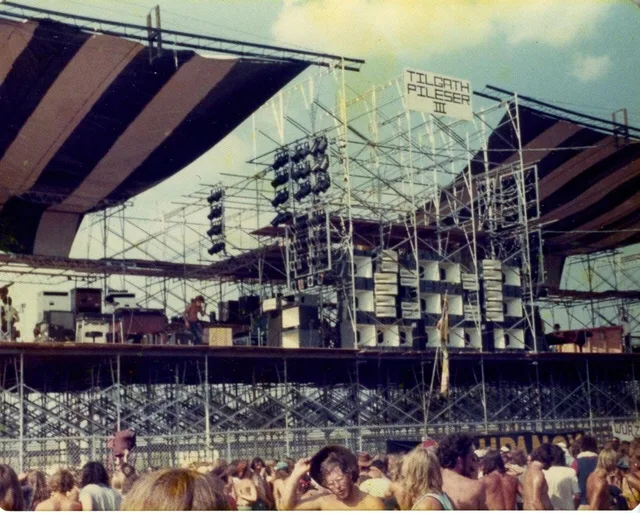
People arrived into intense summer conditions and a site whose services could not match the population. Traffic, water, sanitation, food and sleeping space became collective problems. Many participants remember freedom and extraordinary musical density; local and official accounts emphasise nudity, drugs, damage and danger. Both perspectives can be true without representing every person. The contemporary wide photographs used here resist easy judgement: they show a vast crowd inhabiting a working fairground that had become something its designers never anticipated. The stage continued to deliver a large programme even while the surrounding operation struggled. That distinction matters. Sound, artist movement, electricity and changeovers could function locally while access roads, camps and sanitation failed systemically. Production success at the stage did not mean the event was adequately planned; wider disorder did not mean no music was delivered. Ozark demonstrates why a festival must be evaluated as interconnected systems rather than one verdict applied to every part of the grounds. Sedalia and Missouri officials inherited consequences far beyond a concert lease. Emergency response, traffic, cleanup and public reputation became civic responsibilities, while questions emerged about what promoters had disclosed. The state investigation examined the event and its approval after the crowd had gone. Its existence makes Ozark especially valuable: official records can be read beside participant memory and promoter narrative, revealing how different institutions defined responsibility when private production overwhelmed public infrastructure. The Ozark Music Festival did not become an annual Sedalia institution. Political reaction and the state inquiry made repetition on the same terms implausible. For decades the event remained divided between scandal in civic memory and treasured experience among attendees. Later journalism and documentary work reopened those memories, allowing organisers, officials, residents and visitors to be heard together. The renewed archive does not settle attendance or produce one moral; it shows why those disagreements survived.

Surviving documents
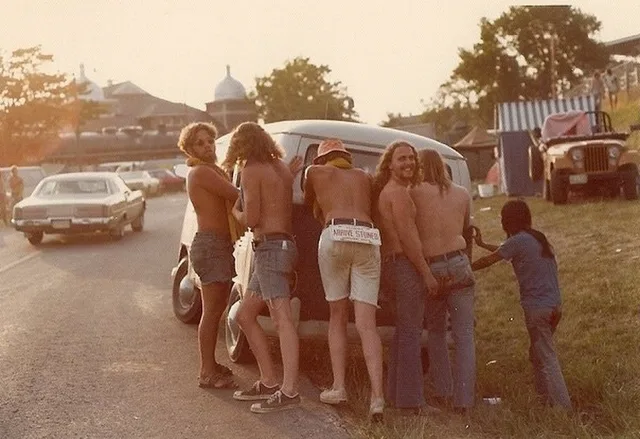
The State Historical Society of Missouri holds a poster and promotional material in the John Stuart Forrester Papers, along with records connected to concert promotion. Contemporary press photographs and participant images preserve scale and informal visual culture. Later KCUR, KBIA and Kansas City Star work brings archival evidence into conversation with interviews. A Missouri Senate committee report offers the official aftermath. Each source has a different purpose, so the page attributes estimates rather than allowing later repetition to harden into fact. Attendance figures range from roughly 100,000 to claims of 350,000 or more. Gate counts were compromised, people arrived and left across several days and later memories often prefer the largest number. The responsible conclusion is not to choose a favourite estimate. Ozark was large enough to overwhelm the fairgrounds and town, and contemporary photographs support mass scale without providing arithmetic. Treating uncertainty openly protects the history from both promotional inflation and dismissive minimisation. Ozark followed early rural counterculture festivals but anticipated the harder, sponsor-ready arena-rock gatherings of the later 1970s. The fairground setting connects it to California Jam’s speedway production and Canada Jam’s one-day scale, while its logistical strain recalls earlier temporary cities such as Goose Lake. The programme’s southern, country and hard-rock routes also reveal a changing American audience beyond coastal psychedelic mythology. Internal links let readers follow those transitions through venues, genres and production models. Ozark’s legacy is the temporary city and the argument it left behind. For participants it could be a once-in-a-lifetime concentration of music and freedom; for Sedalia and the state it became evidence of failed disclosure and inadequate control. The surviving stage photographs, sign, archive records and oral histories preserve both. Its value to festival history lies not in claiming an attendance record, but in showing how quickly promotion could outrun civic planning even at a permanent public venue with established gates and services.

.png)
Follow the festival beyond the field
Timeline
Related genres
More routes will be connected as the archive grows.
Related band guides
More routes will be connected as the archive grows.
Explore by sound
More routes will be connected as the archive grows.
Essential listening
Sources and further reading
- John Stuart Forrester PapersState Historical Society of Missouri · accessed 23 July 2026
- John Stuart Forrester Papers finding aidState Historical Society of Missouri · accessed 23 July 2026
- Missouri’s Woodstock: fifty years laterKCUR · accessed 23 July 2026
- Ozark Music Festival documentary interviewKBIA · accessed 23 July 2026
- Ozark Music Festival at fiftyKansas City Star · accessed 23 July 2026
Image credits5 licensed images
The Ozark Music Festival stage and crowd from the right, showing how the fairgrounds were absorbed into a temporary rock city — Matthew's Photos — Wikimedia Commons — Public domain · source record · Public domain
Converted to WebP and resized; no generative or compositional alterations.
A second contemporary view across the Ozark stage and audience, useful evidence for scale without pretending the attendance was precisely counted — Matthew's Photos — Wikimedia Commons — Public domain · source record · Public domain
Converted to WebP and resized; no generative or compositional alterations.
An 'Arrive Stoned' sign at Ozark in 1974, a participant-made fragment of the event's informal visual culture — Nowheat — Wikimedia Commons — CC BY-SA 3.0 · source record · CC BY-SA 3.0
Converted to WebP and resized; no generative or compositional alterations.
The Missouri State Fair entrance in a later photograph. It documents the permanent civic venue that was overwhelmed by the 1974 gathering — 25or6to4 — Wikimedia Commons — CC BY-SA 4.0 · source record · CC BY-SA 4.0
Converted to WebP and resized; no generative or compositional alterations.
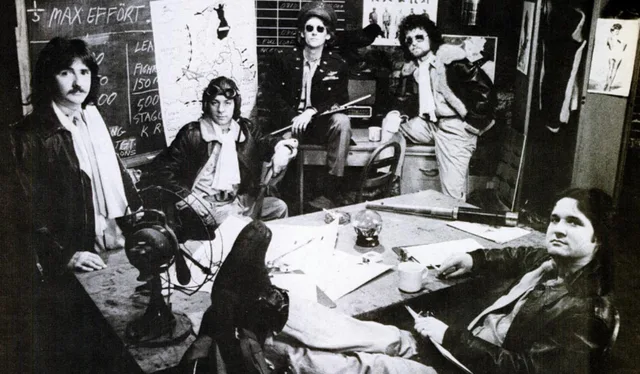
Blue Öyster Cult in 1974. This public-domain publicity image provides period artist context and is not presented as an Ozark stage photograph — Columbia Records — Wikimedia Commons — Public domain · source record · Public domain
Converted to WebP and resized; no generative or compositional alterations.