
.jpg)
Why this event matters
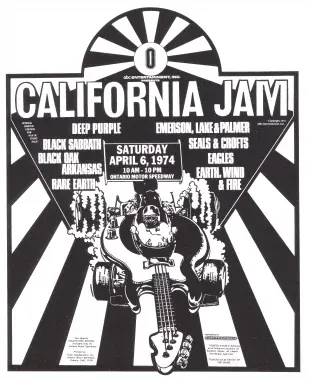
California Jam was conceived at the intersection of live promotion, album-rock stardom and network television. The Ontario Motor Speedway supplied a site already engineered for enormous crowds, long sightlines, vehicle access and broadcast logistics. ABC Entertainment supplied national media ambition. The programme joined radio-friendly acts to Black Sabbath, Deep Purple and Emerson, Lake & Palmer, making hard rock and progressive spectacle part of a single daytime-to-night mass event.
Its importance is not simply that many people attended. Earlier festivals had already demonstrated huge demand. California Jam treated scale as a controllable production asset rather than an emergency to survive. The schedule was designed, cameras were integrated, and the venue’s racing infrastructure was repurposed for music. The festival pointed toward a future in which the biggest concerts would be planned as media events from the beginning.

Building a festival inside a speedway
Ontario Motor Speedway opened in 1970 as a major racing facility east of Los Angeles. Grandstands, infield space, service roads and extensive parking made it attractive for an event expecting a regional audience on the scale of a city. The same geometry created challenges. A racing oval is not designed for equal concert sightlines, and spectators on the field or at the edges experienced the stage at radically different distances.
Promoters used fencing, sanitation, medical provision, concessions and a powerful sound system to support the crowd. Published accounts often celebrate records—largest paid audience, loudest amplification or longest television reach—but those claims vary by definition and source. The defensible achievement is organisational: hundreds of thousands could arrive at a purpose-adapted site and experience a schedule that largely moved forward as a broadcast production.
Eight acts, one long day
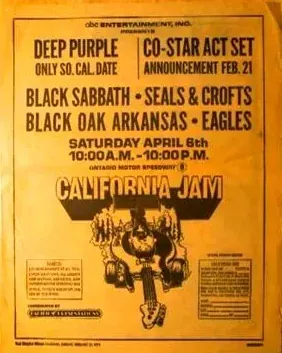
The commonly documented running order began with Rare Earth, followed by Earth, Wind & Fire, Eagles, Seals and Crofts, Black Oak Arkansas, Black Sabbath, Deep Purple and Emerson, Lake & Palmer. That sequence moved from soul and funk through country-inflected California rock into progressively heavier and more theatrical music. It reflects the broad definition of rock used by mass radio and concert promotion in 1974.
The bill’s diversity was commercial and musical. Early acts could reach daylight audiences arriving across the site, while the final groups benefited from darkness, lighting and accumulated expectation. Television could later separate performances into edited units, but the audience experienced heat, waiting and genre changes as one continuous day. California Jam’s real composition was therefore temporal: a carefully escalated movement toward the most visually demanding acts.

Black Sabbath in daylight
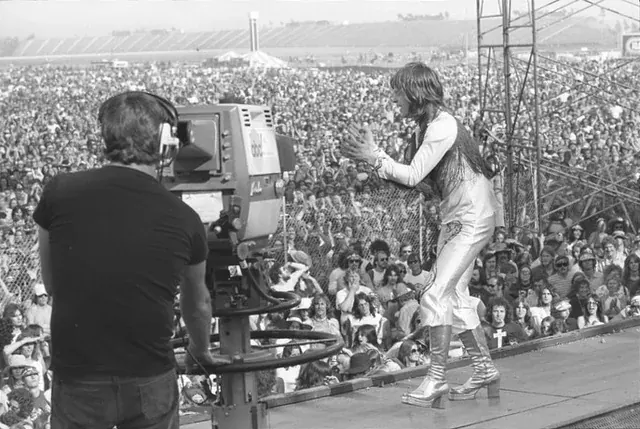
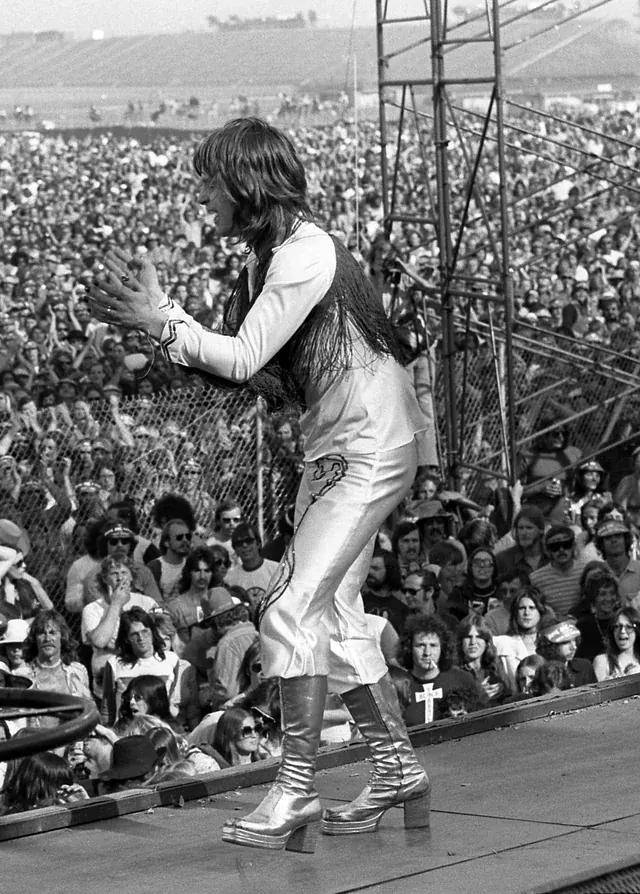
Black Sabbath appeared before sunset, an environment far removed from the dark theatre imagery attached to the band. Licensed Los Angeles Times and UCLA archive photographs show Ozzy Osbourne against the crowd and stage rather than isolate him as a gothic icon. The contrast reveals how heavy music operated inside mainstream festival culture. Sabbath was not hidden at the edge of the programme; it was one of the central attractions of an ABC-backed mass event.
The performance belonged to the Sabbath Bloody Sabbath period, when the group’s arrangements had expanded beyond the minimal stereotype of heavy metal. Outdoor presentation could flatten detail, but it also demonstrated the physical clarity of the rhythm section and riffs. California Jam helped establish heavy rock as music capable of filling the same public infrastructure as major sporting events.
Deep Purple, timing and destruction
Deep Purple’s appearance has generated the festival’s most replayed images. The band’s agreement and expectations concerning performance time became entangled with the schedule, and it delayed until the light suited its production. During the set, guitarist Ritchie Blackmore damaged a television camera and equipment was set alight as part of a dangerous finale. The incident survives because television cameras were already there to record a dispute involving television itself.
It should not become the whole story. Destruction produced dramatic footage but depended on crews, safety decisions and expensive equipment whose operators were not props. The band’s Mark III line-up, with David Coverdale and Glenn Hughes, was presenting a changed vocal and musical identity. Concentrating only on the explosion reduces an important performance to a GIF decades before GIFs existed.

Emerson, Lake & Palmer and progressive theatre
Emerson, Lake & Palmer closed the event with a production suited to darkness. Their performance carried the equipment density and theatrical gestures associated with arena progressive rock, including Keith Emerson’s physical relationship with keyboards and a piano stunt suspended above the stage. At a speedway, virtuosity had to become readable across distance. A rapid passage mattered musically; a rotating or elevated instrument translated activity into mass spectacle.
ELP’s position at the end of the bill confirms how commercially central progressive rock could be in 1974. This was not a specialist side stage. A group built around keyboards, extended arrangements and classical reference was trusted to close a network-backed event after Black Sabbath and Deep Purple. California Jam captures the genre at the point where complexity and showmanship had become mutually reinforcing forms of scale.
ABC, cameras and the edited festival
ABC’s involvement changed the event before the first note. Camera positions, stage access, lighting and performance agreements had to serve both the crowd and later viewers. Television extended the festival beyond California and created a reusable library of performances. It also imposed selection. Viewers saw edited acts and angles rather than the duration, discomfort and peripheral activity experienced at the speedway.
The surviving broadcast material is primary evidence and a media product. Audio may differ between location and television mixes; edits can repair pacing or intensify confrontation. Contemporary recording-industry reporting is valuable because it documents the technical operation rather than only artist memory. California Jam should be read through both: the visible show and the systems that made it visible.

Afterlife of the site and the brand
California Jam II returned to Ontario Motor Speedway in 1978 with a different bill, confirming that the first event had created a marketable name. The speedway itself closed after 1980 and was demolished as the land was redeveloped. A city park and local displays preserve parts of its identity, but the vast oval no longer exists as a concert landscape. This disappearance makes photographs unusually important.
The brand’s afterlife is carried by artist releases, bootlegs, broadcast copies, flyers and anniversary memory. Each source emphasises something different: a band’s definitive set, the promoter’s organisational feat, the television spectacle or an attendee’s endurance. No single version contains the whole day. The archive is strongest when those perspectives remain separate enough to compare.
Legacy
California Jam demonstrated a mature mega-event model: paid mass attendance, a repurposed infrastructure site, a controlled running order, heavy production and national broadcast. It did not eliminate conflict or danger, but it showed that rock at enormous scale could be engineered as scheduled entertainment rather than narrated afterward as miraculous survival.
For progressive and heavy music, the festival is evidence of centrality. Black Sabbath, Deep Purple and Emerson, Lake & Palmer occupied the final hours of a programme designed for mainstream media. Their music had moved from clubs and specialist halls into the largest available frame. The speedway was temporary; the expectation that major rock should be both concert and screen event was not.
Follow the festival beyond the field
Timeline
Related genres
Related band guides
Explore by sound
Essential listening
RetroForge Echo
Hear a Fictional Archive Response
These modern RetroForge releases echo part of the festival’s musical vocabulary; they are not historical festival recordings.
Sources and further reading
- The California Jam: recording and broadcast production reportRecording Engineer / Producer via World Radio History · accessed 23 July 2026
- California Jam 50th anniversaryGreater Ontario California · accessed 23 July 2026
- California Jam historical display at the former speedway siteToyota Arena · accessed 23 July 2026
- Ontario Motor Speedway ParkCity of Ontario, California · accessed 23 July 2026
- California Jam photographic recordsUCLA Library Special Collections / Wikimedia Commons · accessed 23 July 2026
- Ontario Motor Speedway collectionUNC Charlotte Goldmine · accessed 23 July 2026
Image credits5 licensed images
Ozzy Osbourne with Black Sabbath before the California Jam crowd — UCLA Library Special Collections — Wikimedia Commons — CC BY 2.0 · source record · CC BY 2.0
Converted to WebP and resized; no generative or compositional alterations.
A contemporary California Jam advertisement — Mlpearc — Wikimedia Commons — CC BY-SA 3.0 · source record · CC BY-SA 3.0
Converted to WebP and resized; no generative or compositional alterations.
A California Jam flyer from 1974 — Mlpearc — Wikimedia Commons — CC BY-SA 3.0 · source record · CC BY-SA 3.0
Converted to WebP and resized; no generative or compositional alterations.
A participant's view connected with California Jam I — Mark Pearcy — Wikimedia Commons — CC BY-SA 2.5 · source record · CC BY-SA 2.5
Converted to WebP and resized; no generative or compositional alterations.
Ozzy Osbourne at California Jam in 1974 — Tony Barnard, Los Angeles Times — Wikimedia Commons — CC BY 4.0 · source record · CC BY 4.0
Converted to WebP and resized; no generative or compositional alterations.