
History Archive · 1958
How Chuck Berry Created the Language of the Rock Guitar
In 1958, “Johnny B. Goode” placed a guitar riff, an ambitious young musician and the promise of movement at the centre of rock and roll.
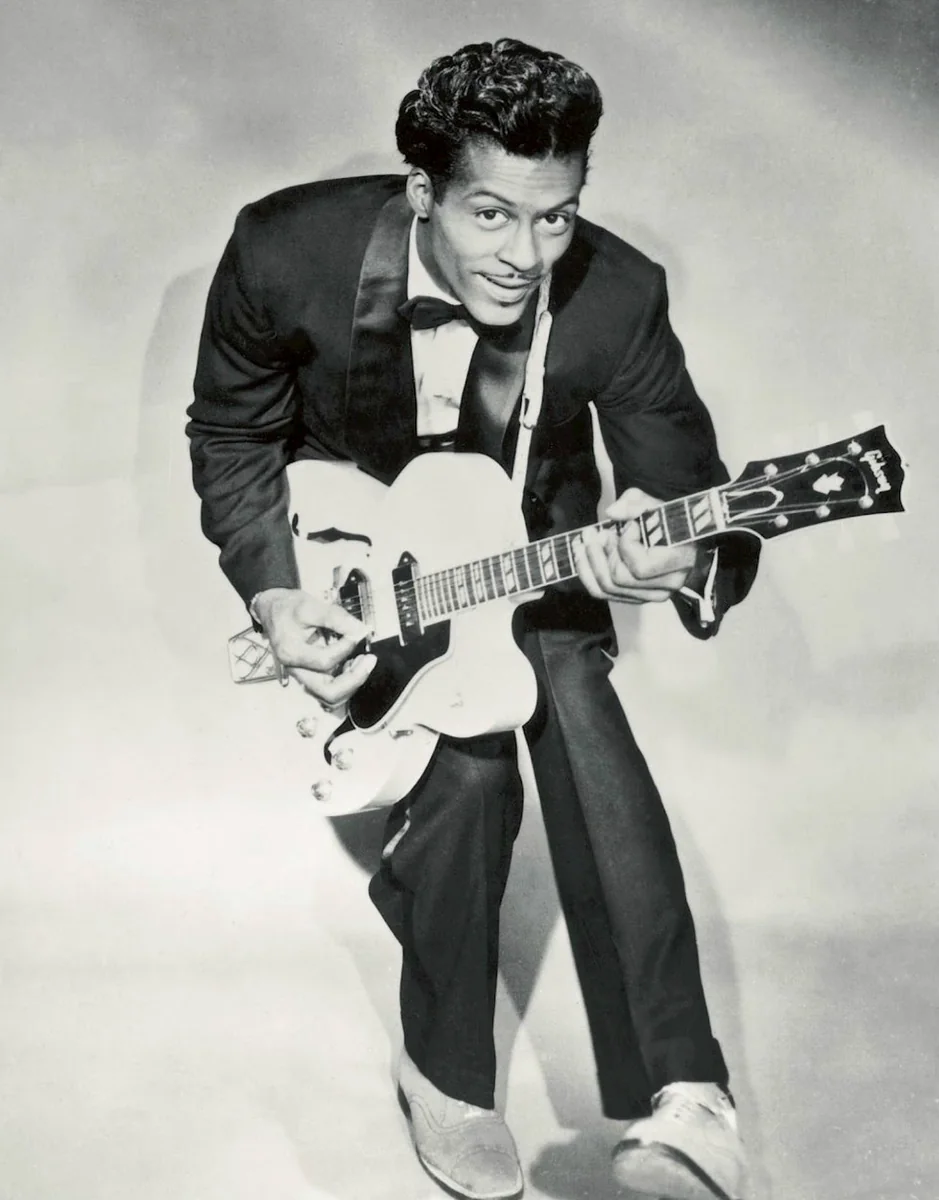
What Happened
Chuck Berry entered 1958 with a musical system already taking shape: concise stories, a bright electric-guitar attack and rhythms that joined blues phrasing to the snap of country music. “Johnny B. Goode” concentrated that system into one record. Its opening figure did not merely introduce the song; it announced that the guitarist could be the protagonist, narrator and engine of a rock performance.
The lyric imagined talent travelling from a modest beginning toward public recognition. Berry understood the new teenage audience because he wrote about aspiration, school, cars, dancing and the secret geography of youth without talking down to it.
What the Music Sounded Like
Berry’s performance is the centre of the record, backed by Lafayette Leake on piano, Willie Dixon on bass and Fred Below on drums. The guitar tone is sharp enough to cut through the compact mono recording, and every part drives the song without wasting motion.
How It Was Made
Berry’s records were built for singles, radio and jukeboxes. That limitation encouraged precision. A recognisable introduction had to arrive immediately; verses had to advance the scene; instrumental breaks had to intensify the hook rather than interrupt it.
The Wider Musical Context
Rock and roll was still a meeting place for Black rhythm and blues, country, gospel and pop. Berry made that exchange audible while refusing to separate guitar technique from songwriting. His records became common language for musicians on both sides of the Atlantic.
What Followed
The British beat boom turned Berry’s vocabulary into a new generation of bands. From garage rock to hard rock and punk, the recurring lesson was the same: a few decisive guitar notes can define a song before the singer enters.
A Guitar Part That Does Three Jobs
Berry’s great practical invention was not a single lick but a complete way of organising a rock-and-roll record. His introductions announce the song before the singer has spoken, his fills answer the vocal without interrupting it, and his solos intensify ideas already planted in the rhythm part. The guitar is lead instrument, timekeeper and second narrator at once. That economy mattered to every young group trying to make two guitars, bass and drums sound larger than the sum of their parts.
The famous double-stop figures draw on electric blues, but Berry tightened them into bright, repeatable shapes that could cut through a small amplifier, a noisy dance hall or a cheap radio. Underneath, the rhythm often carries a rolling boogie pattern associated with piano. Played on guitar, it creates forward motion without requiring harmonic complexity. The result feels both disciplined and airborne: the band holds a hard backbeat while the guitar seems to leap over it.
The Songs Were Built Like Short Films
Technique alone does not explain why the records travelled so far. Berry wrote scenes. A teenager chases freedom in a car, a school day becomes a comic obstacle course, a musician rises from a country cabin to see his name in lights. Place names, brand names, telephone calls and overheard speech give the songs the density of miniature films. His diction is unusually clear, allowing a listener to follow the plot even through the compression and static of AM radio.
That writing also crossed boundaries. Berry had absorbed blues and rhythm and blues, but he understood the narrative directness and guitar snap of country music. “Maybellene,” adapted from the country standard “Ida Red,” turned that overlap into a new commercial language. The songs could speak to Black rhythm-and-blues audiences and white teenagers without pretending those musical histories were identical. Rock and roll’s mass audience was built inside that tension.
Chess Records and the Sound of a Working Band
After Muddy Waters advised Berry to approach Chess Records, Leonard Chess heard the potential in his material. The records that followed were concise, physical and uncluttered. Pianist Johnnie Johnson was crucial to the musical architecture: his rolling figures and harmonic instincts helped give Berry’s guitar room to strike. Willie Dixon, Fred Below and other Chicago players supplied a rhythm section rooted in blues but alert to the sharper demands of the new teenage market.
The records were not pristine museum pieces. They were made to move through jukeboxes, car radios and public-address systems. Their narrow frequency range became an advantage: snare, piano, voice and guitar occupy distinct spaces, and almost every detail pushes the song forward. Later guitarists could copy the opening figure, but the deeper lesson was structural—arrange the band so that every sound has a dramatic purpose.
What the Myth Leaves Out
Rock history often reduces Berry to the man who invented a guitar pose and supplied riffs for the British Invasion. That version is too small. He was also a formalist, comic writer, observer of consumer culture and exceptionally controlled singer. His records helped establish that a guitarist could lead a band without abandoning storytelling, and that an original song could turn ordinary adolescent life into mythology.
The inheritance is audible in the Beatles’ early stage repertoire, the Rolling Stones’ first singles, the Beach Boys’ car songs and generations of bands built around an opening riff. It also carries a contradiction: many later stars became more commercially powerful while drawing directly from a Black songwriter whose innovations had already defined their vocabulary. To hear Berry clearly is to hear both the excitement of rock guitar and the history that guitar can too easily conceal.
Essential Listening
- Chuck Berry — Johnny B. Goode
- Chuck Berry — Sweet Little Sixteen
- Chuck Berry — Carol
- Bo Diddley — Bo Diddley
- Buddy Holly — Not Fade Away
Related Genres and Guides
Related RetroForge listening
Hear the Archive Connection
Research notes
Sources and Further Reading
- Chuck Berry — Rock & Roll Hall of Fame
- Chuck Berry induction essay — Rock & Roll Hall of Fame
- Chuck Berry biography — Official Chuck Berry website
- Career chronology and Berry’s account of “Johnny B. Goode” — Official Chuck Berry website
- Chuck Berry Influences Rock and Roll — Smithsonian Folkways
- “Johnny B. Goode” sheet music record — Smithsonian National Museum of African American History and Culture
- GRAMMY Hall of Fame: “Johnny B. Goode” — Recording Academy
- Johnnie Johnson — Rock & Roll Hall of Fame