The Beatles were never exclusively a psychedelic band, yet their 1965–68 recordings carried psychedelic ideas into the centre of popular culture. Indian instruments, tape loops, varispeed, reversed sound, orchestral collage and surreal lyric imagery became structural parts of records heard by a mass audience rather than isolated novelty effects.
The change unfolds rapidly from Rubber Soul through Revolver, the 1966–67 singles, Sgt. Pepper’s Lonely Hearts Club Band and Magical Mystery Tour. Each project solves a different problem: how to expand a rock arrangement, construct a song from tape and overdubs, sustain an album-length environment or move experimental music between record, television and film.
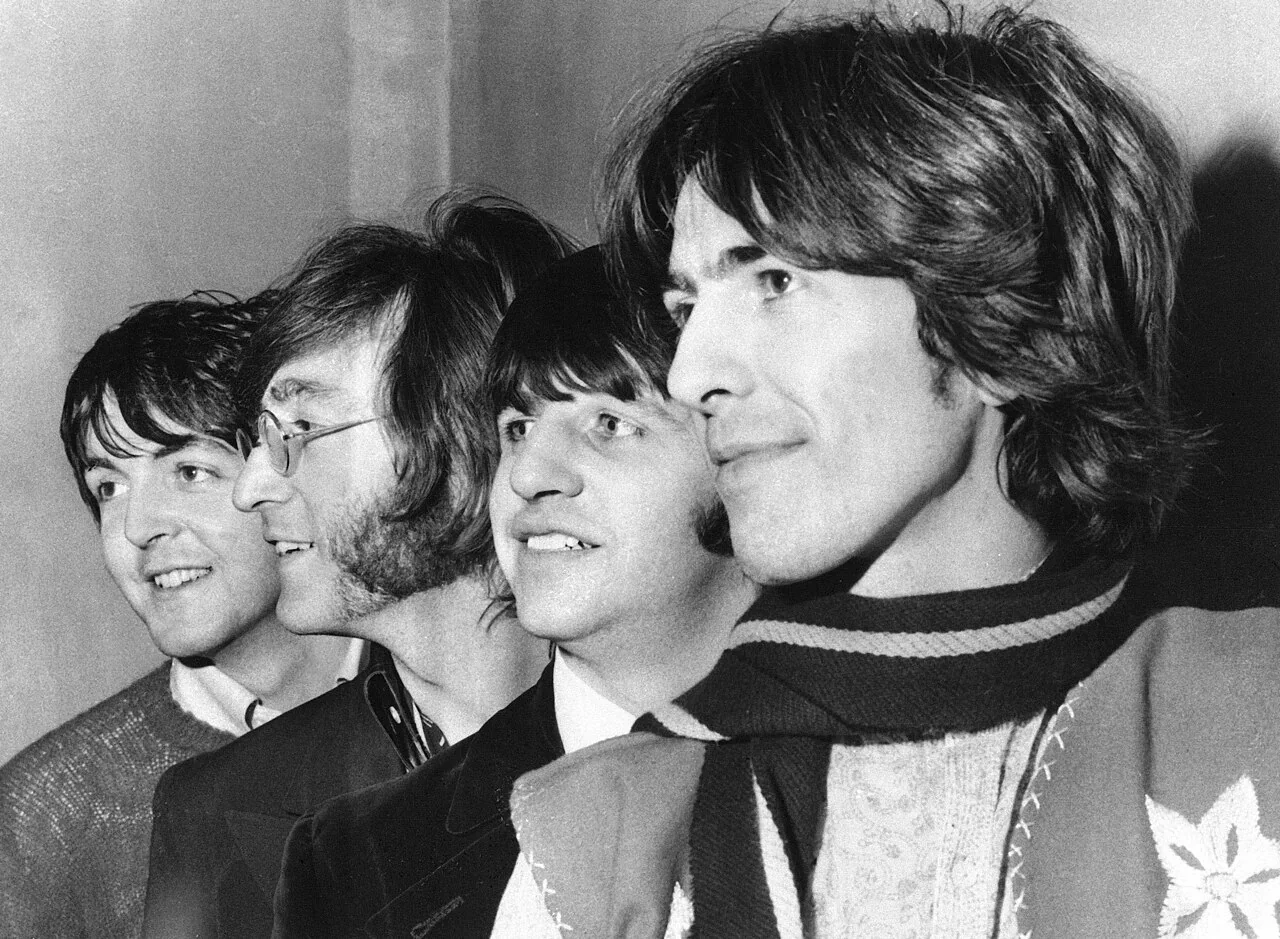
The Beatles in a 1968 press photograph.Photo: Associated Press / Wikimedia Commons · Licensed under Public domain. Converted to WebP for this page.
Formation & History
The group formed in Liverpool in 1960 and reached its stable recording lineup when Ringo Starr joined John Lennon, Paul McCartney and George Harrison in 1962. Manager Brian Epstein, producer George Martin and a run of Lennon–McCartney singles helped turn a working club band into an international touring act. By 1965, however, Rubber Soul and the double A-side “Day Tripper”/“We Can Work It Out” were already widening the harmonic, lyrical and instrumental range of their records.
Revolver was completed before another tour, but the Beatles' last ticketed concert took place at Candlestick Park on 29 August 1966. With touring behind them, they could build recordings that did not need to be recreated onstage. From November 1966 to April 1967 they spent more than 400 hours making Sgt. Pepper’s Lonely Hearts Club Band. The “Strawberry Fields Forever”/“Penny Lane” single, Magical Mystery Tour and “All You Need Is Love” extended the same studio-centred period into film, television and a global satellite broadcast.
Producer George Martin and engineers including Geoff Emerick translated ideas into four-track recordings through reduction mixes, tape-speed changes, artificial double tracking and editing. George Harrison's study of Indian music changed the group's rhythmic and tonal vocabulary rather than merely decorating it. Experimental methods continued after 1967, but the increasingly separate working habits documented on the White Album and Let It Be led toward the 1970 breakup.
Sound & Style
No single psychedelic Beatles sound exists. “Tomorrow Never Knows” holds one harmony while Ringo Starr's drum pattern, tambura drone, Leslie-treated vocal and manually faded tape loops keep the surface moving. “Strawberry Fields Forever” joins performances recorded in different keys and tempos through varispeed and editing. “Being for the Benefit of Mr. Kite!” turns fragments of fairground-organ tape into a collage, while “A Day in the Life” places an instructed orchestral rise between two contrasting song sections.
Harrison's “Love You To” and “Within You Without You” use sitar, tambura and tabla within forms shaped by Indian classical practice. Elsewhere the group relied on reversed guitar, compressed drums, melodic bass, brass, strings, the Mellotron and abrupt edits. The continuity lies in treating recording choices as composition: a vocal timbre, tape splice or change of speed can determine the identity of a song as strongly as melody and harmony.
Essential Albums
1966
Revolver
Parlophone · Original 1966 release
Revolver compresses fourteen sharply different pieces into 35 minutes. “Eleanor Rigby” removes the rock group in favour of a string octet; “Love You To” places Harrison's vocal within sitar, tambura and tabla; “I'm Only Sleeping” turns reversed guitar into a composed counterline. “Tomorrow Never Knows”, the first track recorded but the album's finale, combines a modal drone, tape loops and a vocal sent through a Leslie cabinet. Released on 5 August 1966, the album spent seven weeks at number one in Britain.
Key tracks: Tomorrow Never Knows · She Said She Said · Love You To
Recorded over more than 400 studio hours, Sgt. Pepper uses the fictional-band premise to frame a sequence that is musically less uniform than its reputation suggests. The title reprise creates an audible return, but the route between includes the Lowrey organ and varispeed vocal of “Lucy in the Sky with Diamonds”, the Indian ensemble of “Within You Without You”, music-hall arrangement on “When I'm Sixty-Four” and the edited orchestral crescendos of “A Day in the Life”. It was released in Britain on 1 June 1967 and reached number one.
Key tracks: Lucy in the Sky with Diamonds · Within You Without You · A Day in the Life
Parlophone double EP / Capitol LP · Original 1967 releases
This title needs a format distinction: Britain received six new soundtrack songs as a double EP, while Capitol placed those songs on side one of a US LP and collected five 1967 singles on side two. The soundtrack moves from the brass fanfare of the title track to the suspended Mellotron and tape effects of “Flying”, Harrison's droning “Blue Jay Way” and the radio, choir and orchestral density of “I Am the Walrus”. The LP sequence adds “Strawberry Fields Forever”, “Penny Lane” and “All You Need Is Love”, making the American configuration a concentrated map of the Beatles in 1967.
Key tracks: I Am the Walrus · Strawberry Fields Forever · Blue Jay Way
“Rain”, recorded during the Revolver sessions and released as the B-side of “Paperback Writer”, slows the backing track to give bass and drums unusual weight; the closing vocal is reversed. Harrison's “It's All Too Much” works differently, sustaining an extended organ-and-guitar surge around a narrow harmonic centre rather than assembling a miniature tape construction.
The 1969 Yellow Submarine soundtrack is uneven as a Beatles album because its second side contains George Martin's orchestral score and two songs had already appeared elsewhere. Its four then-new group tracks nevertheless preserve distinct studio experiments: “Only a Northern Song”, “All Together Now”, “Hey Bulldog” and “It's All Too Much”.
The Beatles did not invent tape loops, musique concrète, Indian classical music or the concept album. Their significance lies in placing these methods inside records with an enormous international reach while keeping the songs concise enough for pop circulation. Revolver spent seven weeks at number one in Britain; Sgt. Pepper also topped the chart; and the British Magical Mystery Tour double EP reached number two.
Commercial scale did not make the recordings conventional. Close listening still reveals abrupt edits, unstable speeds, instrumental combinations that change from track to track and arrangements that could not be reproduced by the four musicians alone. Later psychedelic pop, progressive production and studio-centred rock inherited not one Beatles formula but the permission to let the recording process reshape the composition.
RetroForge Records publishes original music and independent editorial guides. This historical band guide is not affiliated with the artist, labels or rights holders. No unlicensed album artwork is reproduced.