
Timeline Archive · 1967
Sgt. Pepper’s Lonely Hearts Club Band
Sgt. Pepper turned the freedom of a non-touring band into an album designed as a complete public event: music, sequence, sleeve and studio illusion working together.
The Record in Context
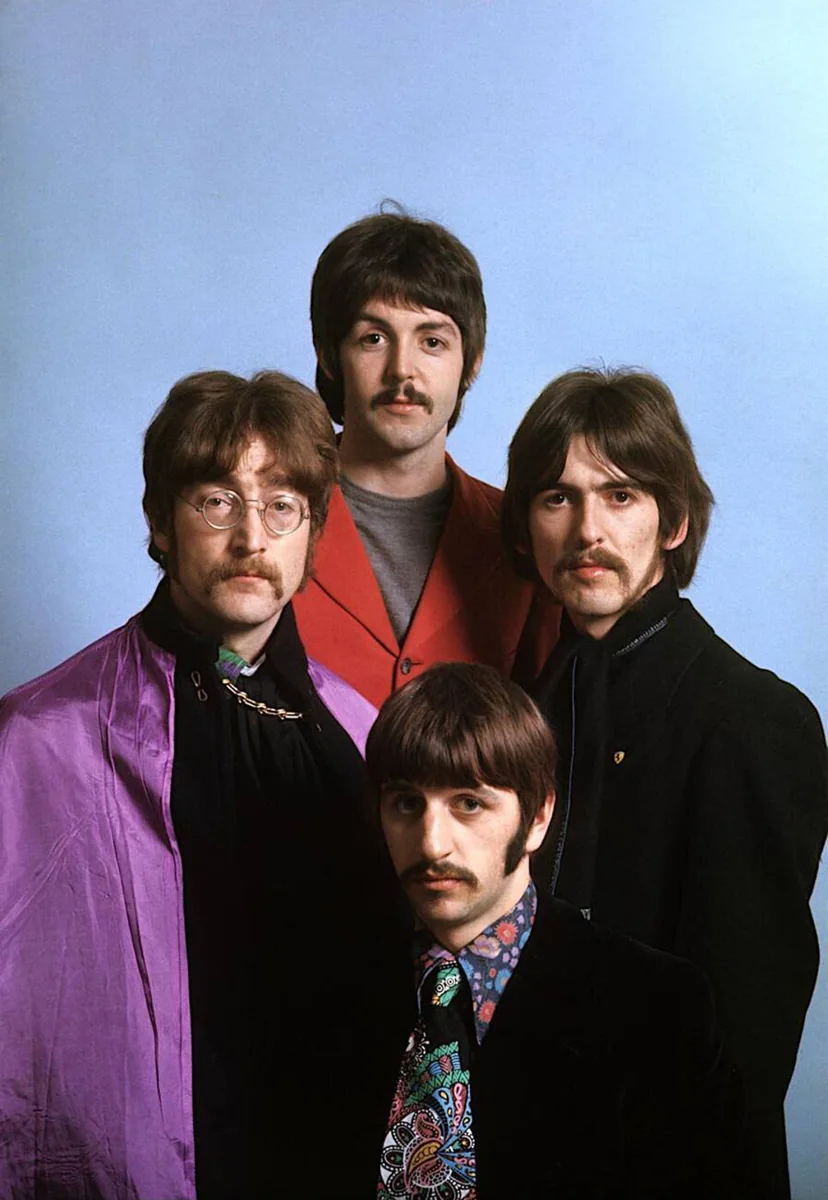
Sgt. Pepper’s Lonely Hearts Club Band was released after the Beatles had withdrawn from touring, but it begins with the sound of an audience gathering. Instruments tune, a crowd murmurs and an imaginary master of ceremonies introduces a band that does not exist. The device gave the Beatles permission to step outside their familiar public identities, even though the fictional concert frame is used most clearly only at the opening, the transition into With a Little Help from My Friends and the reprise near the end.
What holds the album together is not a continuous plot. It is the sense that every detail has been considered as part of one presentation: the order of songs, the joins between several tracks, the recurring title theme, the printed lyrics, the gatefold sleeve and the final run-out groove. The record invites uninterrupted listening while moving through sharply different subjects and arrangements.
Historical Context
The Beatles played their final paid concert in August 1966. When they returned to EMI Studios in November, they no longer had to plan new material around a stage show. Strawberry Fields Forever and Penny Lane were the first major recordings of this period. Both were released as a single in February 1967 rather than held for the album, a decision George Martin later regretted because it removed two central pieces from the developing project.
Recording for Sgt. Pepper stretched from November 1966 into April 1967 and occupied more than 400 studio hours according to the official Beatles archive. The equipment was still based around four-track machines. Complexity came from repeated reduction mixes, careful editing, varispeed recording and the collaboration of the group with producer George Martin, engineer Geoff Emerick and the wider EMI technical staff.
The album appeared in Britain in late May 1967; official Beatles sources currently list both 26 May and 1 June. just as psychedelic music, countercultural imagery and new forms of youth media were converging. It did not create that culture alone, but its visibility made studio experimentation and elaborate album presentation impossible for the record business to treat as a fringe concern.
Sound and Production
The title track establishes the theatrical frame with electric guitars, brass and added crowd noise. Its direct rock arrangement immediately dissolves into With a Little Help from My Friends, where Ringo Starr’s plain, vulnerable delivery is surrounded by supportive call-and-response vocals. Lucy in the Sky with Diamonds changes metre between verse and chorus and uses a Lowrey organ part to produce its distinctive opening shimmer.
Being for the Benefit of Mr. Kite! turns a nineteenth-century circus poster into sound. Martin and Emerick assembled fragments of recorded fairground organ so that mechanical music appears to spin through the track. Within You Without You places George Harrison with Indian musicians and a string section, building an extended meditation whose rhythmic and tonal language sits outside the band’s usual guitar-pop foundations.
A Day in the Life gives the album its most imposing ending. Lennon’s verses, McCartney’s brisk middle passage and two orchestral crescendos are joined by editing rather than conventional song form. The final piano chord was recorded across several instruments and allowed to decay into near-silence. On the original British pressing, that apparent ending was followed by a high-frequency tone and a short loop in the run-out groove, ensuring that even the physical end of the record became part of the design.
Key Tracks
- Sgt. Pepper’s Lonely Hearts Club Band / With a Little Help from My FriendsThe opening transition introduces the fictional performance and immediately hands the spotlight to Billy Shears.
- Lucy in the Sky with DiamondsA Lowrey organ figure, shifting metre and varispeed colour create a dreamlike surface without sacrificing melodic clarity.
- Being for the Benefit of Mr. Kite!Circus-poster language becomes a collage of harmonium, organ fragments, bass and vocal theatre.
- Within You Without YouHarrison’s Indian-influenced composition expands the album’s instrumental and philosophical range.
- A Day in the LifeTwo distinct song ideas, orchestral glissandi and a monumental final chord produce an ending larger than either fragment alone.
Artwork and Visual Identity
The front cover was staged by Peter Blake and Jann Haworth from a concept developed with the Beatles and art director Robert Fraser. The band appears twice: as wax figures in their earlier suits and as the brightly uniformed Pepper group, surrounded by a crowd of photographed and modelled figures. The image turns reinvention into a group portrait with cultural memory assembled behind it.
The package extended beyond the front image. The gatefold opened to a large band portrait; the back printed the complete lyrics, unusual for a pop LP at the time; and early copies included a sheet of cardboard cut-outs and a psychedelic inner sleeve. The object asked to be examined while it played. Packaging was no longer simply protection or advertisement—it became another track in the sequence.
Legacy and Influence
The album’s immediate commercial and critical reach encouraged labels and artists to invest in longer studio schedules, distinctive sleeves and records conceived for continuous listening. It won the Grammy for Album of the Year, the first rock album to receive that award. Its influence can be heard in ornate psychedelic pop, concept albums and progressive rock, but also in the wider expectation that an important release should arrive with a coherent visual and sonic world.
The phrase “concept album” can obscure as much as it explains here. Most songs do not advance a shared story. Sgt. Pepper is more usefully understood as an album with a frame and a carefully controlled experience. That distinction matters because later musicians adopted both approaches: some built strict narratives, while others used recurring sounds, characters or artwork to make varied songs feel like one place.
What Came Next
Within weeks, the Beatles performed All You Need Is Love for the Our World satellite broadcast. Later in 1967 they made Magical Mystery Tour, continuing the period’s colour, editing and psychedelic imagery in a looser film-and-record project.
Their next full studio album moved in the opposite visual direction. The Beatles, released in 1968 and quickly known as the White Album, placed thirty increasingly individual tracks inside a nearly blank numbered sleeve. After the dense collective spectacle of Sgt. Pepper, subtraction became its own statement.
An Album Designed to Announce Itself
Sgt. Pepper did not merely contain ambitious music; it taught the listener how to approach an ambitious album. The opening crowd noise, tuning orchestra and introduction of the fictional band turn the first track into a raised curtain. The reprise near the end returns to that frame, while “A Day in the Life” breaks through it with a conclusion too large to feel like an encore. The concept is loose rather than narrative, but the framing makes sequence audible. Removing or shuffling a track changes the imagined event.
The alter-ego idea also gave the Beatles distance from their own public image. They had stopped touring, yet the record begins as a performance. Instead of pretending to document a concert, it invents one that could exist only on tape. This was an elegant solution to a new problem: how could the most famous live act in Britain become a studio group without making the audience feel abandoned? The answer was to make the studio itself theatrical.
Four-Track Recording, Layer by Layer
The album’s density can make its technology seem futuristic, but it was assembled on four-track machines. Completed parts were repeatedly reduced or “bounced” onto another tape to free space for further overdubs. Each reduction required decisions that could not easily be reversed. Orchestras, brass, Indian instruments, tape effects, keyboards, voices and conventional band performances accumulated through planning rather than unlimited options. Constraint helped produce the record’s deliberate sense of depth.
More than 400 studio hours separated the project from the single-day rush of Please Please Me. Time allowed sound to become narrative. The clarinet arrangement of “When I’m Sixty-Four” creates a knowingly old-fashioned room; the fairground collage in “Being for the Benefit of Mr. Kite!” turns a Victorian poster into disorienting tape theatre; the orchestral crescendos in “A Day in the Life” convert a gap between two song fragments into the album’s most famous event. Production does not give every song one house style. It gives each song its own physical world.
The Sleeve Became Part of the Listening
Peter Blake and Jann Haworth’s cover, Michael Cooper’s photography, the printed lyrics and the gatefold presentation made the package behave like an exhibition. The crowd of historical and contemporary figures invites recognition, argument and repeated inspection. The Beatles appear twice: as brightly uniformed present-tense performers and as waxwork versions of their earlier selves. Before the needle reaches the record, the sleeve has already staged a funeral, a rebirth and a gathering of cultural memory.
Printing the lyrics was especially consequential. It encouraged listeners to treat pop words as text worth following, even while several songs resisted a single stable interpretation. Packaging had long helped sell records, but Sgt. Pepper made it difficult to separate the package from the work’s identity. The LP became an object to own, display and study. Later concept albums, progressive gatefolds and deluxe editions all inherited part of this logic.
The Summer of Love Was Not the Whole Story
The album became associated with 1967’s psychedelic optimism, but its emotional landscape is more divided. “She’s Leaving Home” observes a generational rupture that neither parents nor daughter can fully explain. “Within You Without You” questions ego and separation. “Good Morning Good Morning” turns ordinary routine into an agitated mechanical loop. “A Day in the Life” moves between newspaper tragedy, banal commuting and an overwhelming final chord. Wonder and unease occupy the same brightly coloured room.
That complexity helps explain why the record survived its moment. It was not a neutral soundtrack for one summer, nor did it single-handedly invent the concept album. What it did was place album-scale ambition at the centre of mass culture. Listeners, critics, labels and other musicians now had proof that an elaborately sequenced studio work could be both commercially enormous and culturally serious. After Sgt. Pepper, extravagance was no longer a private experiment. It was a public challenge.
Related listening
Hear the RetroForge Echo
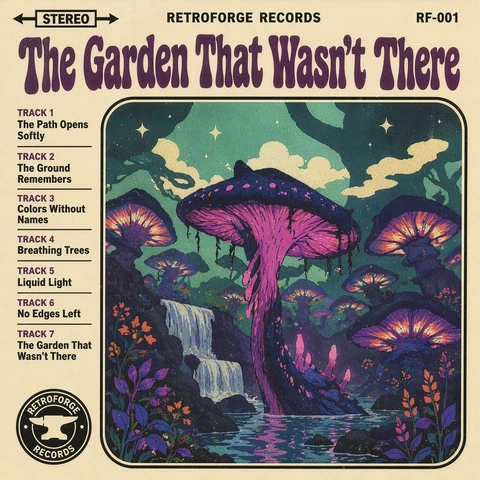
The Garden That Wasn’t There
Its recurring dream imagery and richly arranged late-1960s palette reward the same kind of uninterrupted album listening.
Open liner notes →
The Soft Geometry of Dreams
A gentler psychedelic sequence where atmosphere, pacing and visual identity matter as much as individual tracks.
Open liner notes →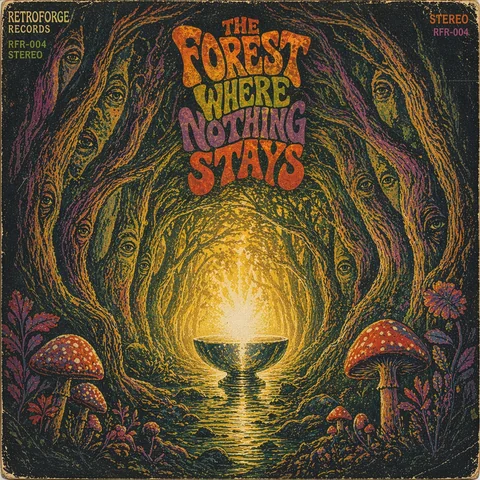
The Forest Where Nothing Stays
For listeners drawn to ornate psychedelic colour, organ textures and an album built as a complete imagined environment.
Open liner notes →Research notes
Sources and Further Reading
- Sgt. Pepper’s Lonely Hearts Club Band — The Beatles
- The Beatles Anthology: 1967 — Sgt. Pepper’s Lonely Hearts Club Band — The Beatles / Apple Corps
- Celebrating The Beatles’ Sgt. Pepper’s 50th Anniversary — The Recording Academy, Paul Zollo (25 May 2017)
- Beatles Reissue to Put Sgt. Pepper’s Back into Perspective — The Recording Academy (15 May 2017)
- 10th Annual Grammy Awards ? Recording Academy
- Penny Lane and the start of the 1967 sessions ? The Beatles