Banco del Mutuo Soccorso joined symphonic scale to an unmistakably Roman dramatic voice. Twin keyboards gave the group unusual harmonic weight, but Francesco Di Giacomo’s singing prevented the music from becoming an abstract exercise: his range could move from conversational warmth to operatic force inside a single composition. The best early records combine philosophical subjects, muscular ensemble playing and melodies rooted in Italian song rather than translated British models.
Banco’s first three albums appeared within two years and established a remarkably complete language. The self-titled debut introduced the lineup’s theatrical breadth; Darwin! organised it around evolution and human origins; Io sono nato libero turned freedom into both a political and personal subject. Later lineups and international versions changed the presentation, yet Vittorio Nocenzi’s keyboards and compositional direction kept the band recognisable across decades.
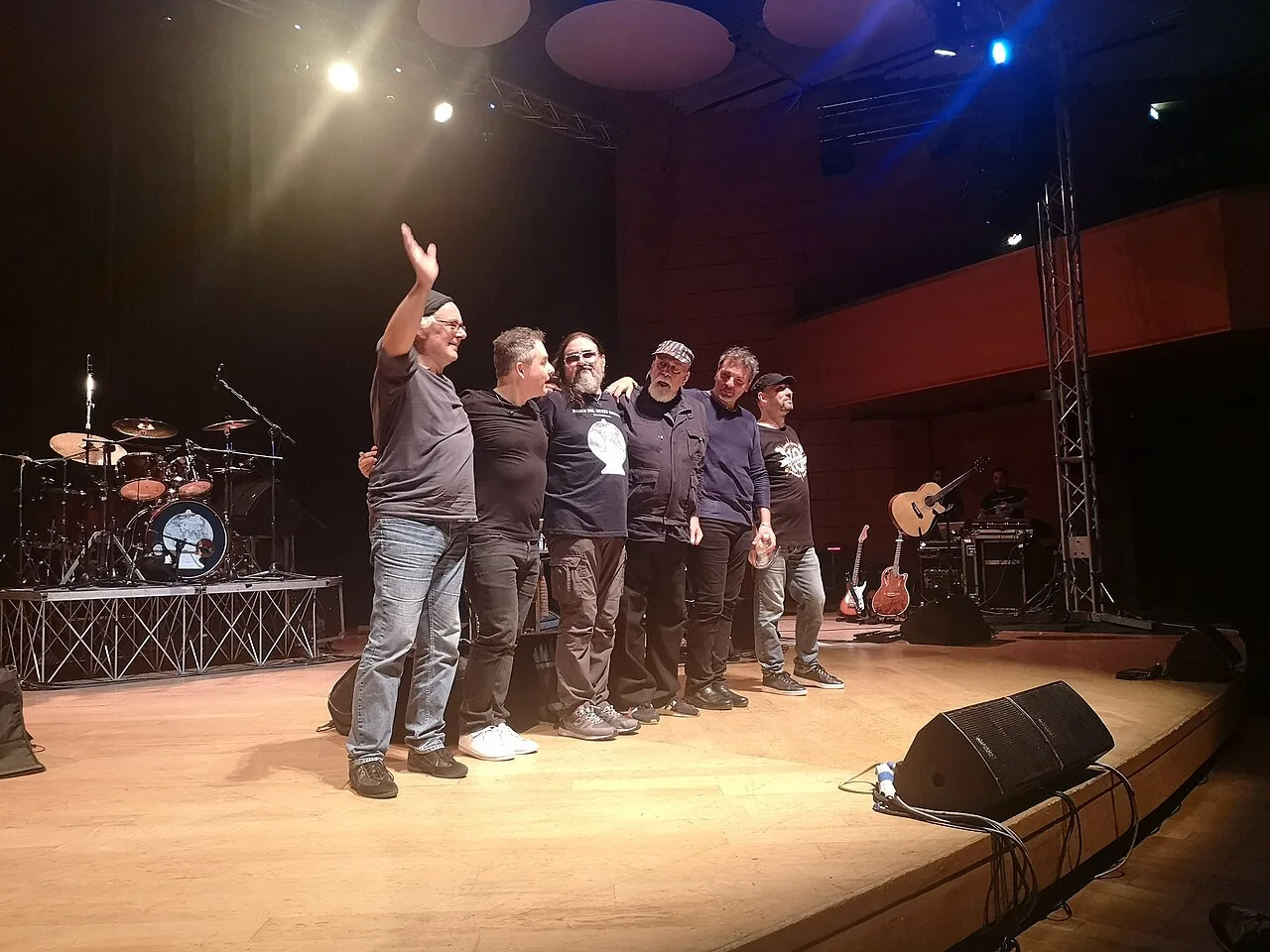
Banco del Mutuo Soccorso performing at Teatro Dal Verme in Milan, 8 November 2019.Photo: Dennis Radaelli / Wikimedia Commons · Licensed under CC BY-SA 4.0. Converted to WebP for this page.
Formation & History
Keyboard player Vittorio Nocenzi initiated the group near Rome in the final months of 1968, assembling an early lineup for an RCA audition and working with his brother Gianni Nocenzi on piano. The decisive configuration emerged after the 1971 Caracalla Pop Festival: singer Francesco Di Giacomo, bassist Renato D’Angelo and drummer Pierluigi Calderoni arrived from Le Esperienze, while guitarist Marcello Todaro came from Fiori di Campo.
Banco del Mutuo Soccorso appeared in 1972 with a distinctive die-cut cover shaped like a terracotta savings bank. Darwin! followed later that year, and Io sono nato libero arrived in 1973 after guitarist Rodolfo Maltese had begun working with the group; he became a defining member. The Nocenzi brothers’ two-keyboard design allowed organ, piano and synthesizer to function as separate dramatic characters rather than one orchestral wash.
Gianni Nocenzi left in 1984, and the band passed through stylistic and personnel changes while remaining active under Vittorio’s leadership. Di Giacomo died in February 2014 and Rodolfo Maltese in October 2015. Tony D’Alessio became lead singer in 2016; Banco then returned to new studio work with Transiberiana in 2019 and Orlando: le forme dell’amore in 2022.
Sound & Style
Banco’s music is built on tension between density and human presence. Vittorio and Gianni Nocenzi layer organ, piano, clavinet and synthesizer in counterpoint; the rhythm section can turn sharply through odd metres, and guitar often enters as colour or interruption rather than constant foundation. Di Giacomo sings with exceptional power but also controls quieter narrative passages, giving philosophical texts the immediacy of theatre.
Compared with PFM’s fluid instrumental transitions, Banco often sounds more architectural and argumentative. Themes collide, pause and return in altered form. Classical influence is audible, yet folk-shaped melody, Italian prosody and bursts of hard rock keep the arrangements from becoming polite symphonic imitation.
Essential Albums
1972
Darwin!
Ricordi · Original 1972 release
Darwin! turns evolutionary history into musical theatre. “L’evoluzione” opens with a large keyboard argument that repeatedly changes pace and perspective; “La conquista della posizione eretta” makes upright movement sound difficult rather than triumphant, while “750.000 anni fa… l’amore?” brings the concept down to intimate human scale. The two-keyboard lineup creates orchestral breadth without an orchestra, and Di Giacomo shifts between narration, wonder and alarm. The album is demanding but unusually clear in purpose: its complex structures follow the questions being asked. For listeners seeking Banco’s balance of concept, force and Italian vocal identity, this is the central record.
Key tracks: L’evoluzione · La conquista della posizione eretta · 750.000 anni fa... l’amore?
Io sono nato libero gives Banco’s early sound more room to breathe. The long “Canto nomade per un prigioniero politico” moves between confinement, memory and imagined movement, with keyboards and Di Giacomo’s voice carrying equal dramatic weight. “Non mi rompete” uses acoustic textures and a direct refrain without losing the album’s wider concern with freedom, while “Dopo... niente è più lo stesso” expands from reflection into a large-scale dramatic finale. Rodolfo Maltese’s presence broadens the guitar writing, and the production separates the instruments more clearly than on the debut.
Key tracks: Canto nomade per un prigioniero politico · Non mi rompete · Io sono nato libero
The 1972 debut already contains Banco’s essential contradictions: learned and unruly, comic and severe, intimate and monumental. After the brief medieval colour of “In volo,” “R.I.P. (Requiescant in pace)” turns a soldier’s view of battle into a forceful early statement, while the extended “Il giardino del mago” moves through multiple scenes without feeling like a demonstration assembled from spare parts. Piano and organ compete as often as they blend, leaving space for Di Giacomo to define the human centre. The rougher production preserves the sensation of a new language being tested in real time.
Key tracks: R.I.P. · Metamorfosi · Il giardino del mago
Banco made intellectual ambition feel physical. Their early albums ask large questions about evolution, freedom, power and individual identity, but the impact comes through voices, keyboards and rhythm rather than explanatory concepts alone. Di Giacomo remains one of progressive rock’s most distinctive singers, while Vittorio Nocenzi’s writing demonstrates how multiple keyboards can argue, converse and propel a rock ensemble.
The group is also essential evidence that Italian progressive rock was not a single symphonic style. Banco’s theatrical gravity differs sharply from PFM’s mobility or Le Orme’s trio economy. Hearing those contrasts makes the whole movement richer and prevents its history from being reduced to a list of imported influences.
RetroForge Records publishes original music and independent editorial guides. This historical band guide is not affiliated with the artist, labels or rights holders. No unlicensed album artwork is reproduced.