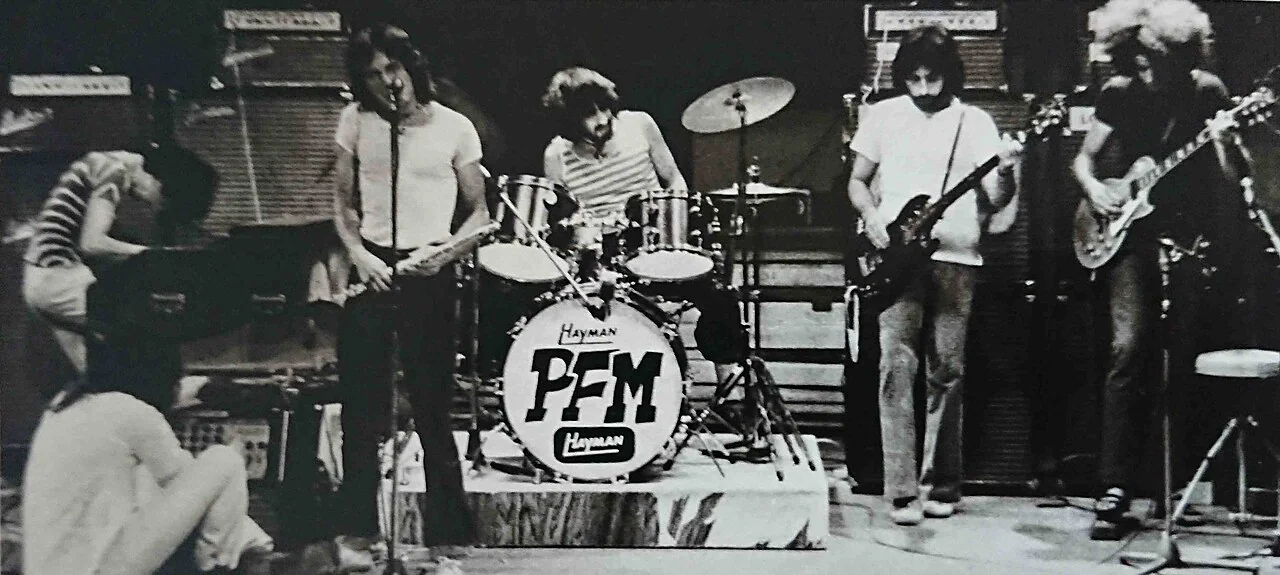
Premiata Forneria Marconi emerged from Milan at the moment Italian musicians were turning British progressive-rock vocabulary into something unmistakably their own. Usually shortened to PFM, the group balanced conservatory-level arrangement with the physical momentum of a working rock band. Acoustic guitar, flute and violin could give way to Mellotron, Moog, electric-guitar attack and jazz-informed ensemble playing without the joins sounding mechanical.
Their early-1970s records helped establish Italian progressive rock internationally. PFM did not simply reproduce Genesis or King Crimson in another language: Mediterranean melody, mobile rhythms and rapid changes of instrumental colour gave the music a separate identity. English-language adaptations and releases through Manticore widened the audience, but the original Italian albums remain the clearest route into the band’s imagination.
Premiata Forneria Marconi performing in 1972.Photo: Unknown author / Wikimedia Commons · Licensed under Public domain. Converted to WebP for this page.
Formation & History
PFM grew from I Quelli, a Milan group whose members had spent the 1960s playing beat music and working on recordings by other Italian artists. Franco Mussida, Franz Di Cioccio, Flavio Premoli and Giorgio Piazza formed the core; Mauro Pagani added flute, violin and vocals. Under the new name, the quintet won joint first place at the 1971 Viareggio Festival of Avant-Garde Music and New Trends with “La carrozza di Hans”. The song then appeared with “Impressioni di settembre” on PFM’s first single.
Storia di un minuto arrived in January 1972 and Per un amico followed that November. Greg Lake saw PFM present the second album at Rome’s PalaEur on 20 December 1972 and brought the group into Emerson, Lake & Palmer’s Manticore orbit. Peter Sinfield produced and wrote English lyrics for Photos of Ghosts, the international adaptation built mainly from Per un amico; it entered the US Billboard album chart and took the band through Britain, Europe, Japan and the United States.
Patrick Djivas, previously with Area, replaced Piazza before L’isola di niente. Pagani left after Chocolate Kings, and later lineups shifted the emphasis among symphonic writing, jazz-rock and more compact songs. The group remained active across reunions and personnel changes; Mussida departed in 2015, while Di Cioccio and Djivas continued to carry the PFM name.
Sound & Style
PFM’s defining skill is transition. A passage led by nylon-string guitar or voice may acquire flute, violin counterpoint and Mellotron before the rhythm section accelerates into an irregular metre. Premoli’s keyboards provide orchestral mass, but the music rarely sits still long enough to become merely grand. Di Cioccio’s drumming and the bass lines beneath him keep the most elaborate writing in motion.
The vocals favour melodic, ensemble-shaped phrasing rather than theatrical declamation, while Mussida’s guitar can move from delicate acoustic figures to sharp fusion lines. That combination allows PFM to sound pastoral, symphonic and rhythmically aggressive inside the same composition. The best records feel less like suites assembled from labelled parts than landscapes continually changing under the listener.
Essential Albums
1972
Per un amico
Numero Uno · Original 1972 release
Per un amico refines PFM’s early language into five tightly connected compositions. “Appena un po’” begins in near-pastoral quiet before Mellotron, flute and a restless rhythm section enlarge the frame; the title track keeps acoustic detail and ensemble power in unusually close balance. Mauro Pagani’s violin and flute are not decorative additions but structural voices, often redirecting the music as decisively as a guitar riff. The record became the foundation for the international Photos of Ghosts, yet the Italian original preserves the natural cadence of the vocal writing and remains the most direct introduction to PFM’s combination of warmth, speed and orchestral colour.
Key tracks: Appena un po’ · Per un amico · Generale
Storia di un minuto is a debut with the confidence of a band that had already spent years learning how studios and stages worked. “Impressioni di settembre” turns a spacious vocal melody into a Moog-led surge, while “È festa” releases the group’s rhythmic exuberance in a compact instrumental rush. Longer pieces such as “Dove… quando…” reveal the method that would define PFM: themes return in altered instrumentation, quiet passages carry real structural weight, and virtuosity serves momentum rather than display. The album is slightly rawer than Per un amico, which makes its sudden leaps from intimacy to full-band impact especially vivid.
Key tracks: Impressioni di settembre · È festa · Dove... quando...
L’isola di niente expands PFM’s scale without sanding away its edges. The title piece opens with choral weight before moving through tense bass, keyboards, acoustic space and some of the group’s most forceful ensemble writing. Patrick Djivas brings a more overtly fusion-oriented bass presence, while “La luna nuova” drives complex metres with the urgency of a live performance. “Via Lumière” closes the record in a more exploratory jazz-rock language. Rather than repeating the pastoral balance of the 1972 albums, PFM makes the contrasts harsher and the instrumental conversations denser, producing a record that suits listeners ready for the band at its most ambitious.
Key tracks: L’isola di niente · La luna nuova · Via Lumière
PFM demonstrated that progressive rock’s international growth was not a story of British bands exporting a fixed template. Their strongest work absorbed outside influences while preserving Italian language, melodic character and instrumental personality. The group also provided many listeners outside Italy with an entrance into a much broader scene that included Banco del Mutuo Soccorso, Le Orme and Area.
Their catalogue still rewards album-length listening because its drama lies in movement between textures: an acoustic phrase returning after a violent ensemble passage can matter as much as any solo. Modern symphonic and jazz-leaning prog bands continue to draw on that balance of technical control and lyrical warmth.
RetroForge Records publishes original music and independent editorial guides. This historical band guide is not affiliated with the artist, labels or rights holders. No unlicensed album artwork is reproduced.