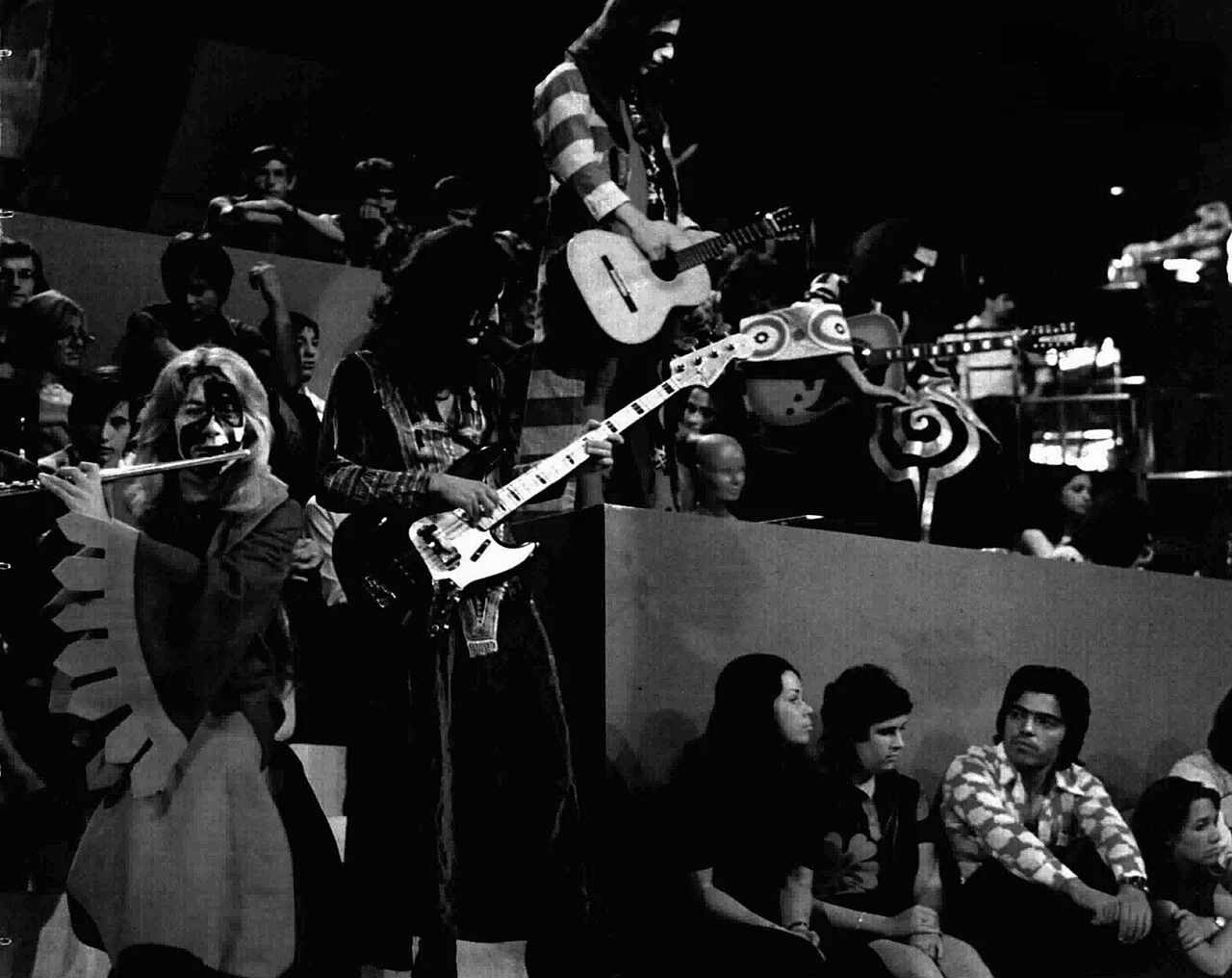
Osanna formed in Naples at the end of 1970 and played their first concert in February 1971. The classic five-piece joined Lino Vairetti’s voice and guitars, Danilo Rustici’s electric guitar, Elio D’Anna’s flute and saxophone, Lello Brandi’s bass and Massimo Guarino’s drums. Their early work connects heavy progressive rock to jazz articulation, Neapolitan identity and a stage language built from painted faces, costume and movement.
The first formation made four Fonit albums in four years: L’uomo, the Luis Enriquez Bacalov collaboration Preludio, Tema, Variazioni e Canzona, Palepoli and Landscape of Life. Those records do not document one fixed style. The debut is compact and volatile; the film project alternates orchestra and rock group; Palepoli expands three compositions into music theatre; the 1974 album closes the original line-up’s studio history. Later returns in 1978 and from 1999 onward belong to separate formations.
Osanna in 1972.Photo: Unknown author / Wikimedia Commons · Licensed under Public domain. Converted to WebP for this page.
Formation & History
Osanna began when Elio D’Anna, recently out of the Showmen, joined Città Frontale after keyboardist Gianni Leone left that group for Il Balletto di Bronzo. The new line-up chose the name Osanna and debuted at Naples club Spry Pan in February 1971. Performances at the Caracalla gathering and the first Festival d’Avanguardia e Nuove Tendenze in Viareggio—where Osanna shared the winning result with Premiata Forneria Marconi and Mia Martini—helped bring a Fonit contract. The band then remade its debut material at Fonit’s Milan studio in June 1971; L’uomo received an Italian record-critics prize.
Fonit next asked the group to work with composer Luis Enriquez Bacalov and producer Sergio Bardotti on Fernando Di Leo’s Milano Calibro 9. The resulting 1972 LP was originally titled Preludio, Tema, Variazioni e Canzona; “Milano Calibro 9” became the familiar title through later reissues. Palepoli followed in 1973 with a touring production involving actors, dancers and mime, and Landscape of Life completed the classic formation’s catalogue in 1974. The five-piece dissolved in 1975.
Vairetti, Rustici and Guarino reconvened in 1978 with keyboardist Fabrizio D’Angelo and bassist Enzo Petrone for Suddance, then stopped again at the end of 1979. Vairetti and Rustici launched Osanna 2000 in 1999, leading to Taka Boom in 2001. Later configurations continued the theatre-and-rock idea with younger Neapolitan musicians; Van der Graaf Generator saxophonist David Jackson became a prominent collaborator on Prog Family and subsequent performances.
Sound & Style
The classic band’s colour comes from tension between instruments with different jobs. Rustici’s fuzz and wah-wah guitar supplies mass and abrasion; D’Anna’s flute and saxophone cut across it with short jazz phrases rather than settling into a soft symphonic layer. Brandi and Guarino can move from a straight rock foundation to broken accents and percussion-led transitions, while Vairetti’s acoustic guitar, keyboards and voice connect the ensemble to Italian and Neapolitan song.
On L’uomo, “Mirror Train” and “Vado verso una meta” expose the Anglo-American blues-rock current, while the title track and “In un vecchio cieco” place that attack beside Italian melodic writing. Preludio, Tema, Variazioni e Canzona makes contrast structural: Bacalov’s orchestral themes alternate with Osanna’s electric sections and with the vocal pieces “There Will Be Time” and “Canzona.” Palepoli works on a larger scale, using repeated material, theatrical voices, Neapolitan text, acoustic space, saxophone, flute and percussion to bind three long pieces into one staged argument about Naples.
Essential Albums
1973
Palepoli
Fonit LPX 19 · Released 1973
Palepoli compresses Osanna’s music-theatre practice into three long pieces: “Oro caldo,” “Stanza città” and “Animale senza respiro.” The title refers to the ancient city, while the music puts historical and modern Naples into friction through Neapolitan text, recurring motifs, flute and saxophone, heavy guitar, acoustic episodes and ensemble percussion. The record was also developed as a touring theatrical work with actors, dancers and mime. Its scale therefore comes from stage construction rather than from adding keyboards to a conventional rock suite.
Key tracks: Oro caldo · Stanza città · Animale senza respiro
Fonit LPX 14 · Released 1972 · Milano Calibro 9 soundtrack
The original LP title matters: Milano Calibro 9 is the name adopted by later reissues of this soundtrack collaboration with Luis Enriquez Bacalov. Short orchestral statements and variations alternate with Osanna’s electric ensemble rather than merely decorating it. “There Will Be Time” gives the band a complete vocal song inside the score, while “Canzona” brings Vairetti’s melodic delivery into Bacalov’s more measured setting. The result documents a specific encounter between film composition and a working rock group, not a standard Osanna studio album with strings added afterward.
Key tracks: Preludio · Tema · There Will Be Time · Canzona
L’uomo introduces Osanna in compact, restless form after the group rebuilt its earlier demo material at Fonit’s Milan studio. The title track and “In un vecchio cieco” draw on Italian melodic writing; “Mirror Train” and “Vado verso una meta” make the blues-rock current explicit. D’Anna’s winds already function as forceful ensemble voices, while Rustici’s guitar remains acidic even inside tightly arranged passages. The album’s quick stylistic turns are not yet the extended theatre of Palepoli, but they establish the instrumental and linguistic vocabulary from which it grew.
Key tracks: L’uomo · Mirror Train · Vado verso una meta
Landscape of Life (1974) is the fourth and final album by the classic five-piece. It places the earlier psychedelic and progressive contrasts beside more direct song forms and should be heard as the close of that formation rather than as a minor appendix to Palepoli.
Suddance (1978) belongs to the separate reunion with Vairetti, Rustici and Guarino joined by Fabrizio D’Angelo and Enzo Petrone. Taka Boom (2001) begins the modern revival, while Prog Family (2009) recasts historical material with David Jackson and guests including David Cross, Gianni Leone and members of the wider Italian progressive-rock community.
Osanna complicate the idea that Italian progressive rock was principally a polished, keyboard-led northern style. The classic records are rooted in Naples through language, theatrical practice and musical imagery, yet they do not reduce that identity to picturesque folklore. Guitar distortion, wind instruments, group percussion and dramatic editing make the regional context active inside the arrangements.
The Bacalov collaboration also records a genuine exchange between film scoring and a rock ensemble. The later revivals matter for a different reason: Vairetti did not present one supposedly unchanged band, but repeatedly rebuilt the repertoire with new Neapolitan musicians and collaborators such as David Jackson. That history makes Osanna both a specific 1970s formation and an evolving performance project.
RetroForge Records publishes original music and independent editorial guides. This historical band guide is not affiliated with the artist, labels or rights holders. No unlicensed album artwork is reproduced.