

Overview
The Grateful Dead made live performance the centre of their identity. Set lists changed, songs opened into improvisation, and the same composition could take a markedly different route from one night to the next. Deadheads who travelled between shows helped turn the audience into a durable community rather than a conventional succession of ticket buyers.
The studio catalogue contains concise, carefully arranged records as well as experiments in tape collage. It is only one part of a much larger archive shaped by concerts, officially tolerated audience recordings and decades of tape circulation.
Formation & History
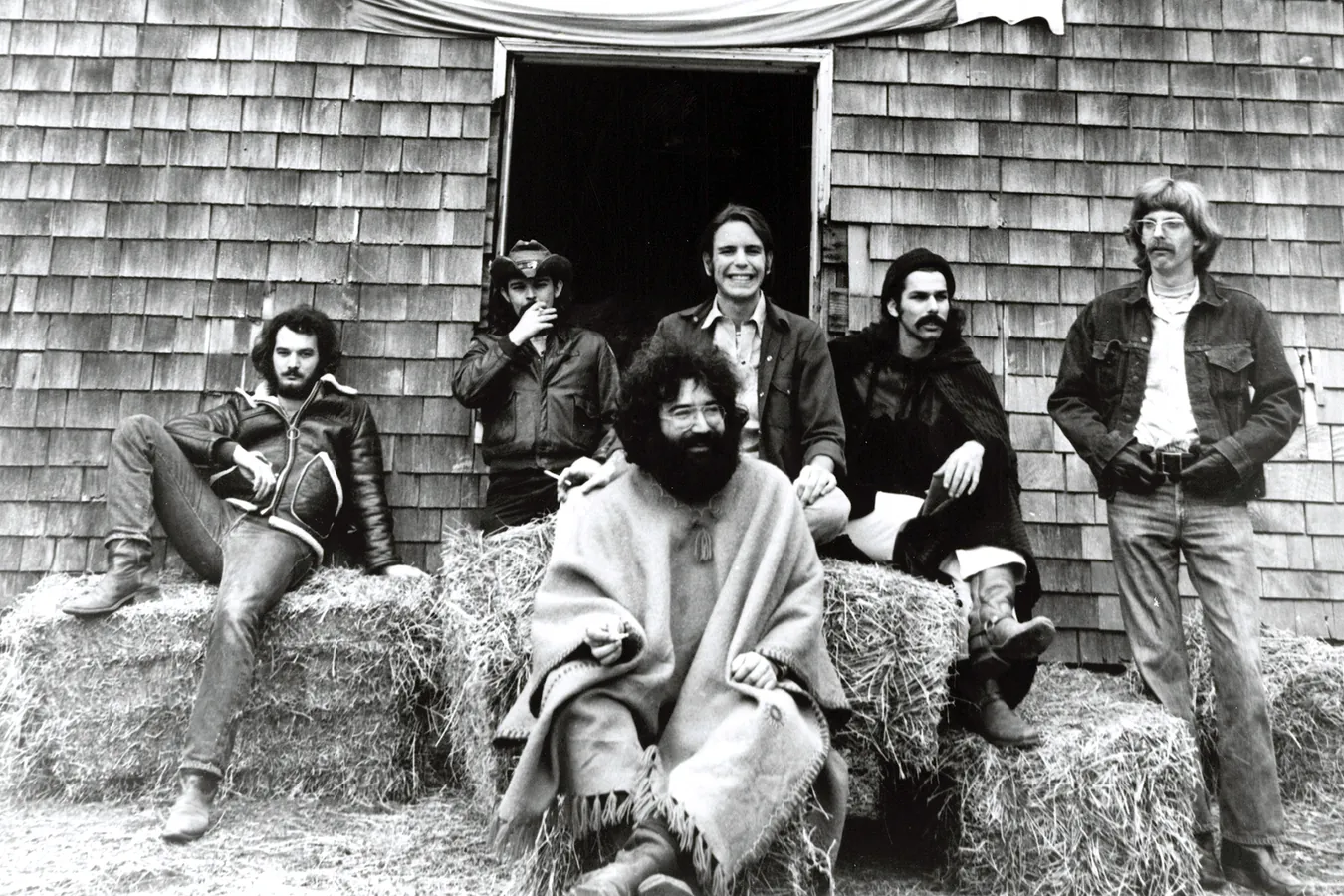
Jerry Garcia's folk and bluegrass work led to Mother McCree's Uptown Jug Champions. In 1965, Garcia, Bob Weir, Ron “Pigpen” McKernan and Bill Kreutzmann electrified the idea as the Warlocks; Phil Lesh soon joined on bass. After learning that another group was already using the Warlocks name, they became the Grateful Dead. Their first public appearance under that name came at an Acid Test in December 1965, tying the band to Ken Kesey's Merry Pranksters and the emerging Bay Area counterculture.
Personnel and keyboards changed repeatedly, but touring remained the band's engine. Mickey Hart joined in 1967, left in 1971 and returned in 1974. Tom Constanten, Keith and Donna Jean Godchaux, Brent Mydland and Vince Welnick each belonged to distinct musical phases. The 1987 single “Touch of Grey” became their only US top-ten hit. Jerry Garcia died in August 1995; the remaining members decided that the Grateful Dead name would end with him, although they later performed together in other formations.
Sound & Style
The Dead moved between electric blues, psychedelia, folk, country and jazz-informed improvisation. Anthem of the Sun splices studio and concert recordings into a dense collage; Workingman's Dead and American Beauty foreground acoustic instruments, close harmonies and compact songs. Onstage, Garcia's melodic guitar lines and Phil Lesh's mobile bass avoided fixed lead-and-accompaniment roles. Bill Kreutzmann supplied the sole drum kit from 1971 to 1974; with Mickey Hart, the band used two percussionists whose interlocking parts could expand into the later “Drums” and “Space” sequences.
Essential Albums
American Beauty
1970A concise studio portrait built from group harmonies, acoustic textures and the Garcia–Hunter and Weir–Barlow songwriting partnerships. “Box of Rain” opens with Phil Lesh singing his own composition, “Ripple” turns a mandolin-led arrangement into a secular hymn, and “Truckin'” gives the record its rolling electric release.
Key tracks: Box of Rain · Ripple · Truckin'
Open album guide → View on Amazon →Live/Dead
1969The band's first live album turns performances recorded at the Avalon Ballroom and Fillmore West into a continuous sequence. “Dark Star” moves from its compact theme into open group improvisation, while Pigpen drives “Turn On Your Love Light” as an R&B frontman before the closing benediction of “And We Bid You Goodnight.”
Key tracks: Dark Star · Turn On Your Love Light · And We Bid You Goodnight
Open album guide → View on Amazon →Workingman's Dead
1970A deliberate turn toward lean arrangements, ensemble vocals and American roots forms. “Uncle John’s Band” establishes the new harmony language, “Cumberland Blues” couples a working song to quick country picking, and “Dire Wolf” sets dark narrative detail against an inviting refrain.
Key tracks: Uncle John’s Band · Cumberland Blues · Dire Wolf
Open album guide → View on Amazon →Affiliate note: Amazon links on this page may earn RetroForge Records a small commission, at no extra cost to you.
Deeper Cuts
Anthem of the Sun
1968Studio-assembled from live and studio tape. Disorienting and visionary — the avant-garde Dead.
Open album guide → View on Amazon →Aoxomoxoa
1969Robert Hunter's lyrics reach their strangest peak. Extraordinarily produced for the era.
Open album guide → View on Amazon →Europe '72
1972The triple live album that captures the band at its most relaxed and confident. An essential document.
Open album guide → View on Amazon →Why They Still Matter
The Dead joined songwriting, improvisation and audience participation into a durable alternative to the usual album-and-hit-single career. Their officially sanctioned taping section, introduced in 1984 after years of informal audience recording, helped performances circulate outside conventional distribution. That archive still allows listeners to compare how songs changed over time. The group also left a substantial songbook, especially through Garcia and Robert Hunter's partnership, while its touring culture became a model for later jam bands.
Sources & Further Reading
Grateful Dead official biography · Official band-member archive · Rock & Roll Hall of Fame profile · Library of Congress: Barton Hall concert in the National Recording Registry
Connected archive routes
Explore This Band
Continue through the RetroForge knowledge graph
Curated paths into the people, records, events and ideas that give this subject its wider musical context.