Gong is less a conventional band than a continuously changing creative community. Daevid Allen and Gilli Smyth placed poetry, satire, communal living and psychedelic theatre around a musical core that could include space rock, jazz improvisation, electronic sound and absurdist pop. The Radio Gnome Invisible trilogy gave this world its best-known shape, but Gong’s history extends through jazz-fusion transformations, reunions and a present-day lineup encouraged by Allen to continue after his death.
That continuity matters because Gong was never based on one fixed instrumental formula. Didier Malherbe’s reeds, Smyth’s “space whisper,” Allen’s glissando guitar, Steve Hillage’s lead work, Tim Blake’s synthesizers and Pierre Moerlen’s percussion each altered the centre of gravity. The mythology of pot-head pixies, flying teapots and octave doctors can be enjoyed as comedy, yet beneath it lies a serious commitment to imagination as a collective practice.
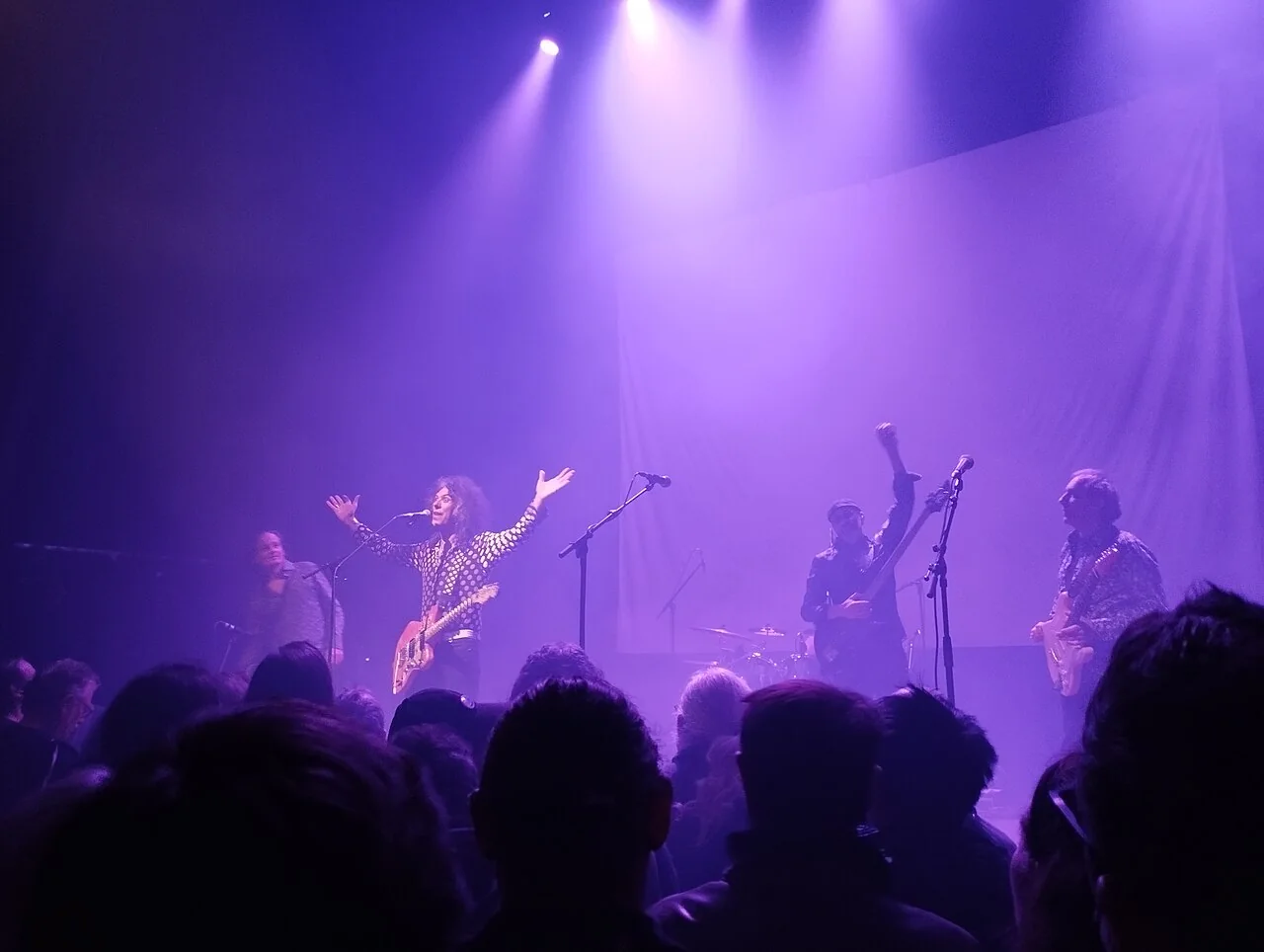
Gong performing at the Café de la Danse in Paris, 6 December 2024.Photo: ManoSolo13241324 / Wikimedia Commons · Licensed under CC0. Converted to WebP for this page.
Formation & History
Australian musician and poet Daevid Allen had helped form Soft Machine, but after being refused re-entry to the United Kingdom he remained in France. There he developed new work with Gilli Smyth amid the political and countercultural upheaval of the late 1960s. A stable Gong lineup eventually formed around them with saxophonist and flautist Didier Malherbe, bassist Christian Tritsch and drummer Pip Pyle. Camembert Electrique, released in 1971, captured that band’s mixture of loose song, free playing and psychedelic provocation.
Virgin Records released the three albums later known as the Radio Gnome Invisible trilogy: Flying Teapot and Angel’s Egg in 1973, followed by You in 1974. Across the sequence, Mike Howlett replaced Tritsch, Pierre Moerlen replaced Pyle, and Steve Hillage and Tim Blake expanded the guitar-and-synthesizer dimension. After You, Allen, Smyth, Blake and Hillage departed. Shamal preserved Howlett, Malherbe and Moerlen in a transitional lineup before Gazeuse! and Expresso II moved the group toward percussion-rich jazz fusion.
Allen revived Gong in several configurations, including the lineup behind Shapeshifter in 1992 and the reunion that produced 2032 in 2009. Dave Sturt and Ian East entered during that period; Fabio Golfetti, Kavus Torabi and drummer Cheb Nettles completed the later five-piece. Allen explicitly supported the band’s continuation before his death in 2015. That lineup has since recorded Rejoice! I’m Dead! (2016), The Universe Also Collapses (2019), Unending Ascending (2023) and Bright Spirit (2026).
Sound & Style
Classic Gong balances weightlessness with discipline. Allen’s echoing glissando guitar and Blake’s synthesizers create the airborne surface, while Howlett and Moerlen give the music a precise, sometimes very heavy rhythmic engine. Malherbe can move from lyrical flute to comic or fiercely improvisational saxophone, and Smyth’s whispered vocals alter the sense of space around the conventional singing.
The compositions often interrupt themselves with announcements, chants or sudden stylistic turns, but the strongest performances never collapse into novelty. Repetition gradually changes colour; extended instrumental sections gather intensity; jokes create permission for genuine strangeness. Later Gong variants emphasise different elements, from Moerlen’s tuned percussion and fusion to the modern band’s denser psychedelic rock.
Essential Albums
1974
You
Virgin · Original 1974 release
You is the Radio Gnome trilogy’s instrumental summit. Short vocal episodes advance the mythology, but the album’s centre lies in “Master Builder,” “A Sprinkling of Clouds” and “The Isle of Everywhere,” where bass and drums lock into cyclical motion beneath synthesizer, reeds and two radically different guitar voices. Steve Hillage’s lines rise through the ensemble while Daevid Allen’s glissando guitar changes the surrounding atmosphere. The music is tightly controlled without losing the sensation of spontaneous lift. Listeners wary of Gong’s comic vocabulary should begin here: the jokes remain, but the extended performances demonstrate why this lineup belongs among the most formidable progressive ensembles of the decade.
Key tracks: Master Builder · A Sprinkling of Clouds · Isle of Everywhere
Angel’s Egg is the trilogy at its most crowded, theatrical and miniature-rich. “Other Side of the Sky” opens a vast electronic space, but the record continually breaks that scale with character songs, spoken fragments and abrupt changes of viewpoint. Gilli Smyth’s “Prostitute Poem” gives the mythology an earthy counterweight, while “I Never Glid Before” and “Oily Way” show the band turning complex ensemble movement into memorable song. The sequencing is deliberately unstable: cosmic philosophy, sexual satire and instrumental precision share the same frame. It is not the easiest Gong album to isolate into highlights, which is precisely why hearing the complete eccentric architecture matters.
Key tracks: Other Side of the Sky · Oily Way · I Never Glid Before
Flying Teapot establishes the trilogy’s vocabulary: Zero the Hero, radio transmissions, pot-head pixies and a planetary mythology delivered with complete commitment and no demand that the listener take it solemnly. The long title track floats on bass, percussion, synthesizer and Allen’s glissando guitar, while “The Pot Head Pixies” condenses the concept into mischievous psychedelic song. Steve Hillage’s arrival adds a sharper lead-guitar dimension without overwhelming Didier Malherbe’s reeds or Gilli Smyth’s vocal presence. The record is looser than You and less densely edited than Angel’s Egg, making it the best doorway into Gong’s narrative world and communal sense of play.
Key tracks: Radio Gnome Invisible · Flying Teapot · The Pot Head Pixies
Gong demonstrates that elaborate progressive music need not choose between precision and play. The Radio Gnome trilogy binds a recurring fictional world to clearly differentiated arrangements: spoken interruptions, glissando guitar and “space whisper” coexist with disciplined rhythm sections, long instrumental development and memorable refrains. The humour is part of the compositional method rather than a layer placed over otherwise solemn music.
The post-Allen catalogue makes the group’s changing identity unusually visible. Shamal and the Moerlen-era records redirect the name toward fusion; the later Allen reunions reconnect it with the mythology; the Torabi-Golfetti-Sturt-East-Nettles lineup writes new material instead of reproducing one historic set. Across those shifts, Gong remains recognisable through collective transformation rather than a fixed personnel list.
RetroForge Records publishes original music and independent editorial guides. This historical band guide is not affiliated with the artist, labels or rights holders. No unlicensed album artwork is reproduced.