Silver Apples formed in New York in 1967 when vocalist Simeon Coxe’s use of an audio oscillator divided the Overland Stage Electric Band until only he and drummer Danny Taylor remained. The resulting duo built songs from voice, drums and a changing bank of electronic test oscillators rather than guitar, bass or a conventional keyboard.
The two Kapp albums, Silver Apples (1968) and Contact (1969), belong to the psychedelic era but organise sound through repeated electronic patterns and independent drum figures. Rediscovery in the 1990s led to new lineups, a reunion with Taylor and the eventual reconstruction of recordings intended for a third album.
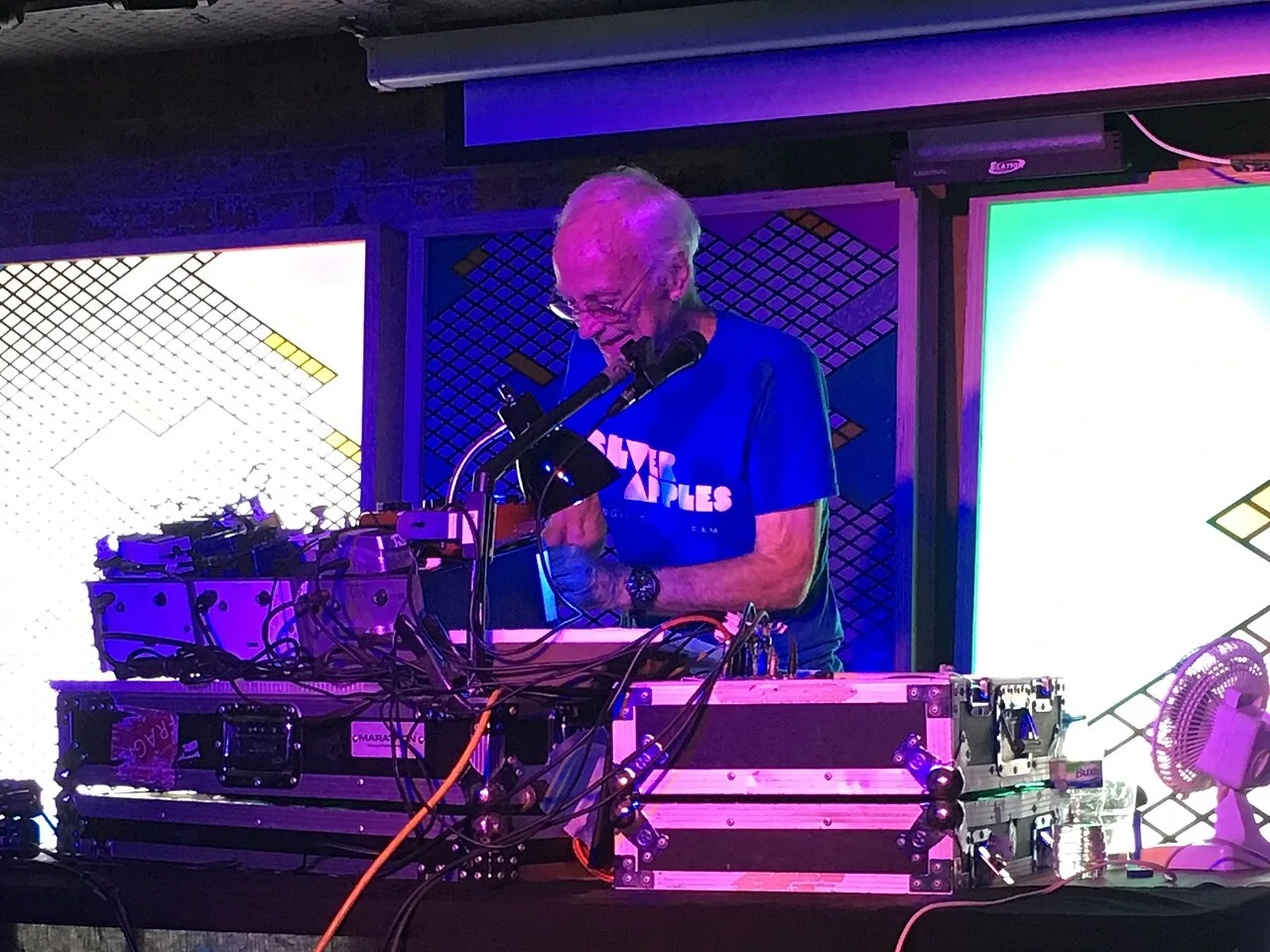
Silver Apples performing at Headrow House in Leeds in 2016.Photo: Cavie78 / Wikimedia Commons · Licensed under CC BY-SA 4.0. Converted to WebP for this page.
Formation & History
Simeon first added a 1940s audio oscillator to the Overland Stage Electric Band’s live set. The guitarists rejected the change; Taylor stayed, and the pair became Silver Apples. Their debut reached number 193 on the Billboard album chart, but the group remained far outside conventional rock instrumentation. Contact followed in 1969. Its front sleeve showed the duo in a Pan Am cockpit while the rear placed them beside a plane-wreck image. Pan Am sued, records were withdrawn and equipment was seized, leaving the duo unable to continue normally.
Interest revived after the first two albums circulated again in the 1990s. Simeon returned with Xian Hawkins and Michael Lerner, recording Beacon and Decatur, and then located Taylor. The original pair recovered tapes connected to the unfinished third album and released The Garden in 1998. A road crash soon broke Simeon’s neck; after recovery he continued performing, later triggering recordings of Taylor’s drums following the drummer’s death in 2005. Simeon’s final Silver Apples studio album was Clinging to a Dream in 2016. He died in 2020.
Sound & Style
The original “Simeon” was not a synthesizer with piano keys. Its expanding rack included nine audio oscillators and dozens of manual controls, with telegraph keys and pedals allowing pitch and pulse to be changed by hands, feet and elbows. One group of oscillators could sustain low repeating figures while another supplied sliding tones, bursts of noise or melody. Because the apparatus changed as components were added or failed, the instrument was also an evolving performance system.
Taylor does not merely keep time beneath the electronics. His compact repeated cells lock to one pulse, then add tom, snare and cymbal accents that make the pattern breathe. “Oscillations” stacks a low electronic cycle, vocal melody and mobile drums; “Lovefingers” makes the machine stutter around a heavier beat; “Program” incorporates live radio frequencies into the arrangement. The calm, lightly inflected voice prevents the electronics from becoming a pure technology demonstration.
Essential Albums
1968
Silver Apples
Kapp · Original 1968 release
The nine-track debut establishes the duo’s complete working method without disguising its homemade origins. Seven songs set texts by poet Stanley Warren; Simeon wrote “Oscillations” and Taylor supplied “Dust”. “Seagreen Serenades” places a pastoral lyric against an unstable pulse, “Lovefingers” turns short electronic bursts into a riff, and “Program” lets radio broadcasts enter a rhythm already in motion.
Key tracks: Oscillations · Seagreen Serenades · Program
The second Kapp album keeps the oscillator-and-drum core but broadens its emotional range. “You and I” opens with a circling low figure and one of Simeon’s most direct vocal lines; “I Have Known Love” stretches repetition into a suspended ballad; “A Pox on You” answers with a harsher, confrontational edge. The notorious Pan Am sleeve belongs to the album’s history, but the music shows a duo refining song form rather than repeating the debut.
Key tracks: You and I · I Have Known Love · Gypsy Love
The Garden is not simply a completed 1970 LP issued late. The 1998 release combines surviving finished recordings from the abandoned third-album period with pieces assembled from Taylor’s period drum tapes and new Simeon additions. The alternation between songs such as “I Don’t Know” and instrumental fragments exposes its archival construction while preserving the original duo’s interaction across time.
Beacon (1997) documents the first comeback lineup: Simeon with Xian Hawkins on keyboards and Michael Lerner on drums, recorded by Steve Albini. It is denser and more abrasive than the Kapp albums because the oscillator language now meets a three-person 1990s studio band rather than an attempt to recreate Taylor’s exact role.
Decatur (1998) moves in the opposite direction: one long, beatless electronic piece removes the song-and-drum framework almost completely. Clinging to a Dream (2016), Simeon’s final studio album under the name, returns to compact tracks while using contemporary samplers and stored drum material as part of the instrument rather than hiding the change in technology.
Silver Apples demonstrate that electronic rock did not need to begin with a commercial synthesizer, keyboard technique or studio overdubbing. Simeon designed a playable system around test equipment, and Taylor developed drum parts that treated its repetitions as a live partner. The songs therefore record an instrument being invented at the same time as its musical vocabulary.
The duo’s later reputation should not be converted into a claim that they single-handedly invented every electronic genre that followed. What the records document more precisely is an unusually early combination of low-frequency loops, noise, live radio, voice and acoustic drums inside short rock songs. That concrete method helps explain why later artists in electronic rock, post-punk and independent production recognised possibilities in the catalogue.
RetroForge Records publishes original music and independent editorial guides. This historical band guide is not affiliated with the artist, labels or rights holders. No unlicensed album artwork is reproduced.