Les Rallizes Dénudés were a Japanese underground rock group formed at Doshisha University in Kyoto in 1967. Vocalist and guitarist Takashi Mizutani remained the central figure through changing lineups and intermittent activity until the final performance at Club Citta in 1996. Their reputation grew from concerts and circulating tapes rather than a normal sequence of contemporary studio albums.
The music sets fragile Japanese-language melodies against repetition, echo and extreme electric-guitar saturation. That contrast—songs that remain mournful and recognisable while feedback threatens to engulf them—distinguishes Les Rallizes Dénudés from both conventional psychedelic rock and noise made purely as abstraction.
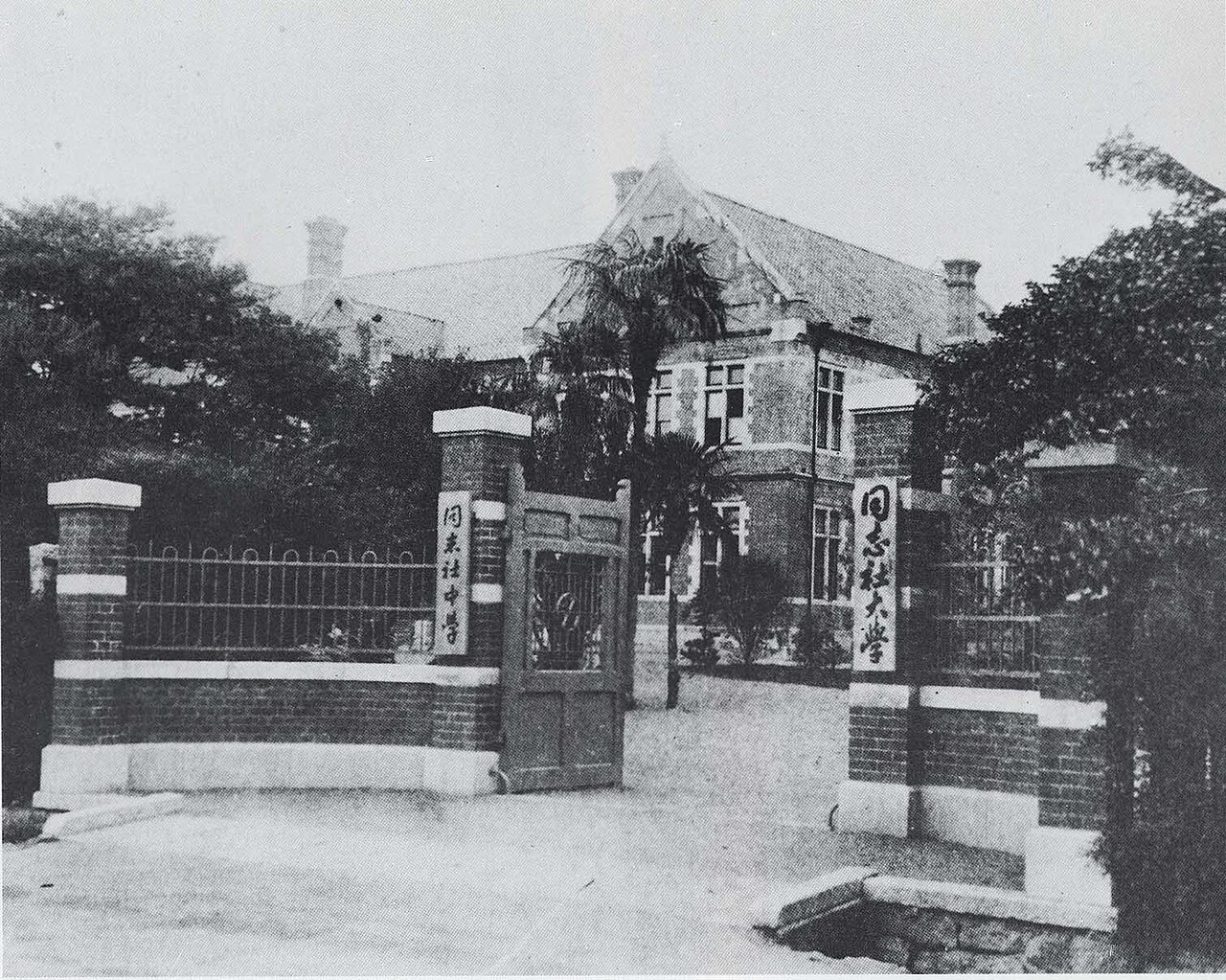
The historic main gate of Doshisha University in Kyoto, where Les Rallizes Dénudés formed in 1967.Photo: Unknown author / Wikimedia Commons · Licensed under Public domain. Converted to WebP for this page.
Formation & History
Les Rallizes Dénudés were founded in 1967 by Doshisha University students Takashi Mizutani (voice and guitar), Takeshi Nakamura (guitar and bass), Moriaki Wakabayashi (bass) and Takashi Katoh (drums). The official history stresses that shared sensibility mattered more than instrumental experience at the outset. Mizutani remained the group’s centre as members, rhythm sections and bases of operation changed.
After the move from Kyoto to Tokyo, the band developed a close relationship with the short-lived Kichijoji venue OZ in 1972–73. Accounts from the venue describe fuzz, wah and two Roland tape echoes expanding a foundation of repeated chords, Japanese lyrics and a hard rhythm section. Recordings made there supplied the Rallizes side of the 1973 private-press compilation OZ Days Live.
A new rhythm lineup recorded material in 1976 during an unsuccessful attempt to secure a deal with Virgin Records. The band continued to perform intermittently, with long gaps and many personnel changes, and played its last show at Club Citta in Kawasaki in 1996. During its lifetime Mizutani authorised three full albums, all compiled and issued by Rivista in 1991: ’67–’69 Studio et Live, Mizutani / Les Rallizes Dénudés and ’77 Live.
The Last One Musique, established with former members and associates and holding the rights to the original recordings, began an authorised archival programme in 2021. Its work with Temporal Drift and Tuff Beats has returned the three Rivista albums and additional concert tapes to circulation from documented sources, making it easier to separate the official catalogue from decades of bootlegs and uncertain titles.
Sound & Style
The classic live sound begins with a deliberately narrow frame: a repeated bass figure, drums that emphasise pulse over display, and Mizutani’s voice carrying a melody in Japanese. Rhythm guitar or violin appeared in some lineups, but the essential tension comes from how long the band can hold this frame while the lead guitar changes its scale.
Mizutani used fuzz, wah and tape echo to turn sustained notes into overlapping layers of distortion. Feedback does not merely decorate a solo; it becomes a moving acoustic environment around the song. Quieter passages matter just as much. The 1970 Doshisha recordings on Mizutani reduce the music to intimate, acoustic-based textures, showing that tenderness and space were always part of the design rather than relief from the “real” noise.
Essential Albums
1991
’77 Live
Rivista · Original 1991 release · authorised reissue 2022
’77 Live is the clearest document of the band’s high-volume concert language. “Enter the Mirror” opens with a recognisable melodic invitation before the guitar begins to bleach the edges; “The Night, Assassin’s Night” locks a famous descending bass figure beneath vocal echo and widening distortion. The second disc gives individual pieces much more room, culminating in “The Last One _1977,” where repetition becomes a framework for long changes in density rather than conventional development. The seven-track sequence preserves the scale and pacing of a performance while remaining a deliberate album compiled by Mizutani, not a later bootleg assemblage.
Key tracks: Enter the Mirror · The Night, Assassin’s Night · The Last One _1977
Rivista · Original 1991 release · authorised reissue 2022
Recorded mainly at Doshisha University’s student broadcast studio in 1970, Mizutani / Les Rallizes Dénudés overturns the idea that the group can be understood only through volume. Mizutani and Makoto Kubota shape the short first-side pieces from voice, acoustic-based guitar, percussion and carefully left space. “Memory Is Far Away” and “Morning Light, L’Aube” feel private rather than remote; the fragments make the session resemble a notebook. “The Last One _1970” then occupies the second side, stretching the same reserve into a long-form performance. It is the essential companion to ’77 Live: intimacy and sonic assault shown as parts of one musical imagination.
Key tracks: Memory Is Far Away · Morning Light, L’Aube · The Last One _1970
Rivista · Original 1991 release · authorised reissue 2022
’67–’69 Studio et Live follows the group before its later concert sound had settled into a single monumental form. “Smokin’ Cigarette Blues” and “La Mal Rouge” retain garage and rhythm-and-blues edges; “Vertigo otherwise My Conviction” and “Les Bulles de Savon” expose the pull between compact song form, French-inflected titles and early studio experimentation. “The Last One _1969” already points toward the extended piece that would close concerts for years. Because the album combines studio and live sources, it is less sonically uniform than the other Rivista sets, but it is the best official account of how the band’s melodic and feedback languages emerged.
Key tracks: Vertigo otherwise My Conviction · Memory Is Far Away · The Last One _1969
Deeper Cuts
OZ Days Live gave the band one side of a 1973 multi-artist private pressing; The OZ Tapes later restored more material from those sessions.
CITTA’ ’93 and BAUS ’93 document the revived early-1990s lineup through authorised concert releases.
The official site states that releases absent from its discography have no connection with Mizutani or The Last One Musique, so provenance matters when navigating older titles.
Les Rallizes Dénudés made amplification part of composition. Their repeated chord cycles and bass figures provide continuity, while feedback changes the perceived size, pressure and emotional temperature of a piece. That method offered later psychedelic, drone and noise musicians a model in which a simple song could support radical sound without being discarded.
The catalogue also matters as a lesson in provenance. For years, listeners encountered the band through copied tapes, bootlegs and unstable English titles. The official archival programme does more than improve fidelity: it restores dates, personnel, track sequences and the distinction between albums Mizutani assembled and compilations created by others. The clearer record reveals a group whose poetry, quiet passages and arrangement discipline are as important as its volume.
RetroForge Records publishes original music and independent editorial guides. This historical band guide is not affiliated with the artist, labels or rights holders. No unlicensed album artwork is reproduced.