Flower Travellin’ Band emerged from Yuya Uchida & the Flowers with a new four-person lineup: Joe Yamanaka on voice and harmonica, Hideki Ishima on guitar and sitar, Jun Kozuki on bass and Joji “George” Wada on drums. Their first LP, Anywhere, radically enlarged four imported songs; Satori then replaced that borrowed repertoire with five numbered original movements.
The quartet’s catalogue is short but unusually easy to hear as a sequence. Anywhere documents transformation, Satori concentration, Made in Japan the Canadian period, and the double album Make Up the contrast between studio construction and a live band. A 2008 reunion album, We Are Here, belongs to a separate phase with keyboardist Nobuhiko Shinohara.
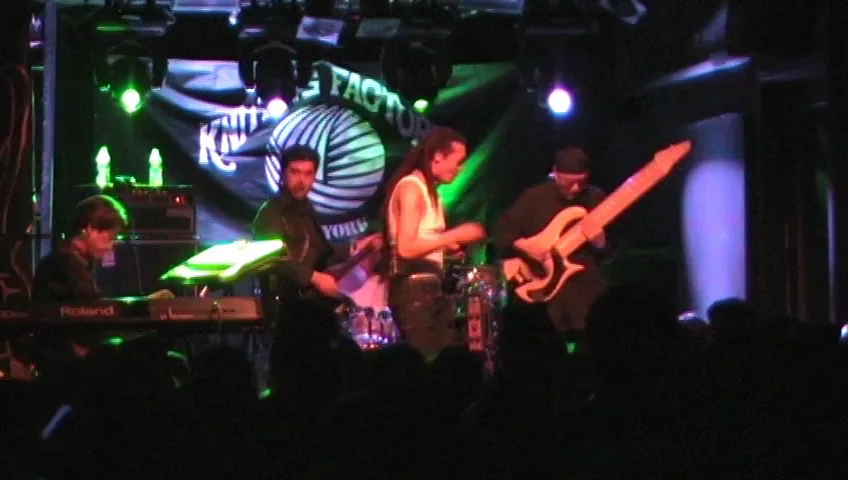
Flower Travellin' Band performing at the Knitting Factory in 2008.Photo: Alex Lozupone / Wikimedia Commons · Licensed under CC BY-SA 3.0. Converted to WebP for this page.
Formation & History
Yuya Uchida & the Flowers had recorded Challenge!, an album dominated by Western covers. Uchida then reorganised the project as Flower Travellin’ Band and moved into a managerial and production role. Wada remained from the Flowers; Yamanaka, Ishima and bassist Jun Kozuki completed the quartet that recorded Anywhere in 1970 and Satori in 1971.
The Canadian connection began at Expo ’70 in Osaka, where the band met Lighthouse. Flower Travellin’ Band travelled to Canada in December 1970 and worked from Toronto before returning to Japan on 9 March 1972. During that period they performed in Canada and recorded Made in Japan at Thunder Sound Studio with Lighthouse leader Paul Hoffert among its producers.
Back in Japan, the group assembled the 1973 double album Make Up from studio recordings and a performance at Yokosuka Bunka Kaikan. Joe Yamanaka’s official biography identifies the July 1973 concert at Kyoto’s Maruyama outdoor music hall as the last performance of the original period. The 1975 release The Times was a compilation, not evidence that the band remained active until that year.
A reunion was announced in 2007 and became public in 2008 with keyboardist Nobuhiko Shinohara added to the four core musicians. We Are Here was recorded in Toronto and released in September 2008, followed by dates in Japan and North America. Activity stopped when Yamanaka became ill; he died on 7 August 2011.
Sound & Style
Ishima’s sustained fuzz tone often supplies both riff and atmosphere. On Satori, modal figures, bends and drones circulate through Jun Kozuki’s bass and Wada’s unhurried drums rather than sitting above a conventional backing track. Yamanaka’s very high register can cut across the ensemble, while his harmonica on Part IV gives the record a different abrasive colour.
Anywhere shows the method before the band had a full album of original material. “Louisiana Blues,” “Black Sabbath,” “House of the Rising Sun” and “21st Century Schizoid Man” are stretched into long performances; the two brief title pieces frame them. Satori removes the familiar song titles and joins five numbered parts through recurring rhythmic cells, sharp dynamic drops and passages in which guitar, bass and drums share the lead.
Made in Japan changes the scale again. Its Toronto sessions produce eight shorter tracks, with acoustic guitar and sitar textures beside compact heavy passages; Paul DeLong adds drums on part of the album. Make Up then places studio pieces beside long concert performances, preserving the friction between controlled arrangement and an ensemble extending material onstage.
Essential Albums
1971
Satori
Atlantic · Original 1971 release
Satori is the quartet’s first album made entirely from its own material: five numbered parts performed by Yamanaka, Ishima, Kozuki and Wada, and produced by Yuya Uchida and Ikuzo Orita. Part I opens with a descending guitar figure and sudden vocal entrance; Part II builds its identity from a turning modal riff; Part IV interrupts the guitar-led texture with harmonica; and Part V closes on the album’s slowest, heaviest cycle. The numbering matters: these are related movements, not five attempts at the same standalone song.
Key tracks: Satori Part I · Satori Part II · Satori Part V
Anywhere introduces the classic quartet through four extended reinterpretations rather than a programme of originals. Muddy Waters’ “Louisiana Blues” runs for almost sixteen minutes; Black Sabbath’s title song is slowed and opened out; “House of the Rising Sun” and King Crimson’s “21st Century Schizoid Man” are rebuilt around Ishima’s guitar and Yamanaka’s range. Two sub-minute pieces titled “Anywhere” form the bookends. The album is therefore best heard as a record of arrangement and performance, not yet the compositional statement that Satori would become.
Key tracks: Louisiana Blues · Black Sabbath · 21st Century Schizoid Man
Despite its title, Made in Japan was recorded at Thunder Sound Studio in Toronto. Yuya Uchida and Ikuzo Orita produced with Lighthouse’s Paul Hoffert; Canadian drummer Paul DeLong appears on part of the album alongside Wada. Eight shorter tracks replace Satori’s numbered architecture. “Kamikaze” and “Hiroshima” retain the quartet’s weight, while “Unaware,” “Aw Give Me Air” and the acoustic passages reveal a more compact and varied studio record shaped by the Canadian sessions.
Make Up is not a conventional fifth studio set. The 1973 double album combines work from Mouri Studio in Tokyo with concert recordings from Yokosuka Bunka Kaikan. Short songs such as “All the Days” and “Make Up” therefore sit beside the extended live performances “Look at My Window” and “Hiroshima.” It is the clearest document of how the quartet’s arranged material changed onstage.
We Are Here, released by Pony Canyon on 17 September 2008, is a reunion album rather than a missing continuation from the 1970s. The returning quartet worked with keyboardist Nobuhiko Shinohara and recorded the eight-track, fifty-minute album in Toronto. Hear it after the original four-album sequence: its production, personnel and historical circumstances belong to a new chapter.
Flower Travellin’ Band’s importance is audible in the distance between Anywhere and Satori. Within one album cycle, the quartet moved from radically rearranged Western repertoire to a self-contained five-part work whose form depends on collective control, not on a sequence of singles.
The Canadian period also prevents the group from fitting a simple national story. They met Lighthouse in Osaka, relocated to Toronto, recorded there with Paul Hoffert and then returned to Japan to make a double album from studio and concert material. That movement across scenes is part of the work itself: the catalogue records how four musicians kept changing the scale and function of the same sparse lineup.
RetroForge Records publishes original music and independent editorial guides. This historical band guide is not affiliated with the artist, labels or rights holders. No unlicensed album artwork is reproduced.