The Red Krayola began in Houston in 1966 as the trio of Mayo Thompson, Frederick Barthelme and Steve Cunningham. Their first album combines terse songs with “Free Form Freak-Out” passages made with the larger, fluid group known as the Familiar Ugly. Rather than treating improvisation as a soloist’s showcase, the record lets massed sound interrupt and reframe the songs.
Thompson remained the project's constant while its context kept changing: Texas psychedelia, collaborations with the conceptual-art collective Art & Language, London post-punk, work around Rough Trade and Pere Ubu, and a 1990s return through Drag City. The spelling also carries history. The group began as the Red Crayola; trademark pressure led to “Krayola” on United States releases, while “Crayola” continued to appear in Britain and Europe.
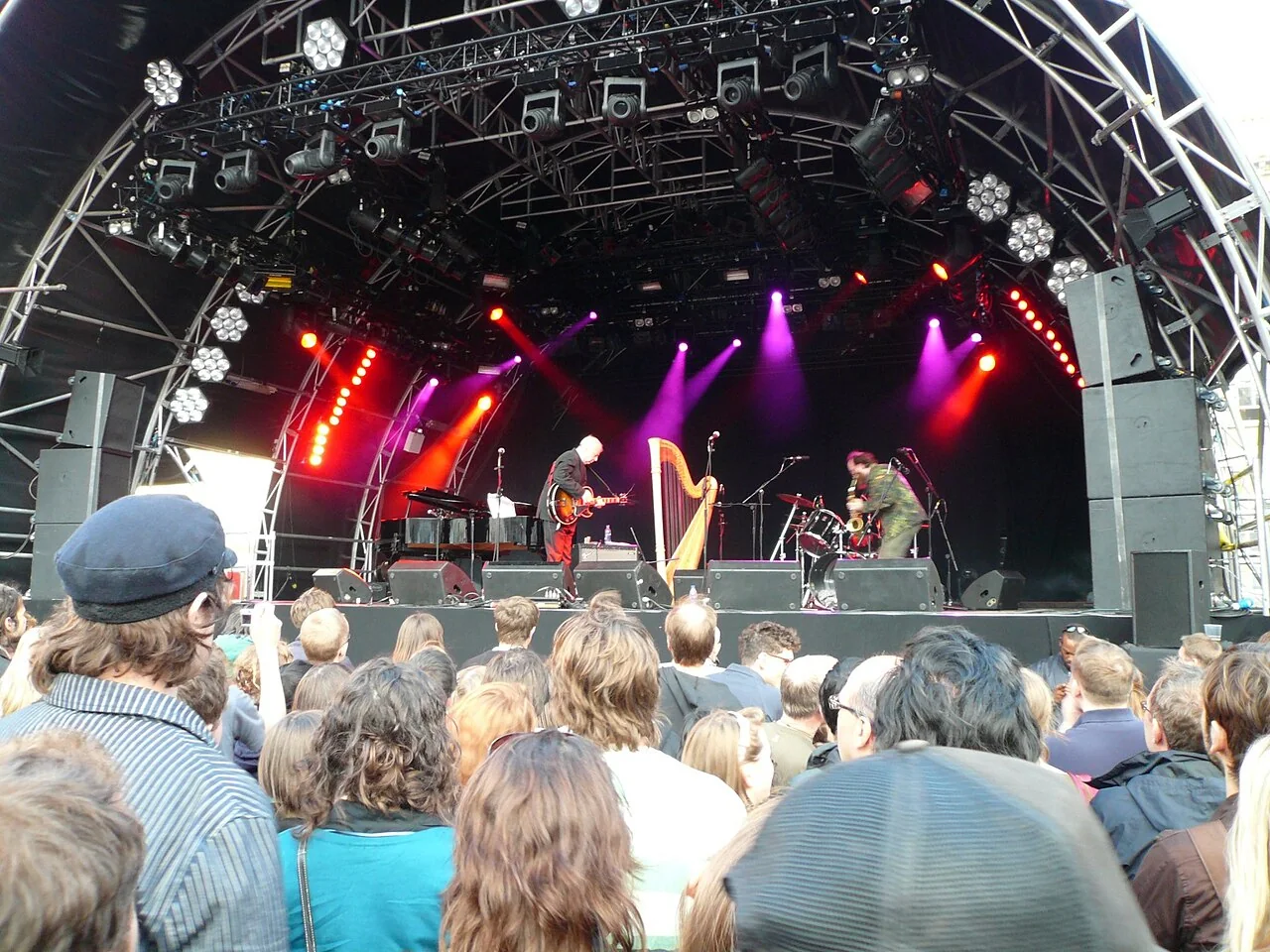
The Red Krayola performing live.Photo: psflannery / Wikimedia Commons · Licensed under CC BY 2.0. Converted to WebP for this page.
Formation & History
Thompson and Barthelme began the group after Thompson returned to Houston in 1965; bassist Cunningham completed the trio. Producer Lelan Rogers encountered them during a KNUZ battle-of-the-bands event and brought them to International Artists, also home to the 13th Floor Elevators. Roky Erickson contributed organ to “Hurricane Fighter Plane” and harmonica to “Transparent Radiation,” but the Red Crayola did not share the Elevators' commitment to psychedelic transcendence.
The Parable of Arable Land appeared in 1967. The trio then recorded the radically abstract Coconut Hotel, which International Artists declined to release; it remained shelved until Drag City issued it in 1995. Barthelme moved to New York, and Thompson returned to Houston to make God Bless the Red Krayola and All Who Sail with It with Cunningham and other musicians in 1968. The original group had effectively ended, but Thompson later revived the name.
His work with Art & Language produced Corrected Slogans in 1976. After relocating to Britain, Thompson and drummer Jesse Chamberlain re-formed the group; Soldier-Talk was recorded with contributors from Pere Ubu and Lora Logic and released by Radar in 1979. Thompson also co-produced records associated with Rough Trade and joined Pere Ubu. New Red Krayola lineups followed in Germany and the United States, with Drag City becoming the principal home for later albums and archival releases. A 2025 Los Angeles performance confirmed that the project remained active.
Sound & Style
The debut is built on collision. Thompson's wiry guitar, Cunningham's bass and Barthelme's drums give songs such as “Hurricane Fighter Plane” and “War Sucks” a recognisable frame; between them, the Familiar Ugly produces whistles, percussion, voices and non-hierarchical ensemble noise. The editing makes composition and interruption inseparable.
Coconut Hotel removes even that anchor. Sustained organ, poured water, silence, brief gestures and dozens of “One-Second Pieces” treat duration and recording itself as material. God Bless turns in the opposite direction, using very short, dryly recorded songs whose clipped structures avoid both blues-rock weight and psychedelic sprawl. The 1970s work adds political language, fractured funk, post-punk rhythm and the instrumental personalities of collaborators, while later records use art song, chamber textures and deliberately awkward rock forms. Across these phases, Thompson's thin voice and angular guitar are less a fixed style than a way of keeping arguments audible.
Essential Albums
1967
The Parable of Arable Land
International Artists · Original 1967 release
Six compact songs alternate with six numbered “Free Form Freak-Outs,” so the album never allows its garage-rock identity to settle. “Hurricane Fighter Plane” rides a lurching riff coloured by Roky Erickson's organ; “Transparent Radiation” makes Erickson's harmonica part of a looser acoustic texture; “War Sucks” turns its blunt refrain into a collision with collective noise. The Familiar Ugly passages were recorded as mass participation and then edited into the sequence, making interruption the album's central organizing device rather than an added effect.
Key tracks: Hurricane Fighter Plane · War Sucks · Former Reflections Enduring Doubt
God Bless the Red Krayola and All Who Sail with It
International Artists · Original 1968 release
After International Artists rejected the abstract Coconut Hotel, Thompson returned with a different challenge: twenty brief, spare songs with almost no psychedelic grandeur. “Say Hello to Jamie Jones” breaks off before it can become conventional pop, “Victory Garden” pares rhythm and melody down to a nursery-rhyme unease, and “Dairymaid's Lament” uses repetition without offering a stable groove. Dry production and sudden endings make the album feel composed through subtraction.
Key tracks: Say Hello to Jamie Jones · Victory Garden · Dairymaid’s Lament
Recorded as the intended follow-up to Parable, Coconut Hotel dispenses with rock songs almost entirely. “Boards” and “Free Guitar” explore sustained and unstable instrumental sound; “Water Pour” treats an ordinary action as recorded event; the sequence of tiny “One-Second Pieces” turns the limits of the LP track into a compositional problem. International Artists shelved the tapes in 1967, and their eventual 1995 release shows that the trio's most radical break occurred before God Bless, not decades later.
Key tracks: Boards · Water Pour · One-Second Pieces
Corrected Slogans (1976) is not simply a band album with political lyrics. Thompson sets texts developed with Art & Language in sparse arrangements where several voices, piano, guitar and silence expose the rhetoric of each phrase. The collaboration relocates the Red Crayola method from psychedelic performance to an argument about language, authorship and political speech.
Soldier-Talk (1979) brings that argumentative method into post-punk without becoming a conventional Rough Trade release. Thompson and Jesse Chamberlain work with Lora Logic and members of Pere Ubu; trumpet, saxophone, synthesizer and two drummers repeatedly pull the songs away from a stable guitar-band format. Originally issued by Radar rather than Rough Trade, it also clarifies Thompson's overlapping roles at the time: bandleader, collaborator, producer and later Pere Ubu member.
The Red Krayola show that the Texas psychedelic underground was not a single musical proposition. Beside the 13th Floor Elevators' drive and spiritual language, Thompson's group used interruption, anti-spectacle and humour to question who could participate and what counted as a finished piece. The early records matter not because they neatly predict punk or post-rock, but because their internal problems remain audible.
The later history prevents the debut from becoming an isolated cult object. Art & Language changed the function of the words; Soldier-Talk placed the project among musicians from post-punk and Pere Ubu; Drag City lineups connected Thompson with experimental musicians of another generation. Each phase alters the personnel and surface while preserving a refusal to let fluency, genre or professional polish settle the argument.
RetroForge Records publishes original music and independent editorial guides. This historical band guide is not affiliated with the artist, labels or rights holders. No unlicensed album artwork is reproduced.