

Edition timeline
West Coast production knowledge travels east
Tom Rounds and Mel Lawrence brought experience associated with the Fantasy Fair and Magic Mountain festival world to South Florida.
Three scheduled festival days
A contemporary notice advertised daily operation from roughly 1 p.m. to 10 p.m. and a three-day ticket costing $6 in advance or $7 at the door.
Two parallel programmes
Contemporary reporting describes two principal stages far enough apart to operate at the same time without overwhelming one another acoustically.
A model without a permanent sequel
Gulfstream Park did not become an annual festival institution, but the production demonstrated how reproducible large multi-genre rock events were becoming.
Why this event matters
The December Miami Pop Festival belongs to the rapid professionalisation of American festival culture. It should not be called the first East Coast rock festival: HistoryMiami and the Hendrix estate assign that distinction to the separate May gathering at Gulfstream Park. December’s importance is different. A production team with West Coast experience returned to the same racetrack with a much broader programme, a denser timetable and two principal stages able to operate simultaneously.
That design made the festival look less like a rare countercultural experiment and more like a large entertainment format that could be reproduced. Soul, folk, jazz, blues, psychedelic rock and foundational rock and roll shared one commercial framework. The event did not eliminate uncertainty—lineups changed, attendance remains approximate and the archive is incomplete—but it demonstrated that production knowledge was moving quickly across regions before Woodstock gave the form its most famous public image.

Before the gates opened
Tom Rounds and Mel Lawrence had backgrounds in the West Coast festival world, including experience around Fantasy Fair and Magic Mountain. Their involvement gave the December production a different starting point from the hurried May event organised by Michael Lang, Ric O’Barry and associates. They were not refining their own earlier Gulfstream festival; they were a separate team applying knowledge developed elsewhere to a venue that had already proved South Florida could attract a large youth-music audience.
The calendar was part of the business case. South Florida drew young visitors during the Christmas vacation, and contemporary trade coverage treated that seasonal movement as an audience waiting to be organised. The Liberation News Service notice preserved by Fifth Estate advertised three days running approximately from 1 p.m. to 10 p.m., with a weekend ticket priced at six dollars in advance or seven at the door. The timetable and pricing make the event concrete as a planned public operation, not only a famous poster.
Gulfstream Park, again
The same racetrack hosted two unrelated festival organisations within seven months. Gulfstream Park offered a roughly 20,000-seat grandstand, parking, road access and open areas that could be adapted for standing audiences and dancing. Those permanent assets reduced some of the work required to create a mass venue, while the surrounding meadow supplied space unavailable inside a conventional auditorium. December’s producers used the complex more systematically than the May team had been able to do on its compressed schedule.
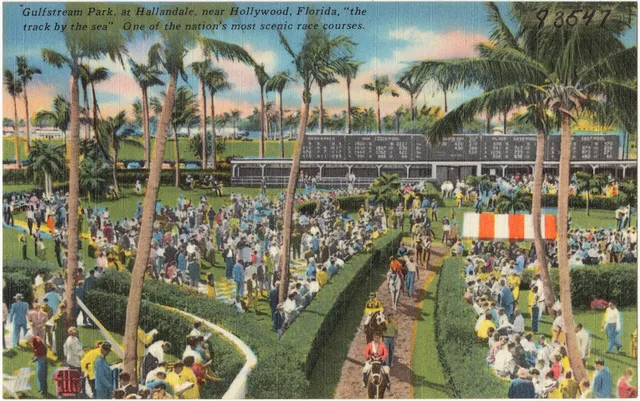
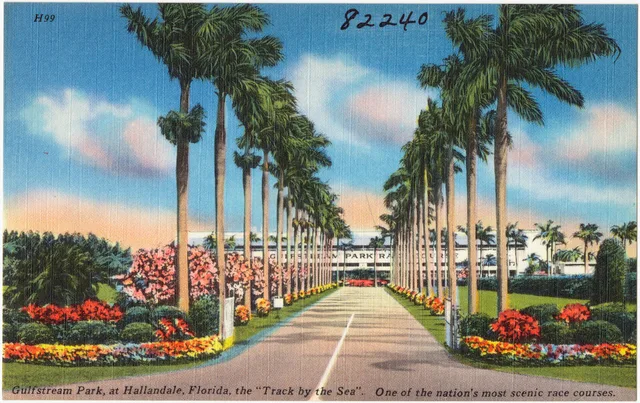
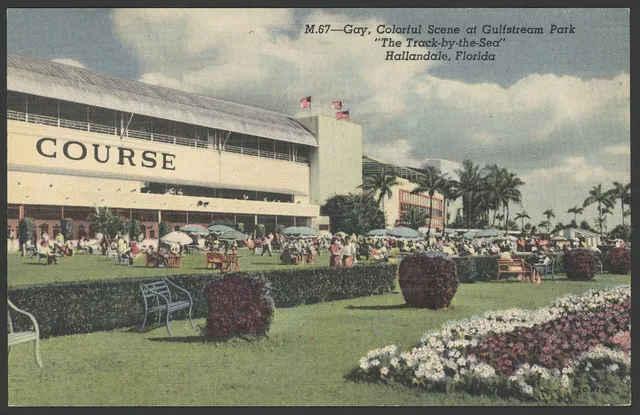
The historical photographs used here document the venue rather than the festival itself and are captioned with that limitation. The entrance, grandstand and crowd postcard show how Gulfstream already processed large public events. Rock production added two simultaneous performance zones and an audience expected to move between them. The venue was therefore both inherited infrastructure and a new temporary city layered on top of racing’s established geography.

A programme broader than rock
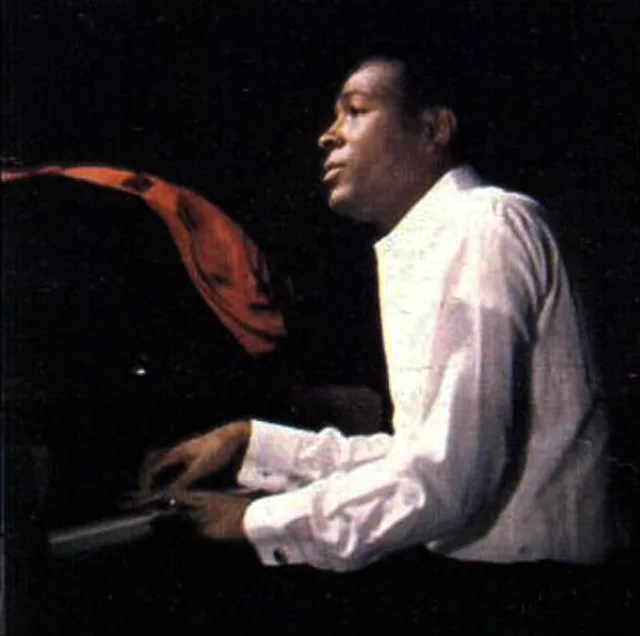
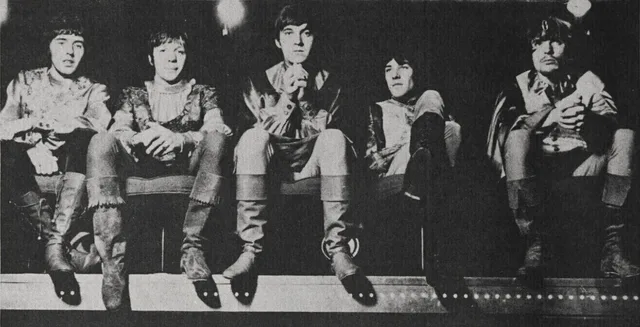
The advertised and documented programme crossed categories that later histories often separate. Grateful Dead, Steppenwolf, Procol Harum and Iron Butterfly represented several psychedelic and heavy routes. Canned Heat, Fleetwood Mac and James Cotton connected the event to electric blues. Marvin Gaye, Jr. Walker and Joe Tex brought soul and rhythm-and-blues audiences. Joni Mitchell, Richie Havens, Buffy Sainte-Marie and Ian & Sylvia carried folk and singer-songwriter traditions, while Charles Lloyd and Hugh Masekela extended the frame toward jazz.
Chuck Berry made an older rock-and-roll lineage audible inside the new festival economy. This breadth was not merely aesthetic generosity. A three-day commercial event needed reasons for different audiences to attend and remain on site. The two-stage design made those strands physically parallel: listeners could choose between simultaneous programmes instead of receiving one promoter-defined sequence. December Miami’s real innovation was therefore not the number of names but the organisation of variety at scale.
What the audience experienced
A contemporary visitor entered a racetrack complex with fixed grandstand seating, open dancing space and two musical centres. The days were advertised from early afternoon into evening rather than as an uninterrupted overnight commune. Movement mattered: a person could leave one style, cross the site and encounter another performance already underway. That choice created freedom but also inevitable loss, since simultaneous stages made it impossible to hear everything.
The experience differs from the mud-and-survival narratives that dominate memories of 1969 and 1970. December in South Florida encouraged a deliberately festive environment shaped by daylight, seasonal travel, concessions and the racetrack’s existing public facilities. That does not make the weekend frictionless. Crowd estimates are uncertain and schedules changed. It means the event’s historical character lies in circulation and programme density rather than in a single shared disaster or one mythologised headline set.

Two stages operating at once
Contemporary reporting describes one principal stage in a meadow and another in front of the grandstand, positioned far enough apart to operate simultaneously without unacceptable acoustic interference. This was not simply an A/B changeover system in which one stage remained silent while crews prepared it. Two different programmes could proceed at once. That choice increased the number of performances but multiplied the production problem: each area required sound coverage, staging, crew coordination and an audience flow that did not collapse the site between sets.
The system is historically important because later multi-stage festivals would make parallel programming ordinary. In December 1968 it still deserved explanation in trade reporting. It transformed the audience from one mass following a single running order into overlapping publics making choices. It also shifted festival memory. Eyewitnesses at different stages could later describe apparently incompatible weekends because they had, in practical terms, attended different sequences inside the same event.
Sound, lighting and production knowledge
Billboard’s contemporary coverage associated Chip Monck with staging or lighting and Hanley Sound with amplification. Their names connect Miami to the growing network of specialists who carried technical knowledge from one large event to another. Professionalisation did not mean every performance ran perfectly. It meant that festival production was becoming a recognisable field in which experienced people, scalable systems and venue planning could be assembled deliberately rather than invented from nothing each weekend.
The racetrack setting supported that effort. Permanent access, power possibilities, seating and service areas gave technicians a stronger base than an empty field, while open ground still required temporary speaker placement and sightline decisions. Two stages doubled many tasks and created new ones, including preventing one programme from masking another. December Miami shows production becoming an organising argument: technology was used not just to make music louder, but to make simultaneous cultural choice possible.
_%E2%80%93_Gay,_Colorful_Scene_at_Gulfstream_Park,_Hallandale,_Florida_front.jpg)
Advertised, scheduled and confirmed
The Liberation News Service notice printed artists day by day before the event. It is valuable primary evidence of promoter intent, ticket information and expected structure. It is not a perfect performed lineup. Late-1960s festivals regularly lost artists to travel, contracts, illness, timetable collapse or changing negotiations. Posters and advance articles can therefore establish that someone was billed without proving that the person reached a stage.
This page uses strongly documented performers and keeps broader lists tied to contemporary billing. Artist archives, photographs, recordings and reliable eyewitness records are needed to move a name from “advertised” to “confirmed to have performed.” The distinction is not pedantry. Miami’s two stages make retrospective reconstruction difficult, and the May festival’s shared venue adds another source of confusion. Careful verbs prevent an attractive poster from becoming a fictional complete history.
Attendance without false precision
Later accounts commonly estimate roughly 100,000 attendees or visits across the three days. That figure should not be read as 100,000 people simultaneously occupying a 20,000-seat grandstand. The festival also used meadow and dancing areas, and cumulative attendance can count separate daily entries rather than one peak crowd. Surviving records do not provide an audited measure that resolves every definition.
The safest conclusion is scale rather than precision. December Miami drew a large multi-day audience far beyond the fixed seats and proved that a racetrack complex could host several musical publics at once. Stating an approximate weekend total while explaining its limits is more informative than converting later recollection into a census. Festival history often inherits promotional numbers; the archive’s task is to retain the event’s magnitude without manufacturing certainty.
What happened afterward
Gulfstream Park did not become a stable annual music-festival institution. The production nevertheless fed the wider burst of American festival expansion that would dominate 1969. Promoters, technicians, artists and audiences had seen another variation work: a commercial holiday event in the Southeast, built on existing racetrack infrastructure and broad enough to combine soul, jazz, folk, blues and rock. That knowledge travelled even when the brand did not.
Alex Cooley’s later Atlanta festival story is one individual line of connection, but December Miami deserves a legacy larger than one observer’s next project. It demonstrated an organised East Coast and Southern market for a multi-stage, multi-genre programme. The shift from rare experiment toward repeatable industry was already underway. Woodstock would make festival culture symbolic; Miami had already made parts of it operational.
Recordings, photographs and surviving documents
The archive is distributed across Billboard, DownBeat, underground press, posters, advertisements, Miami newspaper photography and artist-specific recordings. No single source provides a complete neutral record. Trade coverage captures production intent; underground papers preserve visitor information and advertised lineups; photographs identify visible moments; recordings establish particular performances while leaving other stages silent. Reconstructing the festival means placing those fragments beside one another without forcing them into artificial completeness.
HistoryMiami’s later exhibition was especially useful because it presented both 1968 Gulfstream festivals while maintaining their distinction. Ken Davidoff’s photographs are important historical evidence but are not reused here without explicit compatible rights. Instead, the page combines public-domain period artist images with older public-domain venue postcards. The visual record is less perfect but legally and historically transparent: every image states what it can and cannot prove.
Two stages before the festival boom
Calling December Miami “proto-Woodstock” obscures its most forward-looking feature. Parallel programming meant the festival was already solving a problem created by its own abundance. One stage could no longer contain the desired number and range of performers without intolerable pauses or an impossible running time. Two simultaneous stages increased capacity in time rather than only in space. The audience became an active scheduler, accepting that choice always meant missing something else.
That logic would become standard in later festivals, but it also changed what a festival was. A single-stage gathering produces a temporary common canon because almost everyone hears the same sequence. A parallel festival produces several overlapping histories. December Miami anticipated the modern event as a curated network rather than one concert enlarged. Its technological achievement was inseparable from a new social experience of musical plurality.
Legacy
December Miami showed how quickly the American festival idea could mature within one year. Experienced organisers, specialist sound and lighting personnel, existing venue infrastructure and parallel stages created a framework capable of carrying remarkable stylistic range. It was still a volatile late-1960s event, not a modern standardised product, but the direction was clear. Festival culture was becoming an industry of transferable systems.
The event’s place in history depends on keeping it separate from May. The earlier festival offers a story of compressed invention, Hendrix documentation and weather-battered learning. December offers professionalisation, simultaneous stages and a broader commercial programme. Together they make Gulfstream Park a unique laboratory. Apart, each retains the organisers, audience estimates and musical logic that actually belonged to it.
Follow the festival beyond the field
Timeline
Related genres
Related band guides
Explore by sound
Essential listening
Sources and further reading
- Miami Rocks: the two 1968 Gulfstream festivalsHistoryMiami Museum · accessed 23 July 2026
- Miami Fest Adds 5 ActsBillboard, 7 December 1968 · accessed 23 July 2026
- Miami Pop Festival advance coverageDownBeat, 26 December 1968 · accessed 23 July 2026
- Miami Pop FestivalLiberation News Service / Fifth Estate, December 1968 · accessed 23 July 2026
- Miami music festivals photographic archiveMiami Herald / Flashback Miami · accessed 23 July 2026
- 1968 Miami Pop historical reconstructionThe Strip Project · accessed 23 July 2026
Image credits5 licensed images
Marvin Gaye in 1968. This public-domain publicity photograph provides period artist context and is not presented as a Gulfstream Park performance image — Tamla Records — Wikimedia Commons — Public domain · source record · Public domain
Converted to WebP and resized; no generative or compositional alterations.
Procol Harum in early 1968, providing period context for one of the groups documented at the December festival — Unknown author Unknown author This is a retouched picture , which means that it has been digitally altered from its original version. Modifications made by Dcameron814 . — Wikimedia Commons — Public domain · source record · Public domain
Converted to WebP and resized; no generative or compositional alterations.
A historical view across Gulfstream Park. It documents the racetrack environment and predates the December 1968 festival — Boston Public Library — Wikimedia Commons — Public domain · source record · Public domain
Converted to WebP and resized; no generative or compositional alterations.
The Gulfstream Park entrance in a historical postcard, showing the permanent venue through which the festival audience later arrived — Boston Public Library — Wikimedia Commons — Public domain · source record · Public domain
Converted to WebP and resized; no generative or compositional alterations.
A historical crowd scene at Gulfstream Park. It predates the rock festival and is used only to explain the venue’s existing mass-audience infrastructure — Gulf Stream Card & Distributing Co. — Wikimedia Commons — Public domain · source record · Public domain
Converted to WebP and resized; no generative or compositional alterations.