

Why this event matters
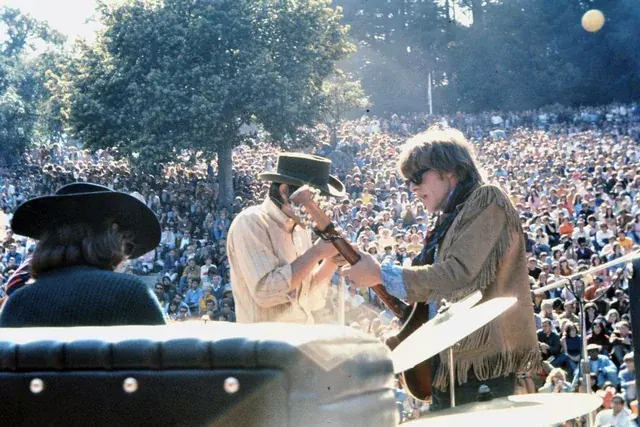
Fantasy Fair is often introduced as the festival that happened one week before Monterey Pop. The comparison is useful for dates and damaging for memory. Monterey possessed stronger film distribution, a more stable institutional archive and a story of national breakthrough. Mount Tamalpais was smaller, stranger and harder to package. Yet it assembled major San Francisco and Los Angeles groups, drew a large audience into a natural amphitheatre and treated movement, costume, stalls and visual experiment as part of the event rather than decoration around it.
Its importance lies in showing that the rock festival was not invented in one place. By June 1967, benefit concerts, radio promotion, park gatherings, folk festivals, acid-test environments and theatre were already converging. Fantasy Fair turned those practices into a weekend form. The result was neither a modern commercial festival nor a completely spontaneous happening. It was a planned charity event whose organisers relied on the cultural energy of a scene that preferred to describe itself as participatory.

A mountain site and a delayed opening
The festival was scheduled for the first weekend of June but was postponed by poor weather to 10 and 11 June. The Sidney B. Cushing Memorial Amphitheatre sat among trees on Mount Tamalpais, reached by winding roads and paths rather than the broad transport infrastructure of a fairground. Buses carried visitors from Mill Valley, and the journey became part of the experience. Arrival required time and a willingness to move through the landscape rather than simply enter a fenced concert field.
The amphitheatre’s stone seating and forest setting gave performances a visual character no temporary flatland stage could reproduce. It also constrained access and capacity. Published attendance estimates vary widely, a familiar problem for events without controlled counting. The significant fact is not a precise number but the transformation of a modest open-air theatre into a regional gathering large enough to test transport, audience circulation and the relationship between a protected landscape and mass culture.
Radio, charity and organisation
KFRC’s involvement demonstrates how commercial radio and countercultural music were already interdependent. A powerful station could publicise the event rapidly, secure performers and present the weekend as public service as well as entertainment. Proceeds were intended for the Hunters Point Child Care Center. That charitable purpose placed the festival inside a longer history of benefits in the Bay Area, where musicians regularly performed without ordinary commercial fees for political, community or practical causes.
Benefit status did not make the production immaterial. Staging, transport, sound, permissions and publicity still required professional labour. Fantasy Fair’s afterlife sometimes treats it as an innocent gathering outside business, while Monterey is cast as the moment commerce arrived. In reality, both events combined idealism with media systems. The difference was in scale, documentation and the degree to which each production could control the story that followed.

The programme crosses scenes
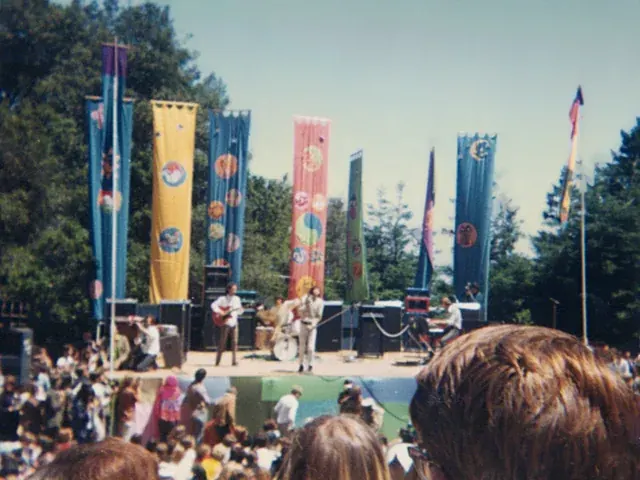
Jefferson Airplane, Country Joe and the Fish and Canned Heat connected Fantasy Fair to northern California’s club and ballroom culture. The Doors, The Byrds, The Seeds and Blues Magoos brought Los Angeles and garage-rock currents. Dionne Warwick, Tim Buckley, Every Mother’s Son and other performers prevented the bill from becoming a narrow summary of San Francisco psychedelia. The schedule was a snapshot of a market and a culture before genre labels had settled.
That breadth matters because later histories often arrange 1967 into separate shelves: psychedelic rock, soul, folk rock, blues revival and pop. Festival programmes were messier. Audiences heard established vocal craft beside amplified improvisation, short singles beside longer forms and regional stars beside musicians approaching national visibility. The weekend’s historical value comes partly from that friction. It records what could share a stage before radio formats and rock criticism made the categories feel permanent.
Designing participation
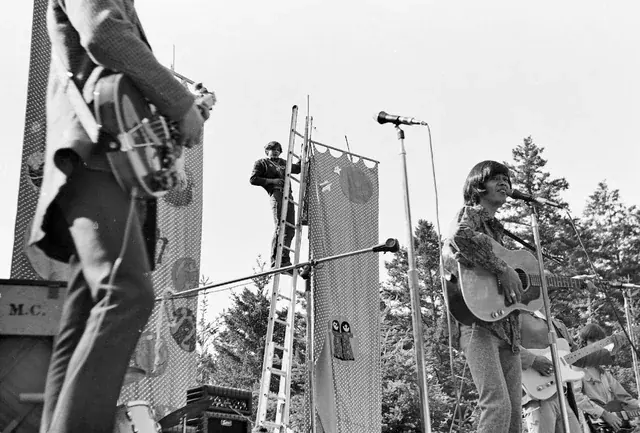
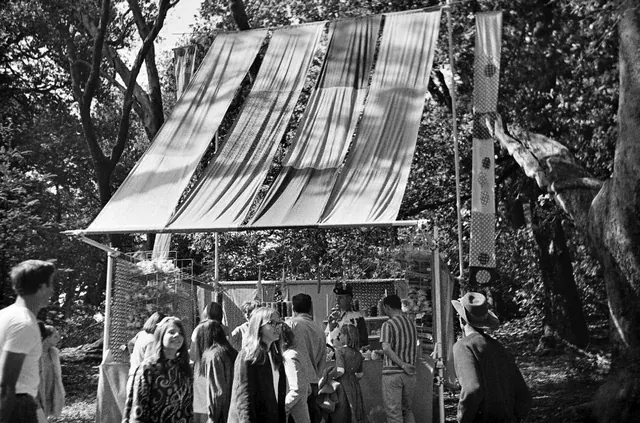
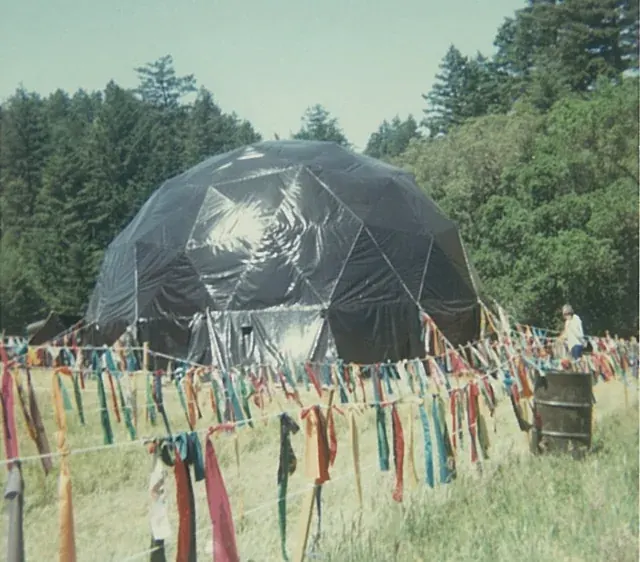
Surviving photographs show a geodesic dome, decorated backdrops, stalls, unusual clothing and people occupying spaces beyond the formal seating. These details are not proof that everybody shared one utopian consciousness. They do show that the event’s visual language encouraged visitors to see themselves as participants in a temporary environment. The distinction between audience and attraction was deliberately softened. What people wore, built and sold became part of the weekend’s public image.
The design vocabulary drew from broader experiments in lightweight architecture, craft, theatre and communal living. A dome could function as shelter and as a symbol of a future assembled by its users. Handmade decoration rejected the neutral efficiency of the arena. At the same time, photographs preserve the most visibly unusual elements and may overstate how completely they defined the crowd. The archive selects spectacle; ordinary waiting, work and discomfort leave fewer memorable images.

Sound, sight and incomplete evidence
Unlike Monterey, Fantasy Fair did not become universally familiar through a widely distributed concert film. Its archive is dispersed among private photographs, press pages, radio histories, recordings of uncertain completeness and later recollections. That fragmentation makes confident reconstruction difficult. Running orders differ, attendance estimates expand or contract, and repeated claims can begin to look like primary evidence simply because they appear on many websites.
The photographs by Bryan Costales and other surviving images are especially valuable because they show relationships: performers inside the amphitheatre, the scale of painted surfaces, people at stalls and the physical intimacy of the site. They still require careful captions. One frame cannot establish how the whole weekend felt, and a later scan or digital repair is not the same thing as an untouched original. Visible provenance allows the image to inform the article without pretending to settle every question.
Before Monterey, after the Human Be-In
Fantasy Fair followed the Human Be-In in Golden Gate Park and immediately preceded Monterey Pop. It therefore sits inside a rapid sequence through which the Bay Area’s local practices became international media. The Be-In demonstrated the power of a free urban gathering. Fantasy Fair tested a ticketed benefit in a dramatic landscape. Monterey joined artist organisation, professional staging and documentary film at a level capable of launching careers across borders.
Calling Fantasy Fair the first rock festival can be tempting, but “first” depends on definitions. Earlier jazz and folk festivals, multi-act rock events and outdoor benefits all supplied parts of the form. Its more defensible distinction is as one of the earliest American weekends to bring psychedelic rock, large youth attendance, participatory visual culture and a natural amphitheatre into a recognisably modern festival experience. That achievement does not require erasing predecessors.

Legacy
Fantasy Fair did not become an annual institution. The site, the charity structure and the unusual concentration of June 1967 could not simply be repeated. Its influence is therefore hard to measure as a direct organisational line. What survives is a model of the festival as temporary world: part concert, part fair, part journey and part visual experiment. Later gatherings expanded that model, sometimes with far greater infrastructure and sometimes while claiming to reject infrastructure altogether.
Remembering Mount Tamalpais restores uncertainty to the standard Summer of Love chronology. Musical culture did not wait for one definitive weekend to announce itself. It appeared through overlapping events, local radio, benefits, clubs and people carrying ideas between them. Fantasy Fair was one of those crossings—brief, imperfectly documented and important precisely because history did not yet know which festival it would choose as the symbol.
Follow the festival beyond the field
Timeline
Related genres
Related band guides
Explore by sound
Essential listening
RetroForge Echo
Hear a Fictional Archive Response
These modern RetroForge releases echo part of the festival’s musical vocabulary; they are not historical festival recordings.
Sources and further reading
- KFRC Fantasy Fair and Magic Mountain Music FestivalSan Francisco Chronicle · accessed 23 July 2026
- From the Archive: A glorious weekend on the mountainSan Francisco Chronicle · accessed 23 July 2026
- Fantasy Fair image archiveWikimedia Commons · accessed 23 July 2026
- Mount Tamalpais and the Mountain TheaterCalifornia State Parks · accessed 23 July 2026
- Fantasy Fair and the festivals before WoodstockThe Museum at Bethel Woods · accessed 23 July 2026
- Fantasy Fair contemporary coverageBillboard / World Radio History · accessed 23 July 2026
Image credits5 licensed images
Grace Slick, Marty Balin and Paul Kantner of Jefferson Airplane at Fantasy Fair — Bryan Costales ©2009 Bryan Costales, licensed CC BY-SA 3.0 — Wikimedia Commons — CC BY-SA 3.0 · source record · CC BY-SA 3.0
Converted to WebP and resized; no generative or compositional alterations.
The decorated stage environment at Fantasy Fair shows how performance, handmade visual culture and landscape were treated as one experience — Bryan Costales ©2009 Bryan Costales, licensed CC BY-SA 3.0 — Wikimedia Commons — CC BY-SA 3.0 · source record · CC BY-SA 3.0
Converted to WebP and resized; no generative or compositional alterations.
A candle booth among the Fantasy Fair crowd — Bryan Costales ©2009 Bryan Costales, licensed CC BY-SA 3.0 — Wikimedia Commons — CC BY-SA 3.0 · source record · CC BY-SA 3.0
Converted to WebP and resized; no generative or compositional alterations.
The Doors at Fantasy Fair in June 1967 — JustRadley — Wikimedia Commons — Public domain · source record · Public domain
Converted to WebP and resized; no generative or compositional alterations.
A geodesic dome at Fantasy Fair — LaMont R DeBarbieri — Wikimedia Commons — CC BY-SA 4.0 · source record · CC BY-SA 4.0
Converted to WebP and resized; no generative or compositional alterations.