

Edition timeline
Three weeks to build a festival
Bethel Woods records that Michael Lang and Ric O’Barry assembled the production on an exceptionally compressed schedule.
Two Hendrix performances
The Jimi Hendrix Experience played two shows, recorded by Eddie Kramer, alongside a broad psychedelic, blues and heavy-rock programme.
Torrential weather
Severe rain cancelled the second day’s electric programme and exposed the financial and technical vulnerability of the improvised event.
The archive returns
Authorised Hendrix audio appeared as Miami Pop Festival, while separately uncovered colour footage entered the documentary Hear My Train A Comin’.
Why this event matters
The May 1968 Pop and Underground Festival belongs between Monterey and Woodstock, but it should not be treated merely as a rehearsal for a more famous event. HistoryMiami and the Hendrix estate identify it as the East Coast’s first major rock festival, a claim best kept attributed because later accounts sometimes assign similar language to the separate December gathering at Gulfstream Park. What is secure is that Miami tested the young festival form in a new region, climate and commercial racetrack environment.
Its independent importance lies in the combination of ambition and fragility. A headline artist at a creative peak, several temporary stages, plans for sound and film recording and a crowd estimated around 25,000 all suggested a new scale of popular culture. Yet the production had been assembled in weeks, and one tropical storm could cancel much of the plan. The weekend made visible both the promise of mass outdoor rock and the systems it still lacked.

Before the gates opened
Michael Lang was connected to the countercultural life of Coconut Grove; Ric O’Barry and Marshall Brevetz were among the associates who helped turn an idea into an event. Monterey Pop supplied an influential recent model, but South Florida was not Northern California. The organisers had to recruit artists, secure Gulfstream Park, arrange stages, sound, transport and publicity, and imagine how a new audience would use a racetrack during a humid May weekend.
Bethel Woods states that Lang and O’Barry assembled the festival in only three weeks. That compressed schedule explains more than the event’s rough edges. It shows how little permanent festival-production knowledge existed to purchase off the shelf. Stages were mounted on flatbed trucks, film and audio ambitions were added, and contingency planning remained thin. Miami was a prototype built under pressure rather than a standard touring package installed at another stop.
A racetrack becomes a festival ground
Gulfstream Park already possessed parking, access roads, grandstand infrastructure and experience moving large crowds. Those advantages made it attractive, but horse racing and an outdoor rock festival organise people differently. A racing audience faces a fixed course from established seating; a festival audience moves among stages, open ground, concessions and social space. The venue had to be reinterpreted around amplified performance and a public whose behaviour local authorities and newspapers were still learning to read.
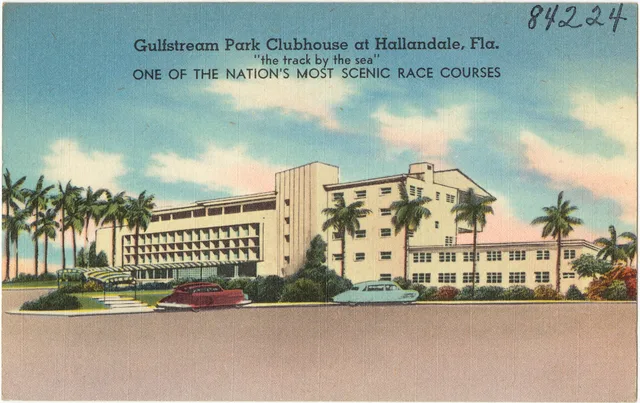
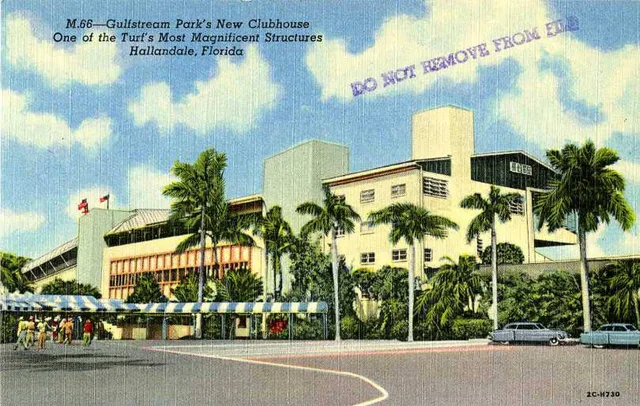
The historical postcards on this page predate 1968 and are labelled accordingly. They show the permanent clubhouse and grandstand environment into which temporary flatbed stages were introduced. That contrast matters. Miami Pop was neither a wholly unstructured field nor a conventional arena concert. It borrowed crowd-handling assets from a commercial racetrack while improvising the parts—multiple performances, festival movement and youth-culture space—that the venue had never been designed to supply.

The musical programme
The Jimi Hendrix Experience was the central attraction, but the documented bill placed Hendrix inside a wider late-1960s mixture. The Mothers of Invention represented compositional satire and underground theatre; Arthur Brown brought visual shock and psychedelic performance; Blue Cheer pushed electric blues toward extreme volume; John Lee Hooker connected the new festival audience to a deeper blues lineage; Chuck Berry represented foundational rock and roll. The programme was eclectic because the festival market had not yet divided these audiences cleanly.
Lineup language remains important. Sources document performers, advertisements record intentions and later memories sometimes merge the May event with the much larger December Miami Pop Festival. This page uses artists supported by the institutional and Hendrix archives and avoids importing names from December. The reciprocal link between the two pages is not an afterthought: it is part of correcting a persistent historical error created by the shared Gulfstream Park setting.
Hendrix on 18 May
Travel delays meant Hendrix reached Gulfstream Park by helicopter, adding urgency to an already compressed production. The Experience played two shows on 18 May. Eddie Kramer had been flown in specifically to record the group, evidence that organisers and the artist’s team understood a festival performance as something that might live beyond the field. The authorised archive identifies first recorded stage performances of “Hear My Train A Comin’” and “Tax Free” among the surviving material.
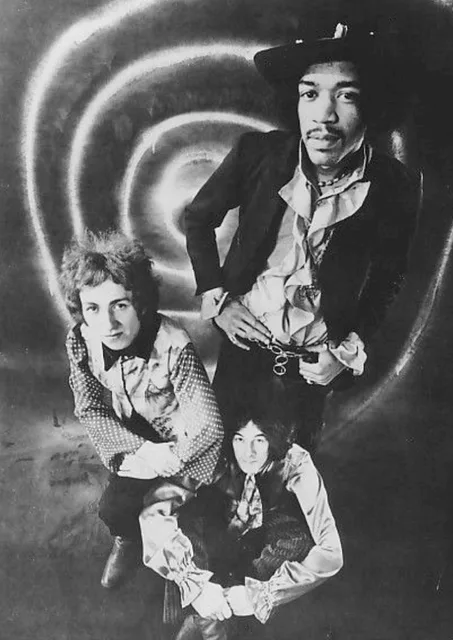
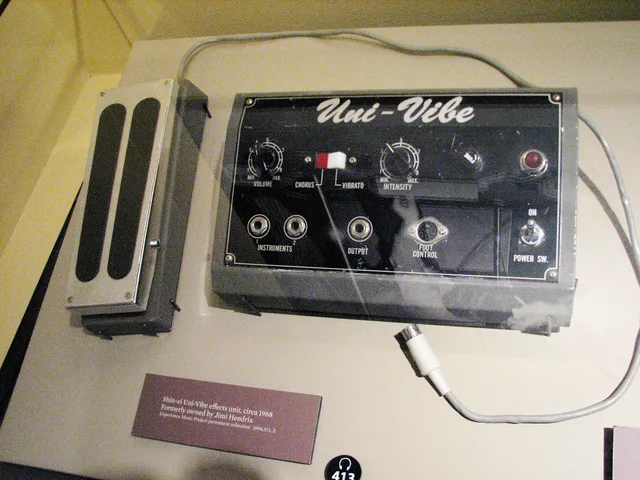
The performance should not be narrated through hindsight alone. Hendrix was already a headline figure, but nobody at Gulfstream knew exactly which parts of the weekend would survive or how valuable they would later become. The public-domain 1968 publicity photograph used as the hero provides period context rather than pretending to show the Miami stage. The effects-unit image similarly explains the changing technological language around Hendrix without claiming that the photographed object was used at this event.
.jpg)
What the audience experienced
South Florida heat and humidity shaped the first day before rain transformed the second. The audience moved through an event built rapidly on an exposed racetrack site, encountering music, open ground and the unfamiliar social scale of thousands of young people gathered outside conventional theatre rules. Bethel Woods preserves local press reactions that ranged from anxiety about an invasion of “hippies” to bemused recognition that the crowd appeared more orderly than expected.
That reaction places the event inside a surrounding community rather than an isolated counterculture bubble. Residents, officials and newspapers were interpreting clothing, hair, traffic and public behaviour as signs of a social change whose conventions were not yet familiar. For participants, the weekend could move from heat and anticipation to uncertainty as the weather intensified. The atmosphere was not Woodstock’s later myth in miniature; it was its own South Florida encounter between youth culture, commerce and climate.
Stage, sound and the attempt to preserve the event
Bethel Woods describes three stages built on flatbed trucks. The arrangement made rapid construction possible and allowed more than one performance area without permanent building work. It also exposed how improvised the production model remained. Temporary platforms, power, cables and sound equipment had to operate under heat and then severe rain. The festival’s physical design was ambitious enough to attract a major crowd but vulnerable to conditions a purpose-built indoor venue could exclude.
Recording and filming added another layer. Eddie Kramer’s dedicated audio work for Hendrix created a professional document even as the wider event struggled. Plans involving ABC-TV film demonstrate the organisers’ media ambition, but the archive later became tangled in financial collapse and seizure. Miami therefore anticipates a central festival-history problem: the live event, the production that records it and the later ownership of those records can follow very different paths.
,_Jimi_Hendrix,_EMP_Museum.jpg)
When the weather ended the plan
Torrential weather cancelled the second day’s electric programme. The cancellation should not be inflated into a catastrophe on the scale of later festival failures. Its significance is more precise. An event built around exposed electrical performance systems had little resilience when tropical rain made the site unsafe and unworkable. Artists, audience and organisers could not simply move into an equivalent indoor space. The programme stopped because the production form had reached its practical boundary.
Lang later recalled that Miami had been experiencing a prolonged dry spell and that costly rain insurance had not been purchased. The storm therefore struck finances as well as scheduling. On the drive back from Gulfstream Park after the cancellation, the official Hendrix archive says Hendrix began writing “Rainy Day, Dream Away.” That creative afterlife is evocative, but it should not romanticise the losses borne by a young organisation whose principal contingency had failed.
What happened afterward
Hendrix archival material describes severe financial consequences and the seizure of recordings and film associated with the failed promotion. Michael Lang nevertheless carried experience from Miami into later festival work. He would describe the event as a place where the seeds of Woodstock were sown. The phrase is historically useful as Lang’s own retrospective interpretation, not as an objective verdict that reduces every Miami decision to a future event in New York.
The lessons were practical: stages, artist movement, documentation, weather exposure, insurance, crowd behaviour and the relationship between a festival and its surrounding community. Some lessons came from what worked, others from failure. Miami’s influence therefore lies less in a transferable visual template than in experience accumulated under pressure. The event showed that a major audience existed and that enthusiasm alone could not make a temporary city technically or financially resilient.
Recordings, missing film and newly uncovered footage
Experience Hendrix records that Eddie Kramer’s tapes and ABC-TV film material were seized after the promoters’ collapse and describes the whereabouts of that film as unknown. The audio followed a recoverable path: authorised performances were issued in 2013 as Miami Pop Festival. The release matters beyond nostalgia because it preserves the Experience in a specific early-festival context and documents material developing onstage before later canonical versions shaped public memory.
A separate archive story must not be collapsed into the missing ABC material. Experience Hendrix announced newly uncovered colour footage from Miami for the 2013 documentary Hear My Train A Comin’. The official sources do not establish that this rediscovered film is the same material earlier described as seized and missing. Keeping those chains separate avoids turning “footage survives” into a false solution to a more complicated provenance problem.
Two Miami festivals, one persistent confusion
Gulfstream Park hosted another large music festival from 28 to 30 December 1968. The shared venue and the later widespread use of “Miami Pop Festival” for both events have encouraged lineups, organisers and attendance estimates to migrate between them. The May production was associated with Lang, O’Barry and Brevetz, was advertised as the 1968 Pop and Underground Festival or 1968 Pop Festival, centred heavily on Hendrix and lost most of its second day to weather.
The December event was led by Tom Rounds and Mel Lawrence, ran for three days, used two main stages simultaneously and presented a much larger programme. It has its own page in this archive. Reading the events together is valuable because seven months separate two stages of festival development at the same racetrack. Merging them destroys that evidence. Their difference shows how quickly the American festival model expanded and professionalised during 1968.
Legacy
Miami’s legacy combines practical learning, Hendrix documentation and Michael Lang’s later role in Woodstock. HistoryMiami’s exhibition and the Bethel Woods account have helped restore the event as more than a footnote. The official recordings give it an unusually strong musical afterlife, while the missing and rediscovered film histories demonstrate how incomplete even a famous artist’s archive can remain.
The festival also complicates simple origin stories. Large-scale rock culture did not travel from Monterey directly to Woodstock without experiments in between. At Gulfstream Park, organisers tested a racetrack, temporary stages, media recording and a broad electric bill under a climate that defeated their second day. The event mattered because it generated both possibility and failure—and because people carried knowledge from each into what came next.
Follow the festival beyond the field
Timeline
Related genres
Related band guides
Explore by sound
More routes will be connected as the archive grows.
Essential listening
Sources and further reading
- Hendrix in the Heat: The May 1968 Miami Pop FestivalBethel Woods Center for the Arts · accessed 23 July 2026
- Miami Rocks: The Miami Pop Festival, May 1968HistoryMiami Museum · accessed 23 July 2026
- 18 May 1968 Miami Pop Festival event recordExperience Hendrix · accessed 23 July 2026
- Miami Pop Festival archive materialExperience Hendrix · accessed 23 July 2026
- Miami Pop Festival 2013 releaseLegacy Recordings · accessed 23 July 2026
- Hear My Train A Comin’ documentary and Miami release announcementExperience Hendrix · accessed 23 July 2026
Image credits5 licensed images
The Jimi Hendrix Experience in 1968. This public-domain publicity photograph provides period artist context and is not presented as a Gulfstream Park performance image — Reprise Records — Wikimedia Commons — Public domain · source record · Public domain
Converted to WebP and resized; no generative or compositional alterations.
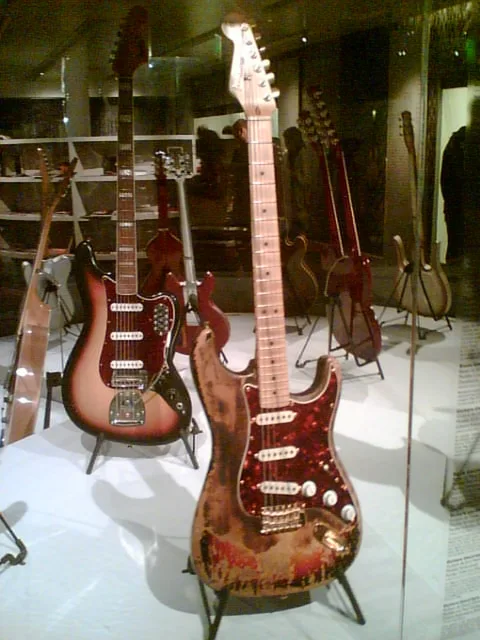
A burned Fender Stratocaster attributed by its source record to Hendrix’s May 1968 Miami performance and later associated with Frank Zappa — Von-zoid — Wikimedia Commons — CC BY-SA 3.0 · source record · CC BY-SA 3.0
Converted to WebP and resized; no generative or compositional alterations.
A historical postcard view of Gulfstream Park. It predates the festival and documents the racetrack environment rather than the May 1968 crowd — Boston Public Library — Wikimedia Commons — Public domain · source record · Public domain
Converted to WebP and resized; no generative or compositional alterations.
Gulfstream Park’s clubhouse and grandstand in a historical postcard, showing permanent racetrack infrastructure later adapted for festival use — Unknown author Unknown author — Wikimedia Commons — Public domain · source record · Public domain
Converted to WebP and resized; no generative or compositional alterations.
A 1968 Shin-ei Uni-Vibe associated with Hendrix, representing the effects technology behind his rapidly evolving live sound — ~Jen~ from Victoria BC, Canada — Wikimedia Commons — CC BY 2.0 · source record · CC BY 2.0
Converted to WebP and resized; no generative or compositional alterations.