

Why a decade-long view matters
Pinkpop's importance cannot be explained by one legendary weekend. Its achievement was repetition. From 1970 onward, organisers returned on Pentecost Monday, learned what the site and audience required, adjusted the programme and turned a regional initiative into a durable Dutch institution. That annual rhythm separates Pinkpop from the many ambitious European festivals that vanished after debt, conflict or one overwhelming crowd.
A series article also prevents one edition from being forced to represent the whole decade. The early bills grew from beat, blues, progressive and hard-rock culture. Later editions responded to changing touring economics and the arrival of punk and new wave. Pinkpop remained recognisable because the date, name and relationship with its audience held while the sound around them changed.

The first edition in 1970
The first Pinkpop took place on 18 May 1970 at Sportpark Burgemeester Damen in Geleen. The name joined “pinksteren,” the Dutch word for Pentecost, to pop music. Jan Smeets became the festival's defining organiser, but its creation depended on a wider local team and the existing Limburg music circuit. Official archives list a bill combining Dutch and international acts rather than a miniature copy of an American festival.
The one-day format imposed discipline. Pinkpop did not ask an audience to establish a week-long temporary society. It offered a concentrated programme on a public holiday and sent people home afterward. That reduced some logistical exposure while creating its own pressure: efficient changeovers, clear transport and a running order capable of carrying momentum across one day.
Geleen and the Limburg setting
Pinkpop emerged in Limburg, away from the Dutch media centre of Amsterdam. The region's industrial history, cross-border position and local youth culture shaped its audience. Belgium and Germany were close; touring routes could cross national borders without making Geleen a remote endpoint. The festival's location challenged the assumption that durable Dutch pop institutions had to begin in the Randstad.
Sportpark Burgemeester Damen provided a recurring, legible site. Returning to the same ground allowed practical knowledge to accumulate: where a stage worked, how crowds entered, what local services expected and how weather affected movement. Festival history is often written through line-ups, but this quiet memory of place is one reason an event survives.

The changing programme
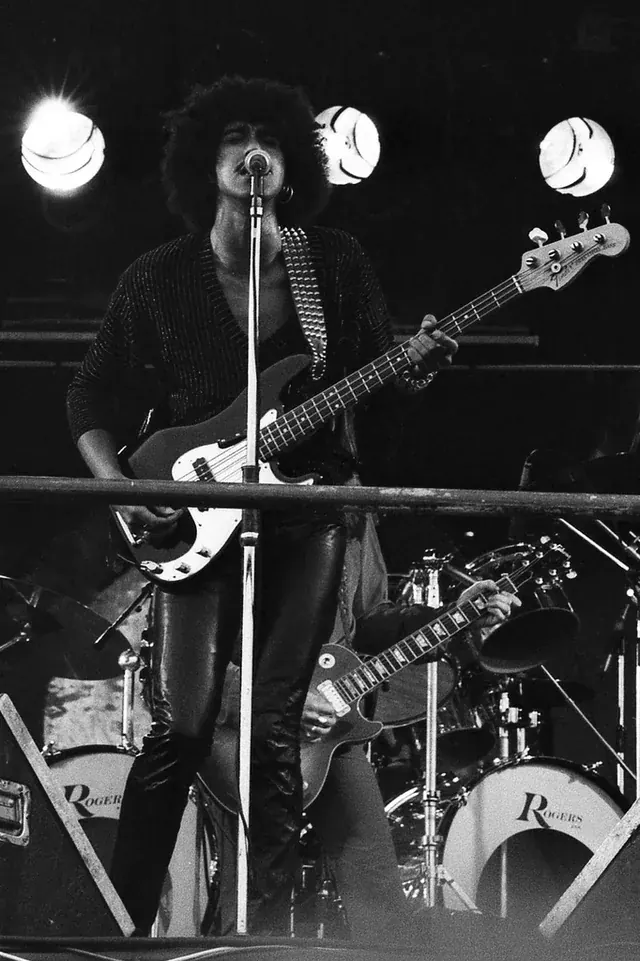
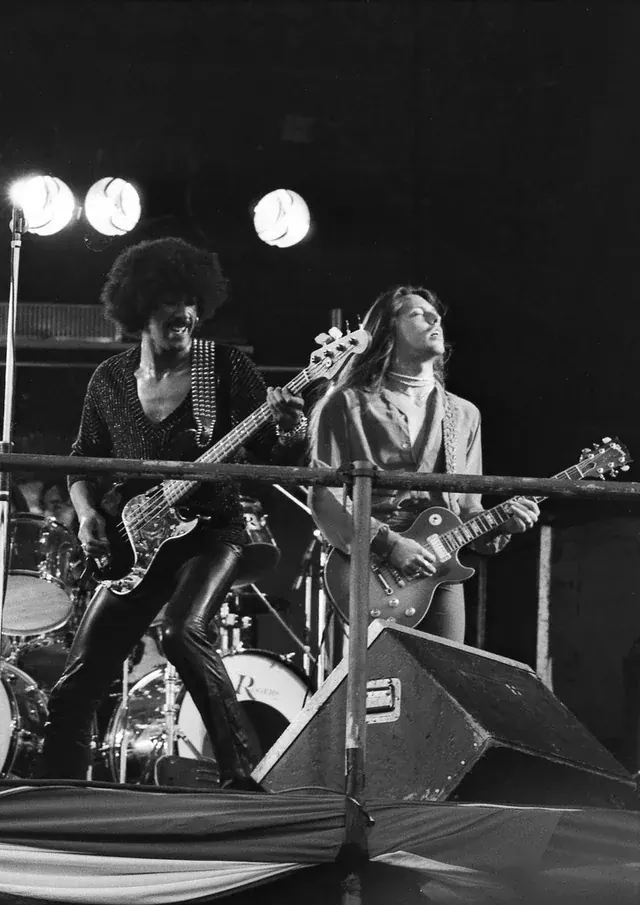
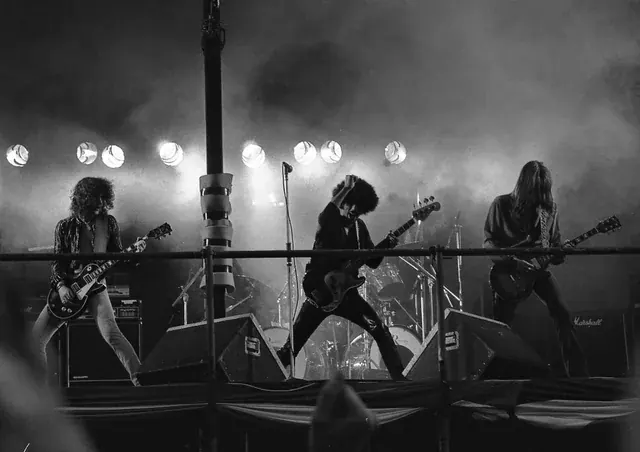
The decade brought Dutch groups into contact with touring British, Irish and American artists. Golden Earring and other national acts appeared within a programme increasingly associated with blues-derived guitar music, hard rock and progressive scale. Rory Gallagher's direct electric blues, Uriah Heep's organ-heavy weight, Status Quo's rhythmic economy and later Thin Lizzy's twin-guitar hard rock represented different ways to command a festival field.
Selective examples are more useful than a copied lineup dump. Every annual bill contained cancellations, running-order realities and artists whose later fame distorts how they were perceived at the time. The official edition archive should be used when checking an exact appearance. The broad pattern is clear: Pinkpop learned to book recognisable international acts while retaining space for Dutch music and emerging directions.
Progressive and heavy rock in the open air
Progressive rock at a one-day festival faced a practical test. Long compositions, keyboard systems and dynamic arrangements had to fit shared changeovers and an audience not gathered for one band's complete world. Groups that succeeded could translate album-scale ambition into a direct public performance. The result was often less delicate than the studio record but more revealing about rhythmic construction and ensemble control.
Heavy rock solved the field differently, through amplified riffs, physical pulse and strong visual focus. Pinkpop's seventies identity grew partly from the productive overlap between these languages. Hard rock could contain progressive instrumentation; progressive groups could generate considerable weight. The festival audience did not always obey the fine distinctions later used by record guides.

Audience, weather and practical culture
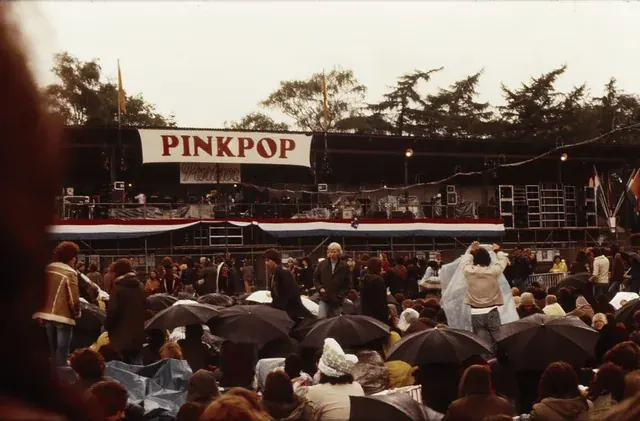
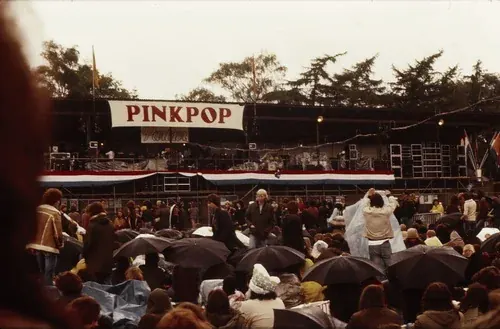
The surviving 1978 photographs show umbrellas, coats, temporary structures, flags and a stage waiting or working through ordinary festival weather. They are valuable because they resist the polished montage. An annual event is made from queues, wet ground, food, toilets, meeting points and long stretches between the moments later selected for broadcast.
Pinkpop's audience also developed memory across editions. Returning visitors compared sound, organisation and atmosphere. Local newspapers and radio could treat the festival as a recurring civic event rather than an inexplicable invasion. That relationship was not free of conflict, but recurrence gave organisers a chance to answer criticism instead of abandoning the name.
Recording the early years
Ruud van Wersch filmed the first editions at the organisers' request, creating a moving-image record from 1970 through 1974. Later television and radio coverage expanded the archive. As with every festival document, the surviving material is selective: camera position, tape cost, broadcast priorities and artist permissions determine what remains easy to see.
Pinkpop's own historical website is therefore unusually valuable. It organises edition pages, posters, memories and video links around the festival's internal chronology. It should still be checked against broadcaster, newspaper and personal archives. An official archive knows its history deeply, but it also tells that history from the perspective of the continuing institution.

Punk, new wave and the end of the decade
By the late seventies, punk and new wave disrupted the assumptions of progressive and classic rock. Pinkpop did not need to erase its earlier audience in order to respond. The Police's 1979 appearance is one useful marker of a faster, leaner, media-aware musical environment entering the programme. The shift was not instantaneous, and hard rock remained powerful, but the festival could no longer behave as if the early-seventies hierarchy would last indefinitely.
That adaptability became institutional strength. A festival tied too narrowly to one generation ages with it. Pinkpop's annual structure forced repeated decisions about the present: which established acts still mattered, which newer audiences were arriving and how much change the event's identity could absorb.
Legacy
Pinkpop eventually moved to Baarlo for one edition and then to Megaland in Landgraaf, expanding far beyond its Geleen form. The seventies nevertheless established the essential practice: one recognisable annual meeting point connecting Limburg to international touring culture. Continuity was not glamorous, but it became historic.
For RetroForge, Pinkpop offers a Dutch counterweight to the usual Anglo-American festival map. It shows live culture becoming permanent through local organisation rather than one mythic explosion. Its story belongs to venues, volunteers, filmers and returning audiences as much as to the names printed largest on each poster.
Annual return also created an unusually useful historical sequence. Posters, television reports, photographs and audience memories can be compared year by year rather than forced into a single legendary weekend. Changes in clothing, stage height, sound equipment, sponsorship and international booking become visible as ordinary evolution. Pinkpop’s archive shows how rock culture settled into civic calendars while still presenting itself as a temporary escape from them.
That history is especially valuable outside the English-language festival canon. Dutch broadcasting, regional newspapers and local collections preserve perspectives that disappear when international rock history is written only from London, New York or California. Pinkpop connected Limburg to those circuits without becoming culturally interchangeable with them. Its continuity belongs to a specific public holiday, region and organisational tradition. That local foundation is the reason international expansion did not erase the festival’s recognisable Dutch identity.
Follow the festival beyond the field
Timeline
Related genres
Related band guides
Explore by sound
Essential listening
RetroForge Echo
Hear a Fictional Archive Response
These modern RetroForge releases echo part of the festival’s musical vocabulary; they are not historical festival recordings.
Sources and further reading
- Pinkpop 1970 edition archivePinkpop History · accessed 23 July 2026
- Pinkpop 1974 edition archivePinkpop History · accessed 23 July 2026
- Het collectieve geheugen van PinkpopPinkpop History · accessed 23 July 2026
- Pinkpop historical documentPinkpop.org archive · accessed 23 July 2026
- Er was hier helemaal niets en toen kwam PinkpopNOS · accessed 23 July 2026
Image credits5 licensed images
Pinkpop in 1978 — Rob Hauer — Wikimedia Commons — CC BY-SA 3.0 · source record · CC BY-SA 3.0
Converted to WebP and resized; no generative or compositional alterations.
Festivalgoers at Pinkpop in 1978, eight years after the first event and during the festival's ninth edition at Geleen's Sportpark Burgemeester Damen — Rob Hauer — Wikimedia Commons — CC BY-SA 3.0 · source record · CC BY-SA 3.0
Converted to WebP and resized; no generative or compositional alterations.
Phil Lynott with Thin Lizzy at Pinkpop in 1978 — Chris Hakkens — Wikimedia Commons — CC BY-SA 2.0 · source record · CC BY-SA 2.0
Converted to WebP and resized; no generative or compositional alterations.
Phil Lynott and Scott Gorham at Pinkpop in 1978, photographed during a period when the programme mixed established rock with newer currents — Chris Hakkens — Wikimedia Commons — CC BY-SA 2.0 · source record · CC BY-SA 2.0
Converted to WebP and resized; no generative or compositional alterations.
Thin Lizzy's 1978 lineup at Pinkpop — Chris Hakkens — Wikimedia Commons — CC BY-SA 2.0 · source record · CC BY-SA 2.0
Converted to WebP and resized; no generative or compositional alterations.