

Overview
Rush formed in Willowdale, Toronto, in August 1968. Alex Lifeson and drummer John Rutsey were in the original trio; bassist Jeff Jones was quickly replaced by Geddy Lee. After the self-financed debut reached an audience through Cleveland radio, Neil Peart replaced Rutsey in July 1974. Lee, Lifeson and Peart then remained the complete lineup through the band's final concert in Los Angeles on 1 August 2015.
The catalogue does not follow one fixed progressive-rock formula. The long narratives of 2112 and Hemispheres give way to tighter structures on Permanent Waves and Moving Pictures; synthesizers and electronic percussion reshape the 1980s records; Counterparts restores a heavier guitar-bass-drum foreground. Continuity comes from the trio's division of labour and willingness to redesign its arrangements.
Formation & History
The debut Rush was recorded cheaply in Toronto and issued on the band's Moon label in March 1974. Its hard-rock framework reflects Lee and Lifeson's writing with Rutsey. Peart joined before the first American tour and became the principal lyricist from Fly by Night onward. After the commercially difficult Caress of Steel, the label advised against another concept record; the trio nevertheless built the first side of 2112 as a seven-part dystopian suite. Its success gave them room to extend that method on the two Rockfield albums, A Farewell to Kings and Hemispheres.
From 1980 the band shortened many songs without simplifying the playing. Moving Pictures, recorded at Le Studio in late 1980, reached number three in both the United States and the UK. The following decade shifted more arranging weight to keyboards, sequencers and electronic drums before the 1990s albums moved guitars forward again. Rush released its final studio album, Clockwork Angels, in 2012. The R40 tour ended in 2015; Peart retired from music and died in January 2020.
Sound & Style
Rush's arrangements begin with practical limits: three players must cover bass, guitar, drums, vocals and increasingly keyboards without losing momentum. Lee's bass often carries the moving melodic line while he sings; Taurus pedals and later synthesizers add sustained harmony. Lifeson alternates open chords, arpeggios, acoustic colour and compact solos rather than filling every space. Peart's parts combine precise subdivisions with large-scale cues that announce transitions between sections.
The balance changes by period. On Hemispheres, guitar synthesizer, Minimoog, Oberheim and Taurus pedals enlarge four long pieces. Moving Pictures puts “YYZ” and the eleven-minute “The Camera Eye” beside concise songs. Grace Under Pressure adds sequencers, samples and electronic drums to a colder, less reverberant production. Counterparts reduces that technological foreground and records the rhythm section with greater physical weight. The trio's signature is therefore coordination across changing systems, not virtuosity used as a permanent display.
Essential Albums
2112
1976Recorded at Toronto Sound with Terry Brown, 2112 answers the label's request to avoid another concept album by devoting its first side to a seven-part suite. Instrumental “Overture” introduces motifs that return as a discovered guitar brings the narrator into conflict with the Priests of Syrinx. Side two is not part of that story: “A Passage to Bangkok”, “Lessons”, “Tears” and “Something for Nothing” test shorter forms, acoustic contrast and Hugh Syme's Mellotron contribution.
Key tracks: 2112 · A Passage to Bangkok · Something for Nothing
Open album guide → View on Amazon →Hemispheres
1978The second Rockfield album completes the Cygnus narrative begun on A Farewell to Kings. Its eighteen-minute first side contrasts Apollo's reason and Dionysus's emotion before the returning traveller becomes a figure of balance. “Circumstances” compresses abrupt metre changes into under four minutes; “The Trees” stages a political fable; the instrumental “La Villa Strangiato” turns Lifeson's dreams into linked episodes. It was Rush's last UK-recorded studio album.
Key tracks: Cygnus X-1 Book II: Hemispheres · The Trees · La Villa Strangiato
Open album guide → View on Amazon →Moving Pictures
1981Recorded and mixed at Le Studio in October and November 1980, Moving Pictures joins compact songs to the trio's long-form methods. “Tom Sawyer” builds around an Oberheim sweep and a central odd-metre break; “YYZ” converts Toronto airport's Morse identifier into rhythm; “Limelight” sets a direct guitar hook against Peart's unease with public exposure. Side two retains the eleven-minute “The Camera Eye”, then moves through the layered “Witch Hunt” to the reggae- and new-wave-inflected “Vital Signs”.
Key tracks: Tom Sawyer · Limelight · Vital Signs
Open album guide → View on Amazon →Affiliate note: Amazon links on this page may earn RetroForge Records a small commission, at no extra cost to you.
Deeper Cuts
A Farewell to Kings
1977Recorded at Rockfield Studios, A Farewell to Kings broadens the trio's palette with twelve-string acoustic guitar, Minimoog, bass pedals and tuned percussion. “Xanadu” develops from a long atmospheric opening into tightly coordinated vocal and instrumental sections; “Closer to the Heart” condenses that control into under three minutes. The closing “Cygnus X-1” ends unresolved, leading directly into the narrative of Hemispheres.
Open album guide → View on Amazon →Grace Under Pressure
1984The first Rush studio album after the Terry Brown production era, Grace Under Pressure was co-produced with Peter Henderson at Le Studio. Sequencers, samples, electronic percussion and Lifeson's clipped guitar shapes give “Distant Early Warning” and “The Enemy Within” their forward pressure. Peart's lyrics connect Cold War threat, bereavement, surveillance and survival; “Red Sector A” turns that tension into the album's starkest narrative.
Open album guide → View on Amazon →Counterparts
1993With Peter Collins back as co-producer and Kevin Shirley recording, Counterparts places guitar, bass and acoustic drums ahead of the synthesizers that dominated parts of the previous decade. “Animate” uses shifting accents beneath a repeated vocal command; “Stick It Out” slows the riff into a heavy, dry groove; instrumental “Leave That Thing Alone” lets Lee's bass carry the principal melody. The album reached number two on the Billboard 200.
Open album guide → View on Amazon →Why They Still Matter
Rush's importance lies less in a claim to technical supremacy than in making continuous change audible inside one stable trio. Between 2112 and Moving Pictures sit four other studio albums, each altering the balance between suite, song, guitar and synthesizer. The 1980s and 1990s records continue that process instead of merely repeating the celebrated progressive period.
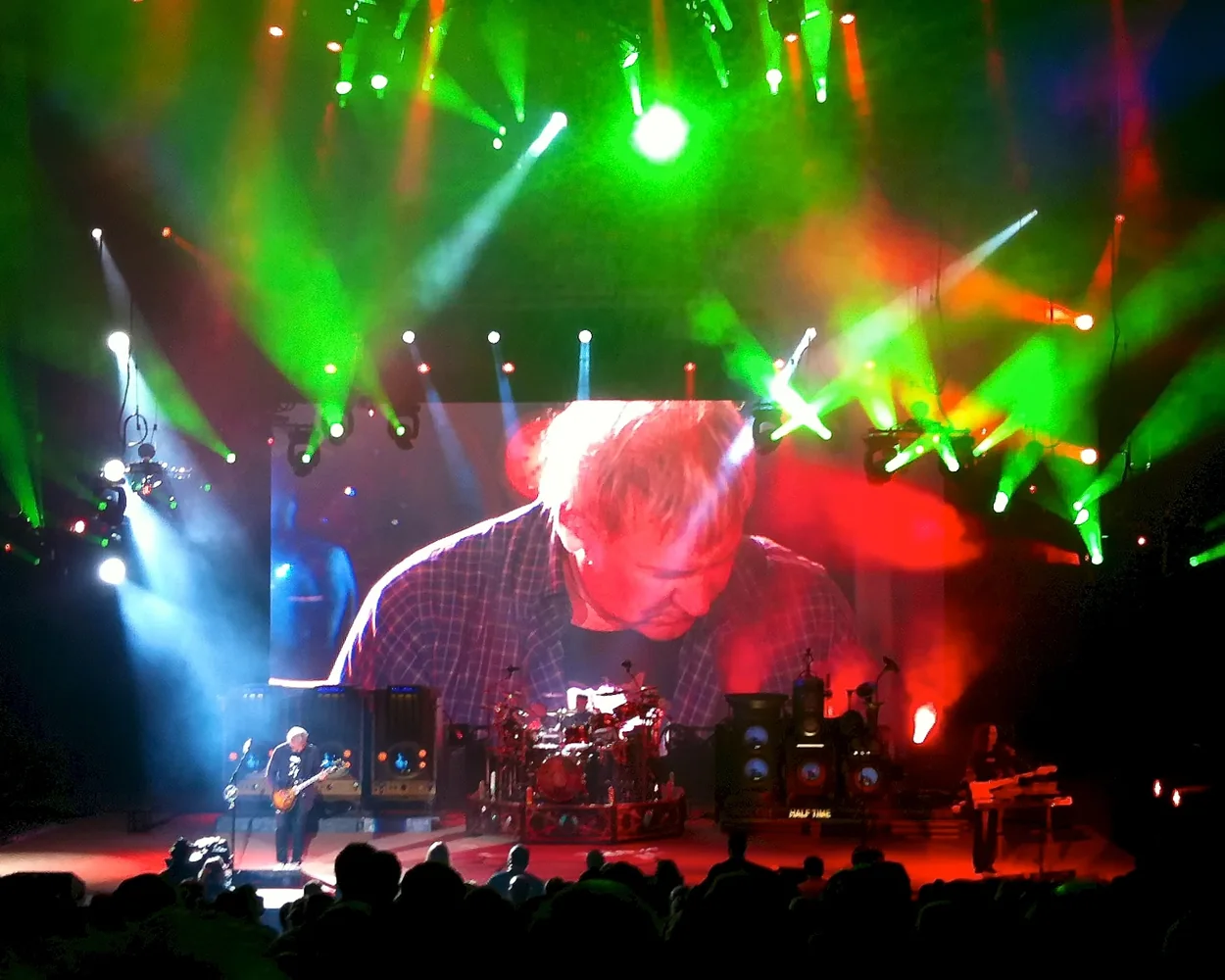
Their live history matters for the same reason: three musicians reproduced increasingly layered records by redistributing parts among bass, guitar, pedals, keyboards and percussion. Rush entered the Rock and Roll Hall of Fame in 2013 and played its last concert in 2015. Peart's death in 2020 closed the trio permanently, while the official archive maintained by Lee and Lifeson documents the recordings, tours and changing equipment without presenting a replacement lineup as Rush.
Sources & Further Reading
Connected archive routes
Explore This Band
Continue through the RetroForge knowledge graph
Curated paths into the people, records, events and ideas that give this subject its wider musical context.
Sounds and instruments
- Mellotron