The Single Stays Central
Experiments are packed into short, direct song forms.

Psychedelic Rock Family
British beat music at the point where sharp mod attack, fuzz guitar and studio experimentation began leaning into psychedelia.
The Sound
Freakbeat is a retrospective name for the tougher British records made between the beat boom and full psychedelic rock. The songs usually remain short and direct, but the guitars distort, the drums hit harder and the production begins to behave unpredictably.
It is less a closed scene than a useful listening bridge. Harmony and structure still belong to mid-1960s pop, while feedback, compression, fuzz and nervous energy point toward garage psych and acid rock.
RetroForge does not currently label an album as pure freakbeat. The recommendation below is an adjacent route because its garage-psych urgency and vintage electric texture share part of that vocabulary.
What You’ll Hear
How It Works
Freakbeat catches British beat and R&B as distortion, studio experiment and psychedelic attitude begin to push through. The songs usually retain compact, urgent structures, but guitar tone, aggressive drumming and strange production make them feel as though the familiar format is coming apart under pressure.
Its excitement lies in compression. Rather than opening into a long acid-rock journey, freakbeat forces instability into the single: a violent fuzz break, a rhythm that hits too hard for pop decorum, or an arrangement whose edges blur before the hook can settle.
Useful distinction: Boundary line: freakbeat belongs to a specific transitional British context. It is not a retrospective label for every modern garage band using fuzz.
Experiments are packed into short, direct song forms.
Guitar tone introduces danger without replacing the hook.
R&B drive and vocal urgency keep the record physically immediate.
Studio colour appears before the music fully leaves beat culture.
Historical Development
Freakbeat is a retrospective collector's term rather than a banner waved by musicians in the 1960s. It identifies the hard, distorted British singles that appeared between beat music, rhythm and blues, mod and psychedelia. The records usually keep the speed and economy of a club band while introducing fuzz, feedback, abrupt dynamics and a more unstable studio sound.
The category is necessarily porous. The Pretty Things, the Yardbirds, the Creation and the Move all travelled beyond straightforward R&B, but they did so in different ways. Some tracks are essentially aggressive beat records; others are already psychedelic pop or early hard rock. Freakbeat is most useful as a listening route through that transitional pressure.
Singles matter more than grand album statements here. A guitar sound, drum break or vocal attack may carry the entire argument in under three minutes. That compression distinguishes freakbeat from the longer jams associated with acid rock and from the more ornamental studio design of psychedelic pop.
The Real-World Foundations
Not a ranking: six useful doors into the style.
Fuzz, blues experiment and compact British songwriting meet at the transition point.
R&B is pushed toward a harsher, less controlled beat-group sound.
A continental-market compilation gathers the Creation's sharp arrangements and Eddie Phillips' pioneering bowed guitar.
A tough provincial beat band delivers the urgency later collectors recognised as freakbeat.
Recordings prepared for a cancelled 1967 LP finally appear in 1970, with studio material dressed in dubbed crowd noise.
Heavy live instincts and colourful singles writing show freakbeat opening into psychedelia.
Closest RetroForge Route
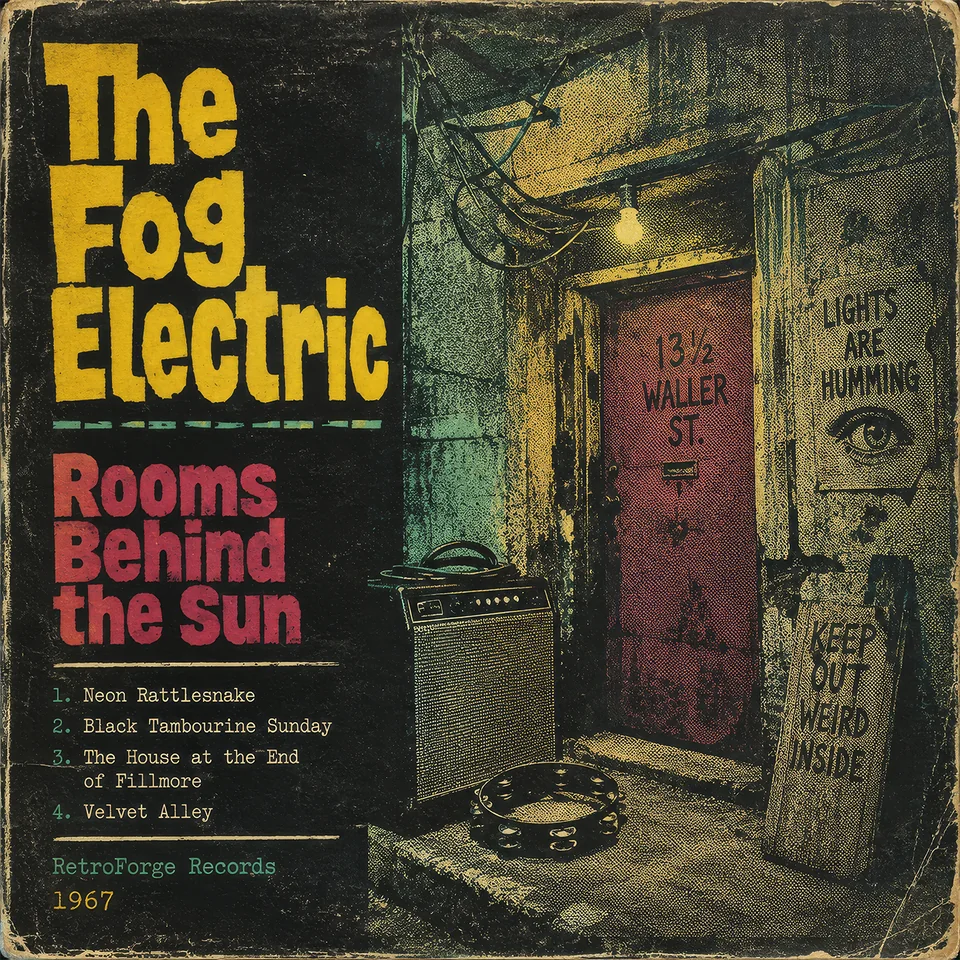
Adjacent: Garage Psych
A rough-edged psychedelic route while the catalogue waits for a dedicated freakbeat release.
Open the liner notes →Questions from the Record Room
Generally no. The term was applied later by collectors and historians to connect transitional British records.
They are close relatives, but freakbeat is tied specifically to the British beat, mod and R&B continuum.
The style's defining evidence often survives as isolated 45s rather than coherent album catalogues.
Research Trail
Deeper Discovery
Start with Leave the Daylight Alone as a RetroForge companion, then return through Psychedelic Rock to place it inside the wider family.
Curated paths into the people, records, events and ideas that give this subject its wider musical context.