Repetition Acts as Ceremony
Returning phrases feel procedural rather than merely catchy.
Psychedelic Rock Family
Psychedelic sound turned toward ritual, haunted landscape and the suspicion that altered perception has revealed something waiting underneath.
The Sound
Occult psychedelia joins two forms of uncertainty. Psychedelic production destabilises sound through echo, drone and repetition; occult imagery gives that instability a hidden cause, ceremony or presence.
The music may be electric or acoustic. What matters is the way timbre, lyric and structure build a self-contained ritual space. Forests, moons, circles and old symbols become more than decoration when the arrangement seems to obey them.
This route overlaps strongly with acid folk and occult rock, but keeps altered perception at its centre.
What You’ll Hear
How It Works
Occult psychedelia uses ceremony, hidden knowledge and symbolic transformation as organising ideas. Drones, repeated vocal lines, modal harmony and shadowed production can make the music feel less like a performance than an event the listener has entered.
Atmosphere alone is not enough. The strongest work gives its symbols musical functions: a chant establishes collective force, a recurring interval signals danger, or a slow instrumental return suggests that the ritual has moved to another stage.
Useful distinction: Boundary line: dark imagery and supernatural lyrics do not automatically create occult psychedelia. Ritual logic must shape the sound as well as the words.
Returning phrases feel procedural rather than merely catchy.
The music circles a tonal centre without offering easy release.
Chant, whisper and group response change the social space of the song.
Recurring images are matched by identifiable musical events.
Historical Development
Occult psychedelia occupies the point where altered perception meets ritual imagination. Late-1960s artists discovered that tape effects, drones, modal repetition, whispered voices and unstable studio space could make a song feel ceremonial without requiring the direct heaviness later associated with doom or occult rock. The supernatural became an environment rather than merely a lyric.
Early examples arrived from several directions. Coven joined psychedelic rock to explicit ritual theatre; Mort Garson used the Moog synthesizer to build an electronic black mass; Comus turned acoustic instruments and ensemble voices into something feral and unsettling. Aphrodite's Child made biblical apocalypse into a sprawling psychedelic concept, proving that esoteric scale could also operate across an entire album.
Modern occult psychedelia often draws from folk ritual, global percussion, drone and analogue electronics. Groups such as Goat create collective ceremony through rhythm and anonymity rather than gothic solemnity. The route remains distinct from occult rock because its primary subject is altered consciousness: symbols matter, but so do disorientation, trance and the sensation that ordinary space has become unreliable.
The Real-World Foundations
Not a ranking: six useful doors into the style.
Psychedelic songcraft and staged ritual make occult presentation central rather than incidental.
Moog electronics create ceremonial space without relying on a conventional rock ensemble.
Acoustic instrumentation, fractured voices and mythic violence turn folk psychedelia into nightmare ritual.
Biblical apocalypse unfolds through electronics, improvisation and a deliberately unstable double album.
An occult-rock boundary case whose triple-guitar heavy rock and mystical lyrics reconnect ritual imagery with psychedelic colour.
Polyrhythm, fuzz and collective anonymity create a bright but genuinely ritual psychedelic experience.
Start Here
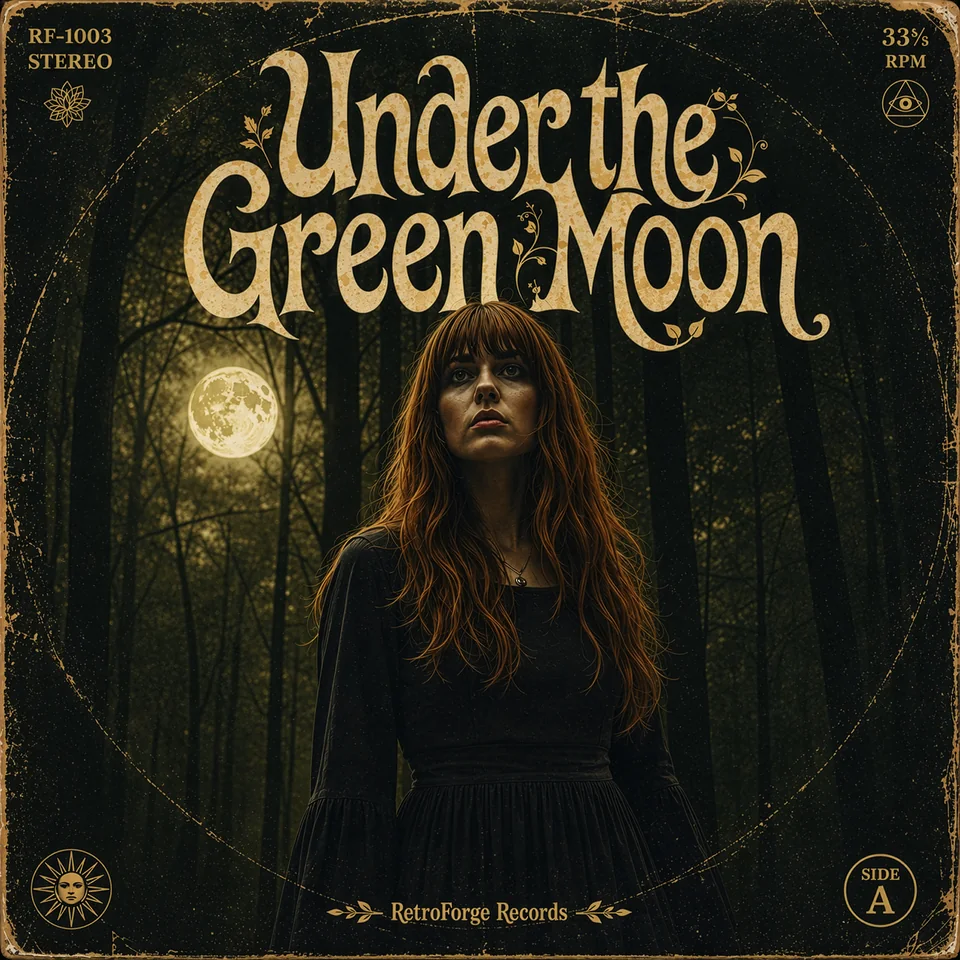
1968 · Occult Acid Folk
Ritual psych shaped by forest imagery, acoustic darkness and a slowly tightening circle.
Open the liner notes →Questions from the Record Room
No. Instrumental texture, ritual rhythm and altered studio space can establish the atmosphere without a literal narrative.
They overlap, especially in acoustic ritual music, but occult psychedelia can also be electronic, heavily amplified or rhythmically driven.
Occult psychedelia uses sound to alter perception and create ceremony; horror imagery alone does not define the musical route.
Research Trail
Deeper Discovery
Start with The Purple Sun Is Watching as a RetroForge companion, then return through Psychedelic Rock to place it inside the wider family.
Curated paths into the people, records, events and ideas that give this subject its wider musical context.