This London Kaleidoscope — unrelated to the American group of the same name — made two albums for Fontana with an unchanged quartet: Peter Daltrey on vocals and keyboards, Eddy Pumer on guitar and keyboards, Steve Clark on bass and flute, and Dan Bridgman on drums. Daltrey supplied the lyrics and Pumer the music for most of the material, giving the band a consistent authorial identity even as individual songs moved between pop concision, childhood fantasy and darker narrative scenes.
The original singles and albums did not produce a commercial breakthrough, but they preserve a particularly song-centred form of British psychedelia. In 1970 the same four musicians changed their name to Fairfield Parlour rather than forming an unrelated successor, making From Home to Home an important continuation of the story.
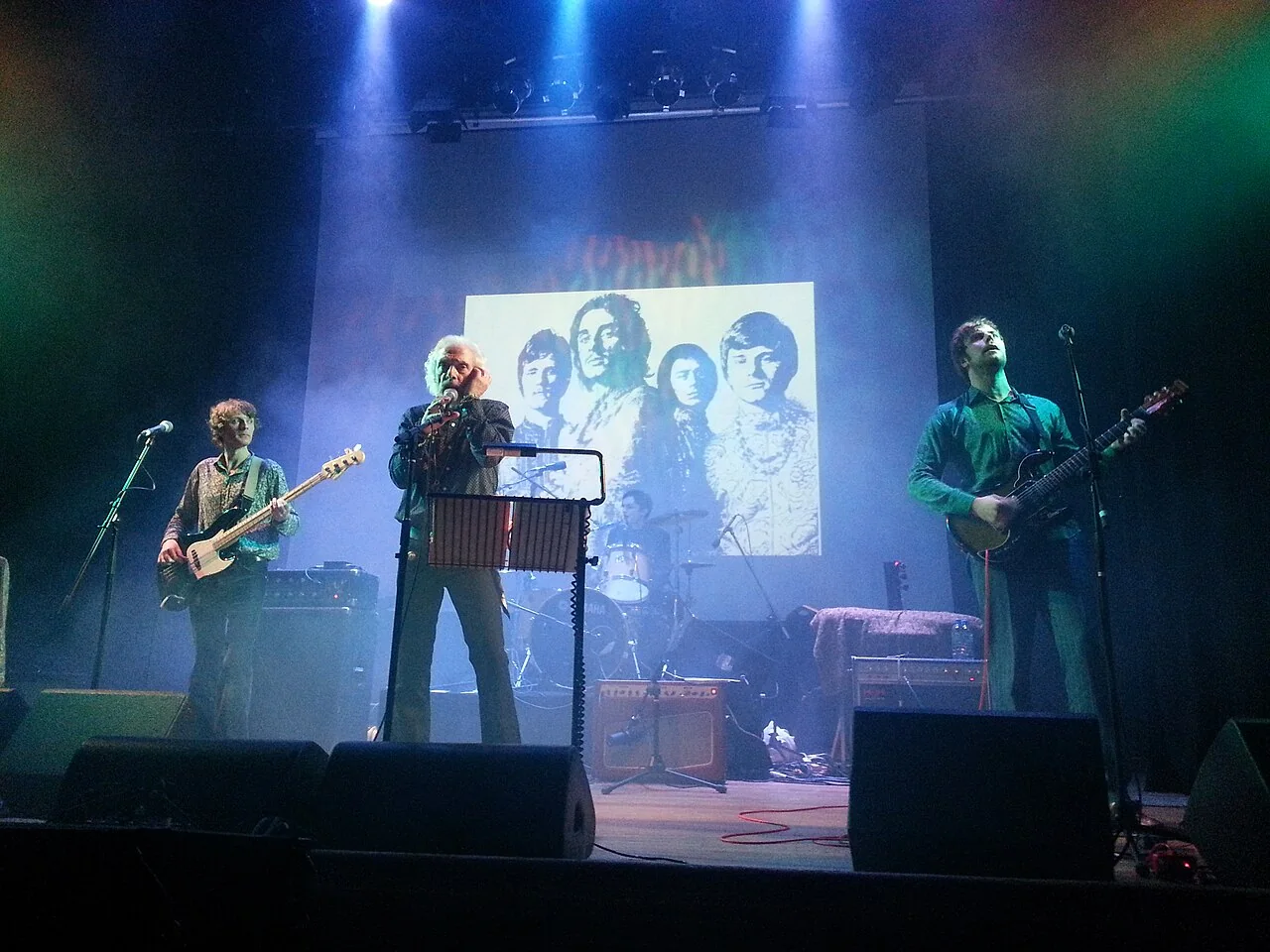
Kaleidoscope in a licensed group photograph.Photo: Knutsk / Wikimedia Commons · Licensed under CC BY-SA 4.0. Converted to WebP for this page.
Formation & History
The four musicians had worked together since the early 1960s, first as the Sidekicks and then as the Key. Peter Daltrey recalled that signing to Fontana in early 1967 prompted the change to Kaleidoscope, a name chosen to match the period's rapidly developing psychedelic imagery. Music publisher Dick Leahy helped secure the contract and produced the band's Fontana recordings.
Fontana issued the debut single "Flight from Ashiya" in September 1967, followed by Tangerine Dream later that year. Further singles included "A Dream for Julie," "Jenny Artichoke" and "Do It Again for Jeffrey." The second album, Faintly Blowing, arrived in 1969 with a heavier studio sound but no chart breakthrough.
With BBC presenter David Symonds as manager, the quartet adopted the name Fairfield Parlour and moved to Vertigo. From Home to Home appeared in 1970, and the musicians also released the Isle of Wight Festival song "Let the World Wash In" as I Luv Wight. A later concept project, White Faced Lady, remained unreleased until 1991. These name changes describe successive phases of the same core group, not separate bands assembled around Daltrey.
Sound & Style
The band works from songs rather than open-ended jams. Pumer's twelve-string and electric guitars supply arpeggios, fuzz and melodic counterlines; organ and piano thicken the harmony; Clark's bass and occasional flute add movement around Bridgman's compact drumming. Layered vocals, reverse effects and changes of acoustic perspective colour the arrangements without displacing Daltrey's lead.
Tangerine Dream often frames unsettling subjects inside bright surfaces: "Flight from Ashiya" narrates an air disaster, while "The Murder of Lewis Tollani" and "(Further Reflections) In the Room of Percussion" place story and atmosphere ahead of instrumental display. Faintly Blowing increases the weight of guitar and rhythm section on tracks such as "Music" and the title song, yet "Poem" and "Love Song for Annie" retain the intimate scale of the debut. Fairfield Parlour then emphasizes piano, acoustic textures and pastoral ensemble writing without abandoning the Daltrey-Pumer partnership.
Essential Albums
1967
Tangerine Dream
Fontana · Original 1967 release
The debut establishes the Daltrey-Pumer method across eleven compact tracks. "Kaleidoscope" opens with the band's name as a visual and musical device; "Flight from Ashiya" sets a doomed aircraft narrative against a composed pop arrangement; "Dive into Yesterday" uses backward-looking imagery and shifting texture; and the long closing "The Sky Children" lets Daltrey's story expand beyond single length. Dick Leahy's production keeps voices, guitar and keyboards sharply separated even when effects complicate the surface.
Key tracks: Kaleidoscope · Dive into Yesterday · Flight from Ashiya · The Sky Children
The second Fontana album is not a repetition of the debut. "Faintly Blowing" and "Music" give Pumer's guitar and the rhythm section more physical weight, while "Poem" reduces the scale and "Love Song for Annie" keeps the melodic directness of the earlier singles. The unchanged quartet sounds broader because the arrangements use contrast more aggressively, moving between fuzz, harmony vocals, keyboards and quiet narrative passages within a tighter sequence.
Key tracks: Faintly Blowing · Music · Poem · Love Song for Annie
Credited to Fairfield Parlour, this Vertigo album documents the same four musicians in a more piano- and acoustic-oriented setting. "Bordeaux Rosé" makes the shift immediately audible, "In My Box" retains the group's miniature storytelling, and the extended "Aries" gives the arrangements more room than the Fontana singles allowed. It belongs here as a continuation, but not as a Kaleidoscope-branded release.
Key tracks: Bordeaux Rosé · In My Box · Aries
Deeper Cuts
"A Dream for Julie," "Jenny Artichoke" and "Do It Again for Jeffrey" show how much of the group's strongest work appeared outside the two original albums.
The Fairfield Parlour single "Let the World Wash In," issued under the temporary name I Luv Wight, was written for the 1970 Isle of Wight Festival.
White Faced Lady extends the Fairfield Parlour phase into a concept work that did not receive its first release until 1991.
Kaleidoscope demonstrate that British psychedelia did not depend on long improvisation or studio spectacle. Their distinction comes from narrative economy: Daltrey could move from childhood recollection to disaster or private unease, while Pumer gave each lyric a specific melodic and harmonic setting. The fixed quartet then realized those songs with enough instrumental colour to reward close listening without overwhelming their structure.
The Fairfield Parlour continuation also makes the catalogue valuable as a record of change. The same writers and players moved from Fontana's 1967 psychedelic-pop moment toward the more acoustic and progressive language of Vertigo in 1970. Later reissues and archive releases restored material that had been commercially overlooked, but the lasting case rests on the songs and on that audible development.
RetroForge Records publishes original music and independent editorial guides. This historical band guide is not affiliated with the artist, labels or rights holders. No unlicensed album artwork is reproduced.