
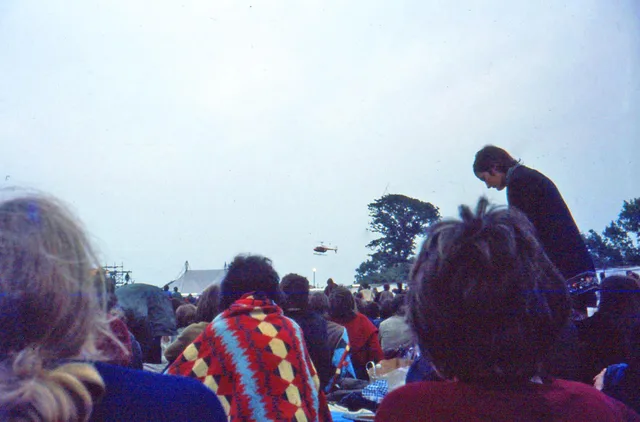

Edition timeline
Ford Farm proves the idea
A comparatively small first gathering establishes that an island rock festival can work.
A free opening concert
Season-ticket holders are offered a preliminary programme before the main weekend.
Woodside Bay changes the scale
A mass audience crosses to the island for a far larger second edition.
Bob Dylan returns
Dylan and The Band perform his first full public concert since 1966.
Why these editions matter
The famous 1970 Isle of Wight Festival did not appear fully formed. The 1968 and 1969 editions show local organisers learning how an island could host first a manageable rock gathering and then an international mass audience. Attendance rose from roughly 10,000 to around 150,000 in one year. Bob Dylan’s return made 1969 globally visible, but the deeper history is the extraordinary acceleration in organisation, transport, expectation and reputation. The Foulk brothers and Fiery Creations were not a multinational promotion company. They were local organisers testing a festival form that remained unsettled in Britain. The success of the 1968 field event created credibility for another attempt, while the British jazz, blues and psychedelic circuits supplied artists and audiences ready to travel. Each decision—site, ferries, camping and contracts—was knowledge acquired in public rather than a standard package bought from an established industry. Ford Farm near Godshill hosted a comparatively small first edition. Exact ticket figures remain estimates, but the gathering was legible at a scale the organisers could learn from. Its importance becomes clearer in hindsight: the field proved that a serious rock programme could attract visitors across the Solent, operate in a rural island setting and generate enough confidence for a second edition. It was a prototype, not a miniature version of the later megafestival. The move to Woodside Bay near Wootton transformed both capacity and logistics. Surviving poster evidence distinguishes a free concert for season-ticket holders on 29 August from the main Saturday and Sunday programme on 30–31 August. A six-figure audience meant ferries, limited roads, camps and local services all became part of production. The island could not be approached from every direction, so arrival itself formed a shared chapter of the event.
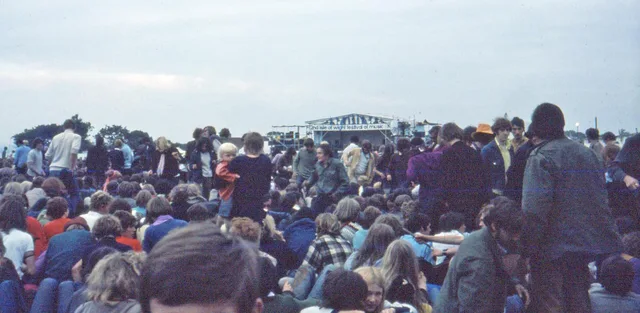

Bob Dylan returns
On 31 August, Bob Dylan performed with The Band at his first full-fledged public concert since his 1966 motorcycle accident, a formulation supported by contemporary TIME coverage. His official site preserves the date, venue and set list. Woodstock had taken place near his American home only weeks earlier, making the Isle of Wight booking seem improbable. The performance was a deliberate return on different terms, not simply a celebrity “snub” of another festival. Dylan and The Band represented the turn toward roots and singer-songwriter authority. The Who and Free supplied harder British rock; Joe Cocker brought blues and soul phrasing; The Nice and The Moody Blues pointed toward progressive scale; The Pretty Things and other underground acts preserved the psychedelic route. Posters remain valuable, but performed lineups require source comparison because festival billing, scheduling and appearance are different categories of evidence. The contrast between years is fundamental. In 1968 the island experiment remained small enough to understand as one field gathering. In 1969 visitors queued for ferries, carried bedrolls, camped, slept rough and waited through a long programme for Dylan. A famous audience included Beatles and Rolling Stones members, but ordinary travel and camping better explain the event’s atmosphere. The open rebellion associated with 1970 should not be projected backward onto this comparatively managed weekend. Scaling from roughly ten thousand to a mass audience required broader amplification, a larger site plan, artist handling, sanitation, traffic control and crowd containment. Island geography magnified every error because equipment and people passed through ferries and constrained roads. Sources do not support inventing a single perfect technical specification, but they clearly show functions expanding. Production history here is the story of converting local proof of concept into a destination event in one year.
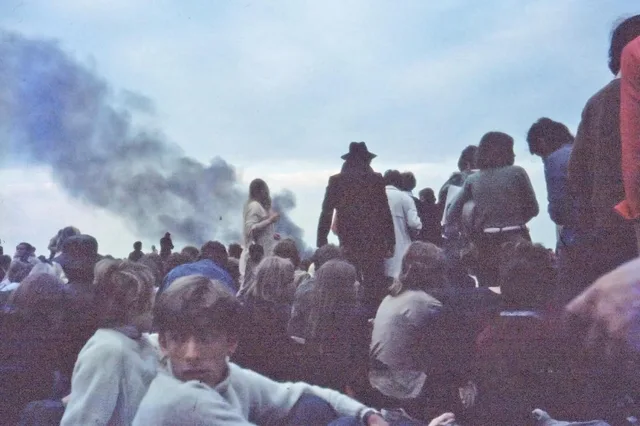

Problems and practical limits
Transport and crowd movement were the central warnings. Huge numbers converged on a place with limited access routes and finite camping space. Ferries and roads had to absorb both planned ticket holders and the wider social movement attracted by Dylan’s return. The 1969 edition did not yet reproduce the political crisis of 1970, but it revealed the physical pressures that greater ambition would intensify. Success supplied confidence and concealed how close several systems were to their limits. Dylan’s complete set has an unusually strong official afterlife, supported by a full set list and later authorised release. Contemporary TIME and music-press coverage record the audience, sound and celebrity interest. A substantial group of reusable contemporary photographs documents the Woodside Bay festival and appears throughout this page. Other film and famous performance photography may remain copyrighted even when used as historical evidence, so each asset requires its own rights record. Crossing water changed the psychology of attendance. Visitors did not merely drive to a field; they entered a place with a visible threshold and limited routes home. Ferries, camps and the island’s temporary population gave the gathering a destination character stronger than many mainland events. That journey helped public memory treat Isle of Wight as a world apart, while the practical strain of the same separation shaped every logistical decision. The first two editions created the organisational runway, press reputation and audience expectation that made the enormous 1970 festival thinkable. Ford Farm established possibility; Woodside Bay established international scale through Dylan’s return. Linking forward to the 1970 guide prevents the famous half-million narrative from swallowing its prehistory. The series’ lasting lesson is that megafestivals are built through repeated experiments—and that each apparent success encourages risks the previous site never had to carry.


Follow the festival beyond the field
Timeline
Related genres
Related band guides
Explore by sound
Essential listening
Sources and further reading
- Festival historyIsle of Wight Festival · accessed 23 July 2026
- Woodside Bay, 31 August 1969Bob Dylan Official Site · accessed 23 July 2026
- Poet’s ReturnTIME · accessed 23 July 2026
- 1969 poster and concert chronologyThe Band archive · accessed 23 July 2026
- Contemporary Isle of Wight reportRecord Mirror · accessed 23 July 2026
Image credits5 licensed images
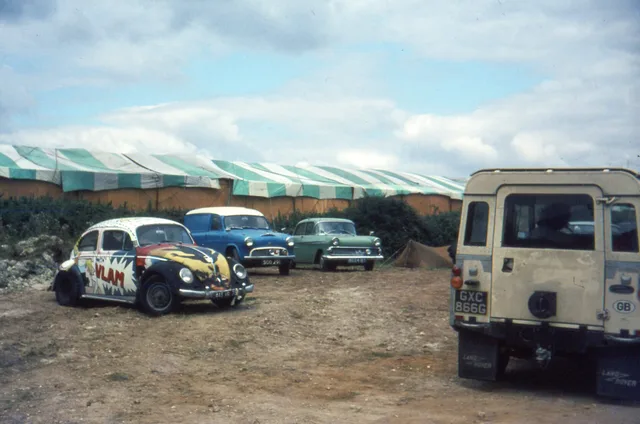
The 1969 Isle of Wight Festival at Woodside Bay, one of a valuable group of reusable contemporary photographs — TimBrighton — Wikimedia Commons — CC BY 2.0 · source record · CC BY 2.0
Converted to WebP and resized; no generative or compositional alterations.
A contemporary view of the 1969 festival, documenting the site before the far larger 1970 edition reshaped public memory — TimBrighton — Wikimedia Commons — CC BY 2.0 · source record · CC BY 2.0
Converted to WebP and resized; no generative or compositional alterations.
Festivalgoers at Woodside Bay in 1969, when Bob Dylan’s return to performance transformed the event’s scale — TimBrighton — Wikimedia Commons — CC BY 2.0 · source record · CC BY 2.0
Converted to WebP and resized; no generative or compositional alterations.
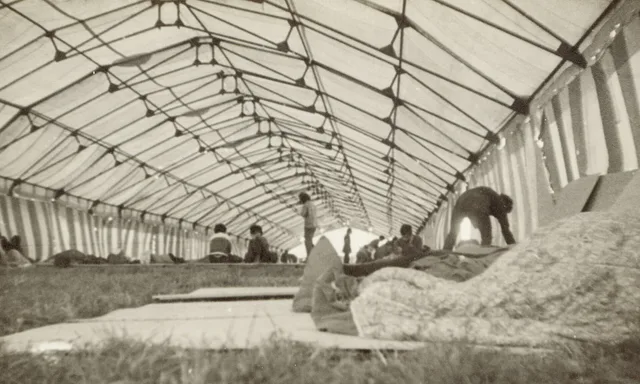
Woodside Bay during the 1969 festival. The photograph records the audience geography as well as the stage event — TimBrighton — Wikimedia Commons — CC BY 2.0 · source record · CC BY 2.0
Converted to WebP and resized; no generative or compositional alterations.
The 1969 Isle of Wight audience, showing the intermediate scale between the 1968 experiment and the 1970 mass gathering — TimBrighton — Wikimedia Commons — CC BY 2.0 · source record · CC BY 2.0
Converted to WebP and resized; no generative or compositional alterations.