The Zombies brought jazz-aware keyboards, carefully voiced harmonies and Colin Blunstone’s close, breathy singing into British beat music. “She’s Not There” made that combination internationally recognisable in 1964; three years later, the band channelled it into the self-produced Odessey and Oracle.
The original group broke up before that album was released. Its closing track, “Time of the Season,” then reached No. 3 in the United States in 1969, creating a hit without a band available to promote it. The Zombies’ story therefore has two centres: the concise Decca singles that first defined their sound and the later album whose reputation grew long after its commercial moment had passed.
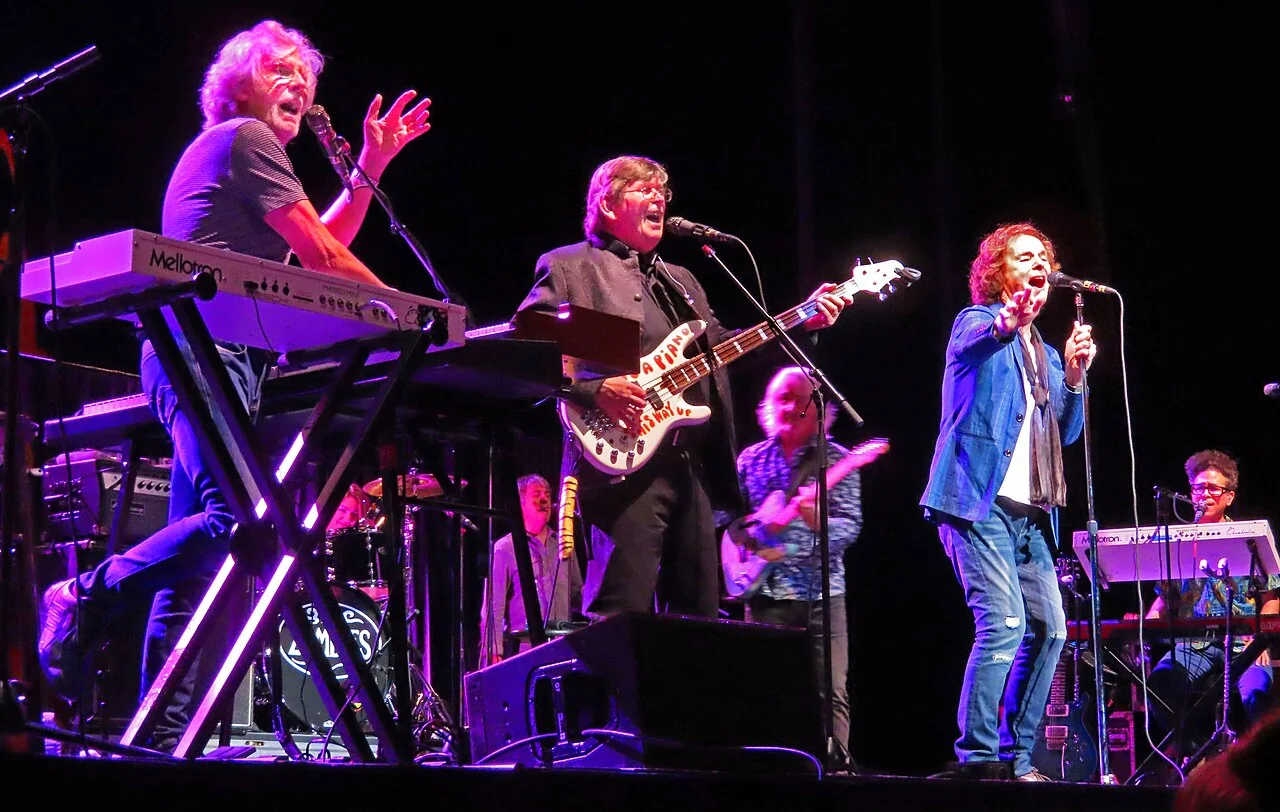
The Zombies in 2019.Photo: J-Ham2000 / Wikimedia Commons · Licensed under CC BY-SA 4.0. Converted to WebP for this page.
Formation & History
Rod Argent, Colin Blunstone and Hugh Grundy began playing together at school in St Albans in 1961; bassist Paul Arnold and guitarist Paul Atkinson completed the first lineup. Chris White replaced Arnold on bass before the group won the 1963 Herts Beat competition, whose prize brought them a Decca recording test. Argent wrote “She’s Not There” for their first session. Released in 1964, it reached No. 12 in Britain and No. 2 in the United States; “Tell Her No” followed into the American Top 10.
Repeated touring and diminishing income exposed the gap between those early records and the band’s finances. After leaving Decca, the five musicians received a small CBS budget and creative control to make Odessey and Oracle. Argent and White produced the sessions at EMI’s Abbey Road and Olympic Studios in 1967. By December, before CBS issued the album in Britain in April 1968, the group had dissolved.
Al Kooper persuaded Columbia to release the album in America, and “Time of the Season” became a delayed hit in early 1969. The five original members reunited for two songs in 1997; Argent and Blunstone then began low-key concerts together in 1999 and developed a new recording and touring Zombies lineup. That incarnation continued for twenty-five years, ending its touring career after Argent suffered a stroke in 2024.
Sound & Style
The Decca recordings are driven by the contrast between rhythm-and-blues attack and unusual harmonic detail. Argent’s Hohner Pianet gives “She’s Not There” its clipped, urgent pulse; White’s mobile bass lines avoid merely following the guitar; Blunstone moves from a near-whisper to a sharply projected chorus without losing intimacy. The group harmonies often answer the lead instead of simply doubling it.
On Odessey and Oracle, the palette becomes more orchestral without relying on an outside arranger. Piano, organ and Mellotron simulate chamber colours, while multiple vocal parts are fitted into four-track recording. “Care of Cell 44” turns a prison homecoming into buoyant pop; “A Rose for Emily” is almost weightless; “Butcher’s Tale” uses harmonium and tape effects to narrow the space around White’s vocal. Psychedelia emerges through arrangement, memory and perspective rather than long solos.
Essential Albums
1968
Odessey and Oracle
CBS · Original 1968 release
Recorded in 1967 and released after the breakup, the second album divides its twelve songs evenly between Argent and White. “Care of Cell 44” opens with piano and stacked voices before revealing that the awaited lover is leaving prison; “A Rose for Emily” strips the arrangement back around Blunstone; “Hung Up on a Dream” lets Mellotron colour an inward lyric; White sings the stark First World War scene of “Butcher’s Tale.” “Time of the Season” closes with bass, breath and organ space unlike anything else on the record. Its coherence comes from sequencing and vocal design, not from every song sharing one mood.
Key tracks: Care of Cell 44 · Hung Up on a Dream · Time of the Season
The British debut mixes seven R&B and soul covers with seven originals, documenting both the group’s club repertoire and the sound already setting them apart. “Road Runner” and the “You’ve Really Got a Hold on Me”/“Bring It on Home to Me” medley show their beat-group foundation. Against them, “She’s Not There” uses electric piano and suspended harmony, “The Way I Feel Inside” reduces the band to exposed voice, and “I Remember When I Loved Her” anticipates the darker restraint of the second album. It is less unified than Odessey, but more revealing about where their language came from.
Key tracks: She’s Not There · I Can’t Make Up My Mind · The Way I Feel Inside
R.I.P. was planned for 1969 but abandoned. Side one consists of post-breakup recordings made by former members and future Argent bassist Jim Rodford; side two revisits six earlier Zombies tracks with new orchestral overdubs. “Imagine the Swan” and “Conversation Off Floral Street” point toward Argent’s firmer progressive pop, while “Smokey Day” and “Girl Help Me” place older performances inside newly arranged settings. The hybrid construction prevents it from being a conventional third album, yet it documents the precise moment when the Zombies catalogue split into archive, solo work and the new band Argent. The complete sequence first appeared in Japan in 2000.
Key tracks: Imagine the Swan · Smokey Day · Girl Help Me
The original Decca period extends far beyond Begin Here. “Whenever You’re Ready” pairs a forceful chorus with a tense verse, “I Love You” became a later American hit for People!, and “Is This the Dream” drives harder than the group’s refined reputation suggests. The four-CD Zombie Heaven box set places those singles, EP tracks, demos, BBC sessions and the proposed R.I.P. material alongside the two original albums.
The reunion catalogue is a separate chapter rather than a continuation of 1967. Argent and Blunstone first worked under their own names before a new lineup adopted The Zombies name in 2004. Breathe Out, Breathe In (2011), Still Got That Hunger (2015) and Different Game (2023) feature later musicians and mature songwriting; anniversary concerts additionally brought White and Grundy back to perform Odessey and Oracle.
The Zombies show how much experimentation can fit inside a three-minute pop song. Their records rely on chord movement, vocal placement, keyboard timbre and dynamic restraint instead of volume. That approach became foundational to baroque pop and remains legible in later chamber-minded psychedelia and indie pop.
The delayed success of “Time of the Season” and the slow reappraisal of Odessey and Oracle also separate contemporary sales from lasting value. The 1997 Zombie Heaven archive, full-album reunion concerts and the band’s 2019 Rock & Roll Hall of Fame induction did not invent the achievement; they made a scattered catalogue and an unusual chronology easier to understand.
RetroForge Records publishes original music and independent editorial guides. This historical band guide is not affiliated with the artist, labels or rights holders. No unlicensed album artwork is reproduced.