

Overview
Kansas built an identifiable American form of progressive rock from a fixed six-person ensemble. Steve Walsh's keyboards and lead voice, Robby Steinhardt's violin and co-lead vocals, the guitars of Kerry Livgren and Rich Williams, Dave Hope's bass and Phil Ehart's drums allowed written passages, hard-rock riffs and vocal harmonies to change roles inside the same song. The sound was not simply British progressive rock relocated to the Midwest: blues, boogie and direct radio songwriting remained audible beside extended forms and irregular metres.
The band's commercial breakthrough arrived only after three increasingly focused albums. Song for America and Masque established the long-form writing; Leftoverture and Point of Know Return then placed that ensemble language beside major singles. Later personnel changes altered the balance, but Kansas continued recording and touring rather than remaining a closed 1970s catalogue.
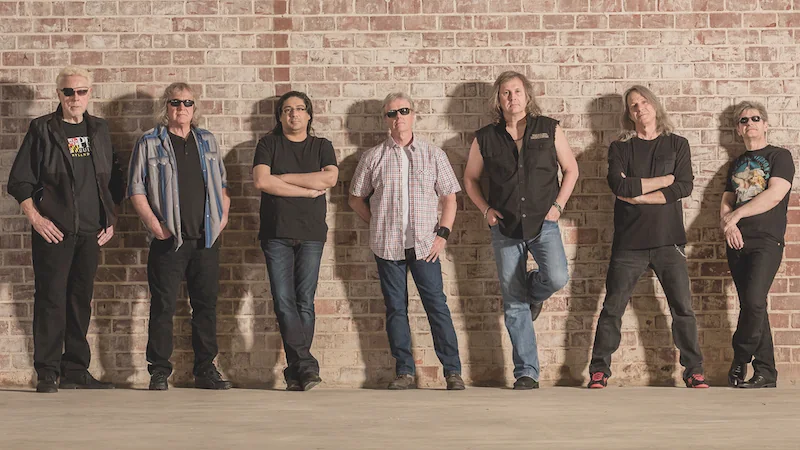
Formation & History
The recording lineup came together in Topeka in 1973 from musicians with intertwined local histories. Ehart, Hope, Walsh and Williams had worked in White Clover; Livgren had led earlier groups that used the Kansas name; Steinhardt brought violin and a second lead voice. After Wally Gold brought the band to Don Kirshner's attention, the self-titled debut appeared in March 1974. Song for America followed in February 1975 and Masque that September, all before the breakthrough single arrived.
Leftoverture reached the US Top Five after "Carry On Wayward Son" gave the fourth album a strong opening and a radio entry point. Point of Know Return reached number four and added three charting singles, including "Dust in the Wind." The same six musicians remained through Audio-Visions in 1980, even as Livgren's and Hope's Christian conversions sharpened disagreements about lyrical direction.
Walsh left in 1981 and John Elefante sang and played keyboards on Vinyl Confessions and Drastic Measures. Steinhardt, Livgren and Hope also departed during this period. Ehart and Williams resumed Kansas with Walsh, guitarist Steve Morse and bassist Billy Greer for Power in 1986. The original six appeared together again on 2000's Somewhere to Elsewhere; Walsh remained until retiring in 2014, when Ronnie Platt became lead singer. Kansas later issued The Prelude Implicit in 2016 and The Absence of Presence in 2020, and the touring lineup has continued to evolve.
Sound & Style
The classic arrangements distribute melody among violin, keyboards, guitars and voices instead of reserving fixed accompaniment roles. On "Song for America," Steinhardt's violin can double or answer written keyboard and guitar figures across a ten-minute structure. "Icarus — Borne on Wings of Steel" moves between a compact vocal refrain and tightly coordinated instrumental passages, while "Magnum Opus" joins six titled sections without disguising the rhythm section's hard-rock weight.
Walsh and Steinhardt give the band two contrasting lead singers, and the full lineup frequently turns backing vocals into part of the arrangement. The acoustic-guitar pattern and violin on "Dust in the Wind" show that Kansas did not need orchestral density to address mortality. On Monolith, the same six musicians move toward shorter, self-produced pieces; Audio-Visions places Walsh's "Got to Rock On" and Livgren's explicitly devotional "Hold On" on the same album, making the group's growing internal division audible in the writing itself.
Essential Albums
Leftoverture
1976Jeff Glixman produced the eight-track fourth album at Studio in the Country in Louisiana. The late-added opener "Carry On Wayward Son" supplied a concise route into a record that still depends on ensemble construction: "The Wall" expands from keyboard-led reflection, "Miracles Out of Nowhere" repeatedly changes instrumental emphasis, and the six-part "Magnum Opus" closes the LP through linked riffs, metres and textures. Its US number-five peak made Kansas an album-scale commercial force without separating the single from the longer programme.
Key tracks: Carry On Wayward Son · Miracles Out of Nowhere · Magnum Opus
Open album guide → View on Amazon →Point of Know Return
1977The ten-track fifth album compresses Kansas's range without eliminating it. The title song and "Paradox" use short forms built from rapid ensemble changes; "Closet Chronicles" retains an extended narrative design; and "Hopelessly Human" closes with layered violin, keyboards, guitars and voices. "Dust in the Wind" reduces the texture to interlocking acoustic guitars, restrained singing and Steinhardt's violin. The album reached number four in the US and became the band's biggest-selling studio release.
Key tracks: Point of Know Return · Dust in the Wind · Hopelessly Human
Open album guide → View on Amazon →Song for America
1975The six-track second album is Kansas at its most openly long-form. The roughly ten-minute title piece moves through sung sections and an extended passage in 9/8; "Lamplight Symphony" builds a nocturnal narrative across more than eight minutes; and the twelve-minute "Incomudro — Hymn to the Atman" gives drums and violin major structural roles. Wally Gold and Jeff Glixman share the production credit, marking the transition toward Glixman's longer association with the band.
Key tracks: Song for America · Lamplight Symphony · Incomudro — Hymn to the Atman
Open album guide → View on Amazon →Affiliate note: Amazon links on this page may earn RetroForge Records a small commission, at no extra cost to you.
Deeper Cuts
Masque
1975Released in September 1975, seven months after Song for America, the third album balances shorter opening songs with a progressively connected second half. "Icarus — Borne on Wings of Steel" gives violin and paired guitars equal melodic force; "Mysteries and Mayhem" leads directly into "The Pinnacle," whose long rise closes the original eight-track LP. Glixman's production keeps the six-player attack dense but legible.
Open album guide → View on Amazon →Monolith
1979Kansas produced their sixth album themselves, and the classic six-member lineup remained unchanged. "People of the South Wind" turns the band's home-state reference into a compact single, while "On the Other Side" and "A Glimpse of Home" retain longer sectional writing. Released in May 1979, Monolith reached number ten in the US—the band's third consecutive Top Ten studio album.
Open album guide → View on Amazon →Audio-Visions
1980The seventh album is the final studio recording by the original six until their 2000 reunion. At Axis Studios in Atlanta, Kansas shared production with Brad Aaron and Davey Moire. "No One Together" preserves the older large-scale ensemble writing, "Got to Rock On" foregrounds Walsh's direct rock approach, and Livgren's "Hold On" makes his new Christian commitment explicit. Walsh left the following year as the disagreement over musical and lyrical direction deepened.
Open album guide → View on Amazon →Why They Still Matter
Kansas demonstrated that extended composition, violin-led ensemble writing and hard-rock touring scale could coexist with American radio success. Official band figures credit Leftoverture and Point of Know Return with sextuple-platinum status, while "Carry On Wayward Son" and "Dust in the Wind" became million-selling singles. Those achievements matter because the hits still carry recognisable parts of the ensemble's vocabulary rather than presenting an unrelated pop identity.
The catalogue also records change rather than one frozen classic period. The Elefante albums document the early-1980s split in personnel and purpose; Power introduces Morse and Greer; Somewhere to Elsewhere reunites the original players around new Livgren compositions; and the Platt-era albums extend Kansas as a recording band. The continuing live group preserves violin, keyboards and layered vocals even when the people performing those roles change.
Sources & Further Reading
This guide was checked against the official Kansas history, discography, player biographies and lineup announcements, together with the Kansas Historical Society overview. Album-specific recording, personnel and track details were cross-checked against the sourced RetroForge album dossiers linked above.
Connected archive routes