

Overview
The Byrds joined the songwriting and repertoire of the folk revival to the format and impact of a rock group. Roger McGuinn's electric twelve-string Rickenbacker and the group's close vocal harmonies gave their early records an immediately recognisable surface; Gene Clark's original songs and their transformations of material by Bob Dylan, Pete Seeger and others gave that sound substance. The catalogue did not stand still: between 1965 and 1968 the band moved from folk rock into modal, psychedelic and studio-based experiments, then made a sustained turn towards country music.
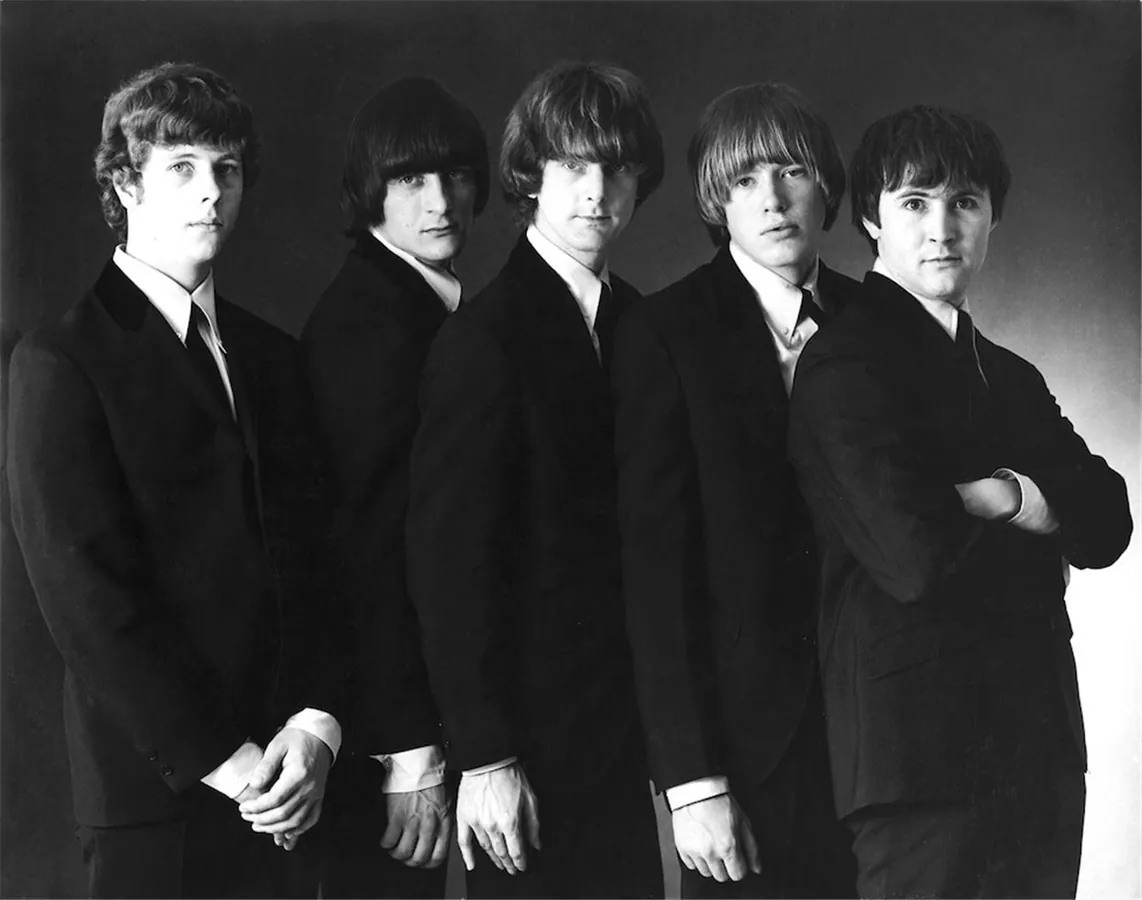
Formation & History
McGuinn and Gene Clark began writing and performing together in Los Angeles in 1964; David Crosby joined them, and Chris Hillman and Michael Clarke completed the five-man lineup. Clark quickly became the group's most prolific original songwriter. Their electric version of "Mr. Tambourine Man" reached number one in both the United States and the United Kingdom in 1965, while the album of the same name reached number seven in the UK. That breakthrough made the Byrds one of the clearest links between the American folk revival and the British-Invasion sound.
Clark left the performing lineup in 1966, and Crosby was dismissed during the difficult 1967 sessions that became The Notorious Byrd Brothers. For Sweetheart of the Rodeo, Chris Hillman and the newly arrived Gram Parsons helped move the repertoire and arrangements decisively towards country. Parsons departed in 1968; a later lineup built around McGuinn and guitarist Clarence White carried the band through extensive touring and recordings until 1973. The original five members reunited for one final studio album that year.
Sound & Style
The early records balance McGuinn's compressed, chiming twelve-string figures against three-part harmony and short, tightly arranged songs. Gene Clark's writing supplies much of the emotional weight on Mr. Tambourine Man, while the group's Dylan interpretations show how radically an arrangement can alter familiar material. On "Eight Miles High", modal guitar lines and a more open rhythmic design enlarged that vocabulary; Fifth Dimension places that experiment beside compact pop and science-fiction imagery.
The Notorious Byrd Brothers treats the studio as an instrument, combining phased textures, early Moog synthesizer, pedal steel and layered vocal arrangements. Sweetheart of the Rodeo changes the centre of gravity again: fiddle, banjo, mandolin, piano and pedal steel support country standards and songs by Dylan and Parsons. The Clarence White era brought a sharper live attack, with White's Telecaster and StringBender work making the later band more muscular without removing McGuinn's twelve-string identity.
Essential Albums
Chris Hillman emerges as a major writer and singer on "Have You Seen Her Face" and "Time Between", while David Crosby's "Everybody's Been Burned" and the McGuinn–Hillman satire "So You Want to Be a Rock 'n' Roll Star" pull in different directions without breaking the album's flow. Its mix of brass, fuzz guitar, country touches and close harmony makes it a concise portrait of a band becoming less dependent on cover material.
Key tracks: So You Want to Be a Rock 'n' Roll Star · Have You Seen Her Face · Everybody's Been Burned
Open album guide → View on Amazon →Made across the departures of Crosby and Michael Clarke, this studio album sounds remarkably continuous. Gary Usher's production joins Moog, pedal steel, phased voices and orchestration to songs as different as the anti-war "Draft Morning", the drifting "Wasn't Born to Follow" and the electronic closing piece "Space Odyssey". It is less a document of one stable lineup than a carefully assembled record from a band in transition.
Key tracks: Draft Morning · Wasn't Born to Follow · Dolphin's Smile · Space Odyssey
Open album guide → View on Amazon →Chris Hillman and Gram Parsons lead the Byrds deeper into country repertoire, with sessions in Nashville and Los Angeles and contributions from specialist players including Lloyd Green, John Hartford and Earl P. Ball. Dylan's "You Ain't Going Nowhere" and "Nothing Was Delivered" sit beside country and gospel standards and Parsons originals. The result is a landmark country-rock album, but part of a wider exchange between rock and country rather than the work of one inventor.
Key tracks: You Ain't Going Nowhere · I Am a Pilgrim · Hickory Wind · Nothing Was Delivered
Open album guide → View on Amazon →Affiliate note: Amazon links on this page may earn RetroForge Records a small commission, at no extra cost to you.
Deeper Cuts
Mr. Tambourine Man
1965The debut establishes the electric twelve-string and harmony sound, but Gene Clark's originals make it more than a collection of Dylan adaptations. "I'll Feel a Whole Lot Better", "Here Without You" and "I Knew I'd Want You" give the album its own emotional centre; in the UK, the LP reached number seven.
Open album guide → View on Amazon →Fifth Dimension
1966The first album completed after Gene Clark's departure is uneven but genuinely transitional. "Eight Miles High" stretches the group's guitar language, "5D (Fifth Dimension)" turns abstract ideas into pop, and "Mr. Spaceman" places country phrasing beside science-fiction wit.
Open album guide → View on Amazon →Untitled
1970One live disc and one studio disc capture the McGuinn–Clarence White–Gene Parsons–Skip Battin lineup from two angles. The concert side expands "Eight Miles High" into a long group improvisation; the studio side supplies "Chestnut Mare" and "Just a Season", two of McGuinn's strongest later songs.
Open album guide → View on Amazon →Why They Still Matter
The Byrds were not the sole inventors of folk rock, psychedelia or country rock, but they were unusually visible and influential participants in each development. Their 1965 success demonstrated how folk repertoire could work as electric pop; "Eight Miles High" and the 1966–68 albums widened the possibilities of American psychedelic rock; Sweetheart of the Rodeo gave a rock audience a sustained encounter with country repertoire and Nashville musicians. The chiming twelve-string and close-harmony model remained audible in later guitar pop, while Hillman and Parsons carried the country strand into the Flying Burrito Brothers. The band's importance lies as much in its repeated reinvention as in any single sound.
Sources & Further Reading
Recording Academy: Roger McGuinn on The Byrds, 1964–1967
Official Charts: The Byrds chart history
Official Charts: “Mr. Tambourine Man”
Rock & Roll Hall of Fame: Gram Parsons
Legacy Recordings: Sweetheart of the Rodeo
Legacy Recordings: The Essential Byrds
Wikimedia Commons: 1965 band photograph and rights information
Connected archive routes
Explore This Band
Continue through the RetroForge knowledge graph
Curated paths into the people, records, events and ideas that give this subject its wider musical context.
Genres and scenes
- Psychedelic Rock