Voltage Has Gesture
Filter and envelope movement give a note attack, breath and direction.

Krautrock & Electronic Family
Rock music in which oscillators, filters and voltage-controlled movement carry structural weight rather than supplying background colour.
The Sound
Analogue synth rock describes an instrumental relationship more than one historical scene. Drums, bass, guitar and voice may remain present, but synthesizers generate themes, countermelodies, transitions and sometimes the central dramatic arc.
The analogue character matters because small instabilities remain audible. Pitch drifts, filters open imperfectly and repeated patches never feel entirely identical. Those behaviours can make a formal arrangement feel physical and alive.
Frozen Skies is the strongest RetroForge connection. Its documented palette combines Moog, Mellotron, Hammond, electric guitar and orchestral synthesizer texture inside a progressive rock framework.
What You’ll Hear
How It Works
Analogue synth rock places voltage-controlled sound inside a physical band setting. Oscillator drift, filter movement and imperfect tuning give the electronic parts character, while live rhythm prevents them from becoming detached demonstrations of equipment.
Listen for negotiation. A sequenced figure may challenge the drummer’s timing, a filter sweep may become the arrangement’s climax, or a sustained keyboard tone may force guitar and bass into new harmonic roles. The technology changes how the ensemble behaves.
Useful distinction: Boundary line: analogue hardware is not a genre by itself. The musical identity comes from how electronic instability and rock performance shape one another.
Filter and envelope movement give a note attack, breath and direction.
Small tuning changes keep repetition from feeling mechanically fixed.
Live rhythm makes electronic precision flex and breathe.
A change in timbre may carry the drama normally assigned to harmony.
Historical Development
Analogue synth rock follows the moment when voltage-controlled oscillators, filters and sequencers moved from specialist studios into rock arrangements. Early instruments were large, unstable and often monophonic, so musicians could not treat them like later preset keyboards. A sound had to be built, tuned and performed as a changing signal.
The Who turned repeated, electronically treated organ patterns into structural engines; Pink Floyd joined EMS electronics to rock-band precision; Emerson, Lake & Palmer made modular synthesis part of virtuoso stage theatre. Roxy Music and progressive groups used the same tools less as replacement orchestras than as sources of instability, noise and unfamiliar attack.
The category describes an instrumental relationship rather than one historical scene. Synthesizers can lead a riff, generate pulse, reshape an acoustic input or occupy a role no traditional instrument could fill. The strongest records let that behaviour change the arrangement instead of adding a futuristic coating after the song is complete.
The Real-World Foundations
Not a ranking: six useful doors into the style.
Baba O'Riley's Lowrey-organ pulse and the electronically treated organ of Won't Get Fooled Again make repeating keyboard patterns foundational to rock form.
Modular synthesis enters both composition and high-risk performance spectacle.
EMS systems, sequencing and tape integrate electronics into an exceptionally coherent band record.
Brian Eno's treatment and synthesizer make glam rock unstable at the edges.
A keyboard-centred studio approach demonstrates how fully synthesizers could carry rock songs.
Analogue polyphonic keyboards reshape a guitar trio's writing without eliminating its identity.
Start Here
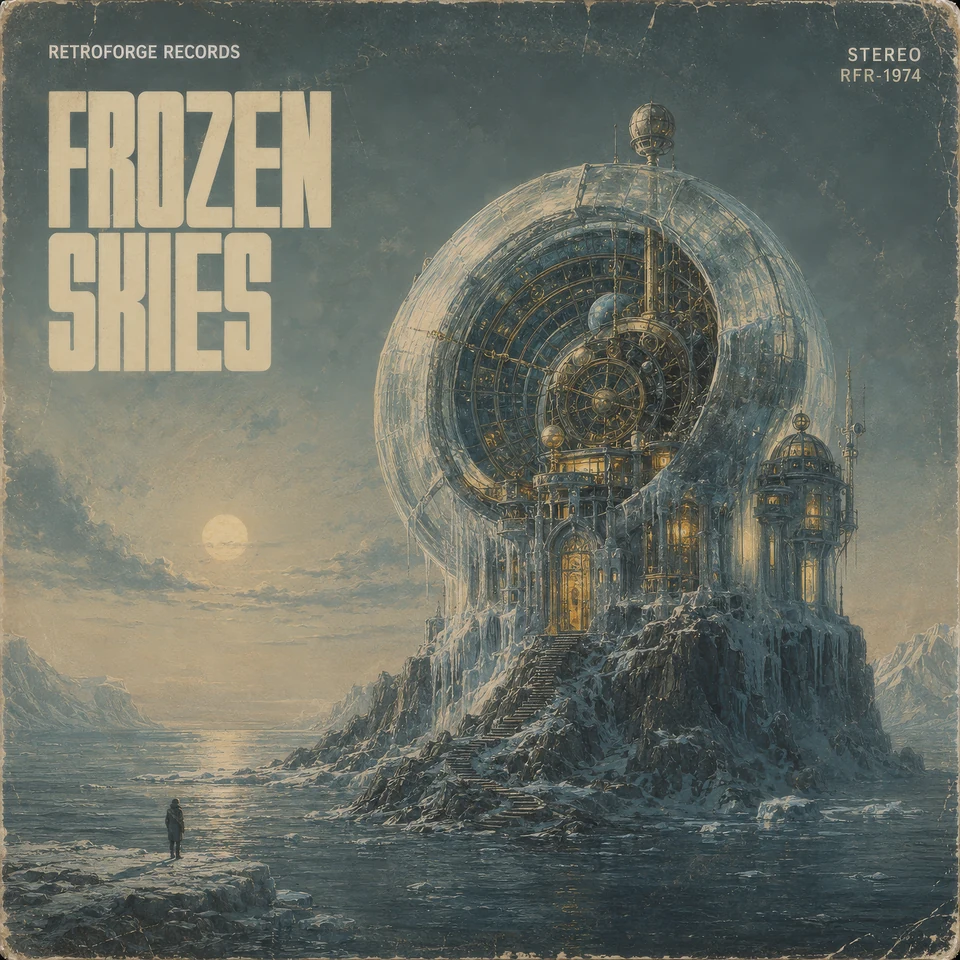
1970s · Progressive Synth Rock
Cosmic progressive rock built from Moog, Mellotron, Hammond and electric guitar.
Open the liner notes →Questions from the Record Room
Its principal sound and control signals are generated through continuous electrical voltage rather than digital calculation.
No. It is a listening route across rock styles in which analogue synthesis materially changes rhythm, texture or structure.
Musicians worked within unstable, limited systems and often built each sound manually, making performance and signal design inseparable.
Research Trail
Deeper Discovery
Start with Transitnacht / Westlicht as a RetroForge companion, then return through Krautrock to place it inside the wider family.
Curated paths into the people, records, events and ideas that give this subject its wider musical context.