
History Archive · 1978
The Man-Machine and the Moment Electronic Music Became Pop
The Man-Machine sounded designed rather than performed, yet its melodies and images travelled far beyond the experimental underground.
What Happened
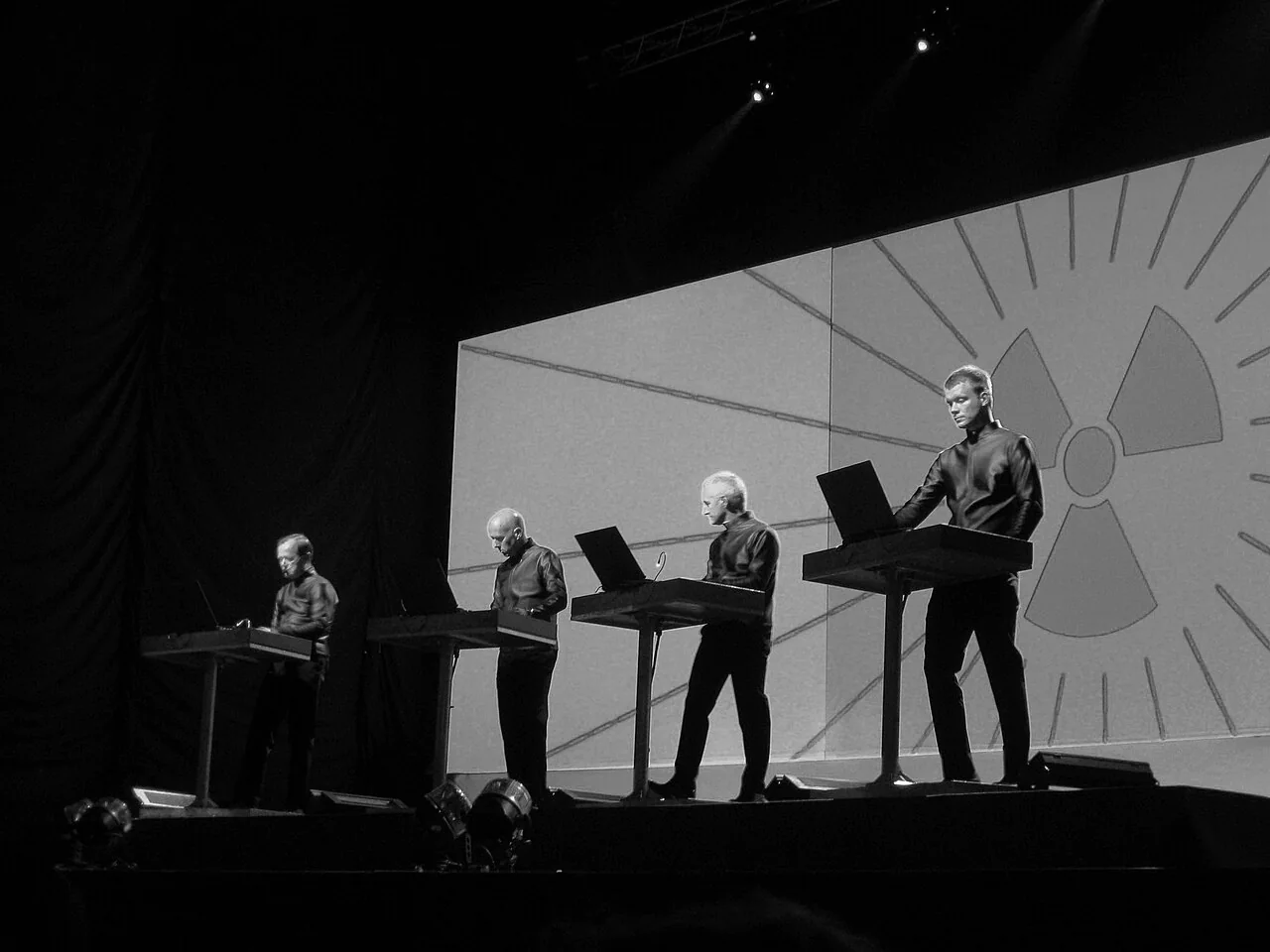
Kraftwerk released The Man-Machine in 1978, presenting six pieces around automation, urban movement, models and space. The group’s red-and-black visual design made the musicians appear as components within the same engineered system as the music.
The album followed the travel concept of Trans-Europe Express with shorter, more immediately melodic constructions. “The Model” would become a later chart success, proving the material’s unusual durability.
What the Music Sounded Like
Electronic percussion establishes exact grids while sequenced bass, vocoder-like treatment and simple melodic lines create movement through accumulation. “Neon Lights” stretches the same language across a longer, luminous ending.
How It Was Made
Kraftwerk’s Kling Klang studio functioned as workshop, instrument and identity. The group developed and adapted equipment rather than treating commercial keyboards as neutral tools. The controlled surface was the result of detailed construction.
The Wider Musical Context
Disco had made electronic pulse central to clubs, while new wave groups were searching for sounds distinct from both punk guitar and progressive scale. The Man-Machine offered a vocabulary for both.
What Followed
Synth-pop, electro, hip-hop and dance music drew on Kraftwerk’s economy and rhythm. The electronic group became a model in which music, clothing, typography and performance described one idea.
The Robots Were Both Characters and Method
On The Man-Machine, Kraftwerk’s robot image is not a simple celebration of automation. The group presents itself as disciplined workers, mannequins, pop stars and products at the same time. “The Robots” makes identity repeatable; “The Model” watches a person become an image; the title track turns labour into choreography. Emotion is never absent, but it arrives through controlled surfaces rather than confessional performance.
This ambiguity prevents the album from dating as a gadget demonstration. A machine can represent efficiency, alienation, glamour or liberation depending on who controls it. Kraftwerk’s humour is crucial: the poses are severe enough to be iconic and artificial enough to remain questionable. The record asks listeners to enjoy precision while noticing the social roles hidden inside it.
Analogue Precision Still Required Human Labour
The album’s clean geometry can suggest a push-button process that did not exist. Sequencers, drum electronics, vocoders and synthesizers had to be programmed, synchronised and performed within the limitations of late-1970s equipment. Repetition was constructed from decisions about timing, timbre and duration. A pulse may remain stable while melody, voice and texture adjust the listener’s sense of scale.
That combination of rigour and melody is the album’s great pop achievement. “Neon Lights” unfolds patiently for roughly nine minutes without losing its simple emotional centre. “The Model” is concise enough to function as a pop single, yet its detached viewpoint makes conventional desire feel like media analysis. Kraftwerk did not dilute its electronic language to reach a broader audience. It discovered how much pop was already possible inside that language.
A City, a Space Station and a Fashion Photograph
The subjects of The Man-Machine are modern archetypes rather than private stories. “Metropolis” turns the city into repeated signals; “Spacelab” looks down from an imagined technological distance; “Neon Lights” makes urban illumination tender. The album moves between public systems and solitary perception without explaining whether the future is welcoming or cold.
Its artwork reinforces that uncertainty. The red, black and white design draws on modernist visual languages while presenting the musicians as a unified graphic object. Sleeve, clothing, typography and stage identity all belong to the composition. In an era when electronic groups still risked looking like technicians behind equipment, Kraftwerk made stillness and design into performance.
Electronic Music Entered Pop Without Leaving Experiment Behind
The album became a reference point for synth-pop, electro, hip-hop, techno and later electronic performance. Different scenes heard different possibilities: concise melody, programmable rhythm, non-rock identity, visual anonymity or a model for treating technology as culture rather than equipment. Its influence cannot be reduced to a single drum sound or keyboard patch.
By 1978, the boundary between experimental electronics and pop was becoming porous. Giorgio Moroder and Donna Summer had already shown how synthetic pulse could transform disco; Bowie and Eno had moved electronic process into art rock. Kraftwerk supplied a complete public language in which the machine could sing, pose and become memorable. The future sounded less like a distant laboratory and more like a record you could put on again.
Essential Listening
- Kraftwerk — The Robots
- Kraftwerk — Spacelab
- Kraftwerk — The Model
- Kraftwerk — Neon Lights
- Yellow Magic Orchestra — Computer Game
Related Genres and Guides
Related RetroForge listening
Hear the Archive Connection
Research notes
Sources and Further Reading
- Kraftwerk catalogue — Kraftwerk
- Kraftwerk — Rock & Roll Hall of Fame
- The Man-Machine — Museum of Modern Art
- Kraftwerk – Retrospective 1 2 3 4 5 6 7 8 — Museum of Modern Art
- The Man-Machine release and six-track listing ? Apple Music / Parlophone
- The Model / Computer Love chart history ? Official Charts