Contrast as Grammar
Style changes act like punctuation rather than novelty.

Progressive Rock Family
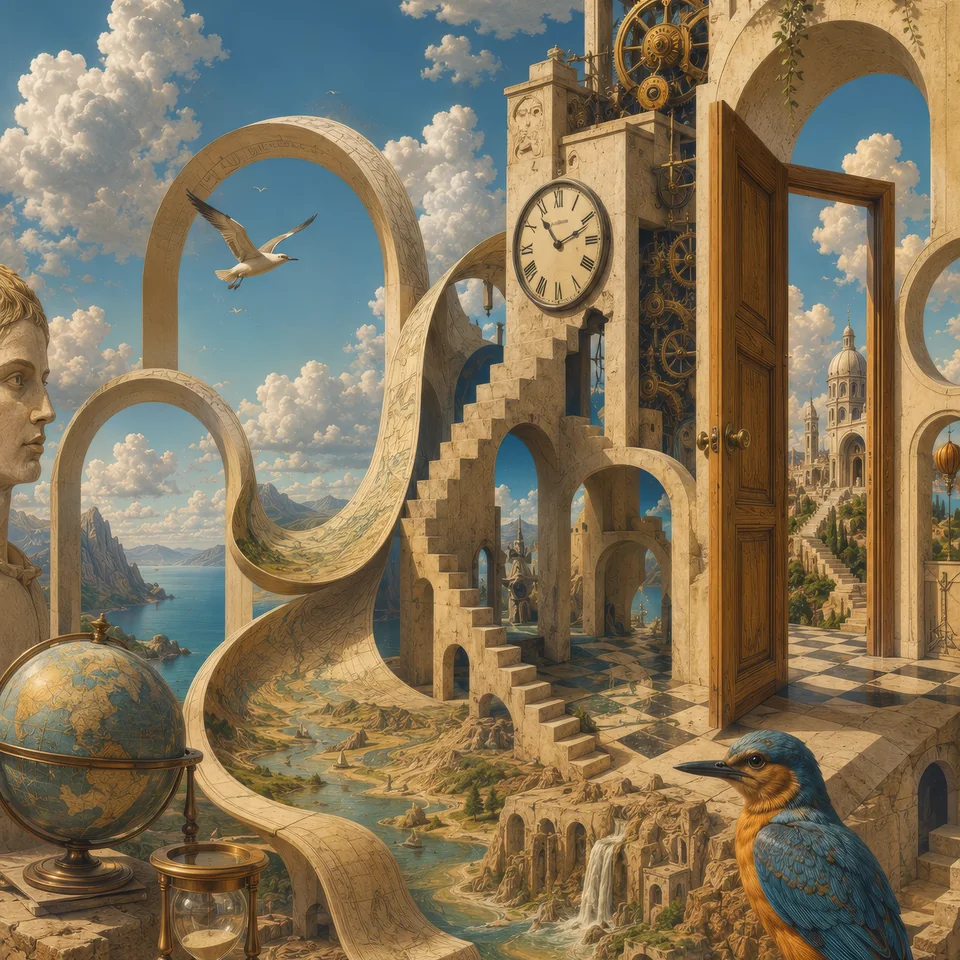
Progressive music assembled from several traditions at once, with no single school allowed to explain the whole record.
The Sound
Eclectic prog is less a historical scene than a useful classification for bands and albums that resist a narrower branch. Classical development may sit beside jazz harmony; pastoral acoustic writing can turn into hard rock; a Canterbury-like keyboard passage may lead into dissonance or psychedelic drift. The defining feature is not variety alone, but the way those sources are composed into one language.
A weakly eclectic record can feel like a pile of references. A strong one creates continuity through recurring motifs, a recognisable ensemble sound or a clear dramatic arc. Changes of metre and instrumentation then feel like different rooms in the same building rather than unrelated demonstrations.
The category is necessarily broad and often debated. That is precisely why it belongs in a genre map: it gives genuinely hybrid records a home without pretending that every progressive album must be symphonic, heavy, electronic or jazz-led. Use it when the mixture itself is the stable identity.
What You’ll Hear
How It Works
Eclectic prog draws from several progressive traditions without settling permanently inside one of them. Symphonic scale may meet jazz harmony, folk colour may interrupt a hard-rock passage, and an avant-garde rhythm may resolve into an unexpectedly direct melody.
The important question is not how many influences can be identified, but whether the transitions reveal a distinct musical identity. Strong eclectic records make contrast feel inevitable: each borrowed language performs a specific job, and the sequence gradually teaches the listener how those languages belong together.
Useful distinction: Boundary line: stylistic variety becomes eclectic prog only when the album integrates its sources. A playlist of unrelated gestures is not the same as a coherent hybrid.
Style changes act like punctuation rather than novelty.
Motifs, tone or rhythm preserve identity across changing musical languages.
Players shift roles as the arrangement moves between traditions.
The order of sections teaches the listener how to hear the whole.
Historical Development
Eclectic prog is best understood as a compositional strategy rather than a historical movement. It describes artists whose identity depends on moving among several progressive languages—symphonic, heavy, folk, jazz, electronic or avant-garde—without allowing one school to explain the whole.
King Crimson repeatedly rebuilt its vocabulary around new line-ups; Gentle Giant made stylistic contrast and counterpoint part of its grammar; Van der Graaf Generator joined organ-driven drama to free-jazz abrasion. Later groups inherited the freedom to combine sources across decades and national scenes.
Variety alone is not enough. The strongest records establish recurring rhythmic, melodic or timbral DNA, so a sudden change of style feels like another sentence from the same speaker. The listener should hear integration, not a demonstration reel.
The Real-World Foundations
Not a ranking: six useful doors into the style.
Medieval counterpoint, hard rock and compact ensemble writing share one unmistakable identity.
Percussion, violin, improvisation and heavy riffing redefine the band from the ground up.
Organ, saxophone and psychological theatre resist every comfortable subgenre boundary.
Complex composition, humour and rock directness change relationship from track to track.
Swedish folk colour, symphonic keyboards and angular writing revive prog without simple imitation.
Dark theatre, long-form development and modern ensemble force create a coherent later synthesis.
Closest RetroForge Route
1970s · Canterbury-Style Progressive Rock
Jazz-coloured keyboards, eccentric motion and conceptual structure make it the clearest RetroForge route into hybrid progressive language.
Open the liner notes →Questions from the Record Room
It should not be. The label is useful only when combining different progressive languages is central to an artist's identity.
Crossover prog usually clarifies prog through songcraft; eclectic prog foregrounds movement among several stylistic systems.
Follow recurring motifs, rhythmic habits and instrumental tone—the elements that preserve identity while the surface changes.
Related Styles
Research Trail
Deeper Discovery
Start with The River Beneath the World as a RetroForge companion, then return through Progressive Rock to place it inside the wider family.
Curated paths into the people, records, events and ideas that give this subject its wider musical context.