

Overview
Ash Ra Tempel turned side-long improvisation into a defining form of Berlin’s early-1970s cosmic music. Manuel Göttsching’s guitar could act as lead voice, repeating pattern or electronic texture, while Hartmut Enke and Klaus Schulze supplied the bass and percussion framework of the original trio.
The Conny Plank-engineered 1971 debut set a forceful electric piece, “Amboss,” against the quieter “Traummaschine.” Later records changed personnel and emphasis: Schwingungen added voice and saxophone, Seven Up involved Timothy Leary and other guests, and Join Inn briefly reunited the founding trio.
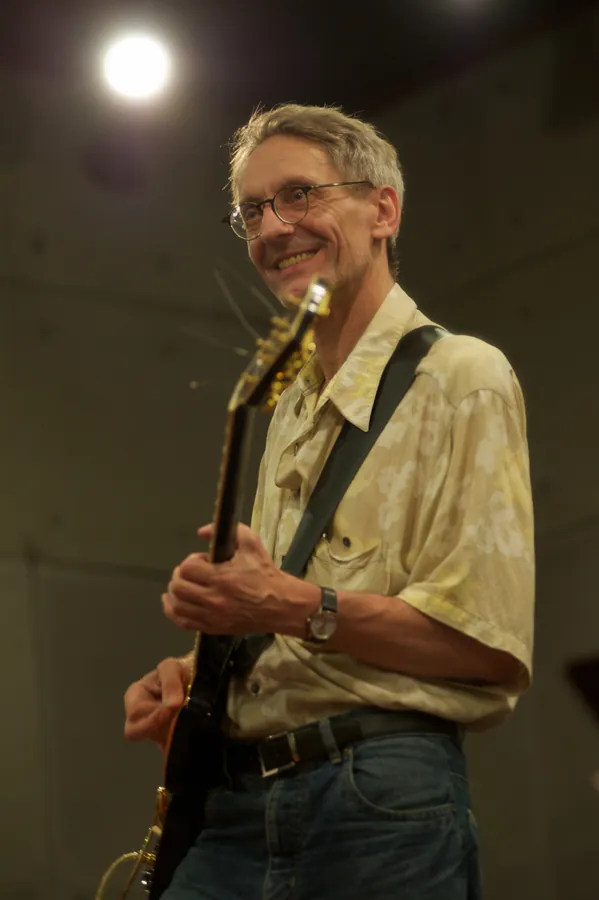
Formation & History
Ash Ra Tempel formed in Berlin in 1970 around guitarist Manuel Göttsching, bassist Hartmut Enke and drummer Klaus Schulze, who had recently left Tangerine Dream. Conny Plank engineered the trio’s self-titled debut, released by Ohr in 1971. Schulze then departed to pursue his solo career.
Göttsching and Enke recorded Schwingungen with changing guests and collaborated with Timothy Leary in Switzerland on Seven Up. Schulze returned for Join Inn, recorded during breaks in the sessions for Walter Wegmüller’s Tarot. Enke and Schulze left again after that album; Starring Rosi paired Göttsching with Rosi Müller and guests including Harald Grosskopf.
Göttsching’s 1975 Inventions for Electric Guitar was presented as both his first solo album and “Ash Ra Tempel VI.” Music recorded that year with Lutz Ulbrich for Philippe Garrel’s film Le Berceau de cristal did not receive its first commercial album release until 1993. Göttsching adopted the shorter Ashra name for New Age of Earth in 1976, and reunited with Schulze as Ash Ra Tempel for Friendship in 2000.
Sound & Style
Duration and contrast define the early records. Extended performances move between heavy collective attack and near-still passages, with Göttsching using feedback, sustain and repetition to push electric guitar toward continuous texture. Enke’s bass anchors the louder improvisations, while Schulze’s drums and organ can supply either momentum or atmosphere.
Schwingungen broadens that palette with John L.’s vocal declamation and Matthias Wehler’s saxophone. Join Inn restores the original trio but divides its two sides sharply: “Freak ’n’ Roll” is driven by bass, drums and guitar, while “Jenseits” moves through organ, voice and suspended guitar colour. The later Göttsching-led recordings increasingly replace group improvisation with layered guitar, electronics and carefully controlled repetition.
Essential Albums
Ash Ra Tempel
1971The debut contains two side-long pieces by Göttsching, Enke and Schulze. “Amboss” grows from a quiet opening into dense, high-volume improvisation; “Traummaschine” reverses the pressure through percussion, cymbal wash and sustained guitar. The opposition between force and suspension establishes the method that later lineups would keep revisiting.
Key tracks: Amboss · Traummaschine
Open album guide → View on Amazon →Schwingungen
1972Schwingungen keeps Göttsching and Enke at the centre while adding singer John L., saxophonist Matthias Wehler and drummer Wolfgang Müller. “Light: Look at Your Sun” begins in a comparatively song-like form, “Darkness: Flowers Must Die” turns voice, saxophone and rhythm into a turbulent procession, and “Suche & Liebe” stretches the second side into a quieter guitar-led arc.
Key tracks: Light: Look at Your Sun · Darkness: Flowers Must Die · Suche & Liebe
Open album guide → View on Amazon →Join Inn
1973Join Inn reunites Göttsching, Enke and Schulze; Rosi Müller contributes the spoken vocal on “Jenseits.” “Freak ’n’ Roll” develops a propulsive electric improvisation across the first side, while the organ-led second side slows the music into a spacious meditation. Recorded during breaks in the Tarot sessions, it became the original trio’s final studio album together until Friendship in 2000.
Key tracks: Freak ’n’ Roll · Jenseits
Open album guide → View on Amazon →Affiliate note: Amazon links on this page may earn RetroForge Records a small commission, at no extra cost to you.
Deeper Cuts
Starring Rosi
1973With Enke and Schulze gone, Göttsching and Rosi Müller shape a shorter, more song-oriented set with assistance from Harald Grosskopf and Dieter Dierks. Voice, acoustic guitar and compact structures sit beside the electronic drift of the earlier records.
Open album guide → View on Amazon →Le Berceau de Cristal
1993 (recorded 1975)Recorded in 1975 by Göttsching and Lutz Ulbrich for Philippe Garrel’s film, this guitar-and-electronics soundtrack remained commercially unreleased until 1993. Its patient layers connect the final Ash Ra Tempel period to Göttsching’s more controlled work as Ashra.
Open album guide → View on Amazon →Why They Still Matter
Ash Ra Tempel placed open-ended psychedelic improvisation at the centre of the album rather than treating it as a live interlude. The contrast between sustained texture and sudden collective force remains a useful model for later space rock, drone and experimental guitar music.
Göttsching carried the group’s lessons in repetition and gradual change into his solo work. His hour-long E2-E4, recorded in one take in 1981 and released in 1984, later circulated through New York clubs and became an acknowledged reference point for techno and ambient house. That later reception does not make Ash Ra Tempel a dance act, but it reveals a clear continuity in Göttsching’s attention to pulse, duration and small transformations.
Sources & Further Reading
Connected archive routes
Explore This Band
Continue through the RetroForge knowledge graph
Curated paths into the people, records, events and ideas that give this subject its wider musical context.