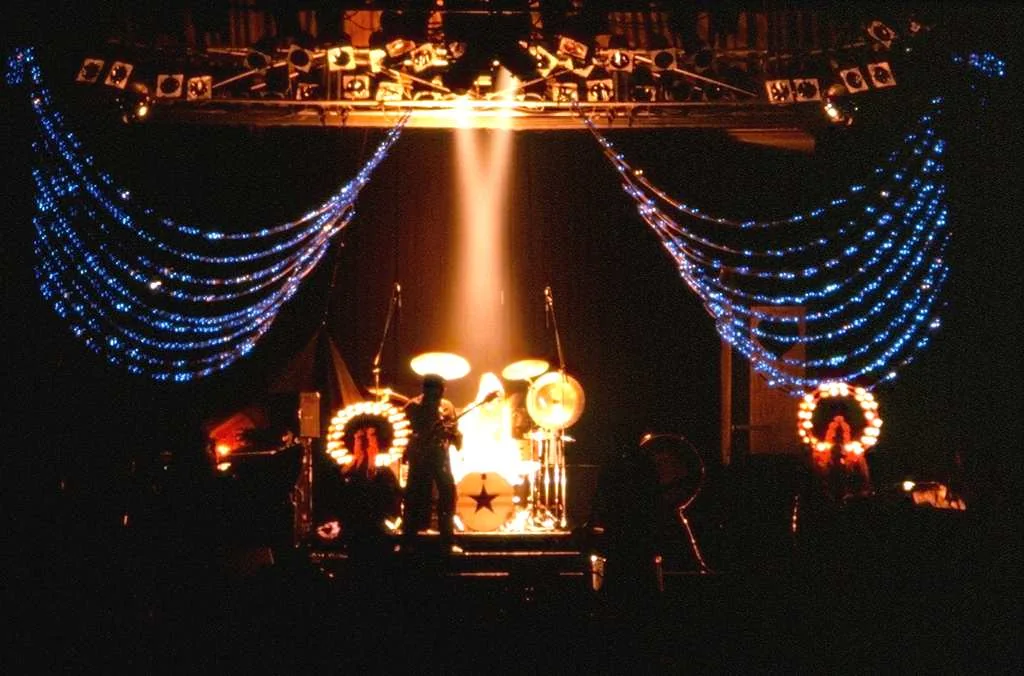
Grobschnitt developed a particularly theatrical form of German progressive rock. Long improvisations, symphonic narratives and carefully prepared tape effects shared the stage with slapstick, costumes, comic characters and lighting designed as part of the performance rather than decoration.
The catalogue records several different sides of that identity. Ballermann places compact songs beside the first released version of “Solar Music”; Rockpommel’s Land turns a fairy-tale story into a continuous studio work; Solar Music Live documents a composition whose shape depended on collective timing and the conditions of a particular concert.
Grobschnitt in a group photograph.Photo: unknown / original uploader was de:user:Markus Schweiß at 2004-04-19 21:03:29 / Wikimedia Commons · Licensed under CC BY-SA 3.0. Converted to WebP for this page.
Formation & History
Grobschnitt emerged in Hagen when members of the successor groups Charing Cross and Wutpickel reunited in February 1971. The first six-piece combined Joachim “Eroc” Ehrig and Axel “Felix” Harlos on drums with Gerd Otto “Lupo” Kühn on lead guitar, Stefan “Wildschwein” Danielak on guitar and vocals, Bernhard “Baer” Uhlemann on bass and Hermann “Quecksilber” Quetting on keyboards. Their first performances under the Kapelle Elias Grobschnitt name followed in April; the self-titled debut was recorded in December 1971 and released on Brain in April 1972.
Uhlemann, Harlos and Quetting left during 1972, briefly stopping the band. Eroc, Lupo and Wildschwein resumed with keyboardist Volker “Mist” Kahrs; Uhlemann returned before Wolfgang “Popo” or “Hunter” Jäger took over bass in 1975. From 1973 onward, the concerts increasingly integrated taped collages, make-up, acting and characters performed by crew members including Toni Moff Mollo. The original band's albums moved from the double-LP scale of Ballermann through the bilingual versions of Jumbo, the concept album Rockpommel’s Land and the live monument Solar Music Live. Later lineups became more song-oriented; the farewell concert took place in Hagen on 4 December 1989. Reunion concerts followed from 2006 to 2012, and Lupo, Wildschwein and Nuki later revisited the repertoire acoustically.
Sound & Style
Lupo's sustained lead guitar and Mist's organ, piano and synthesizer lines could build wide symphonic arcs, while Eroc used drums, percussion, electronic effects and prepared tapes to shape the space around the band. Wildschwein's voice could carry sincere narrative one moment and exaggerated theatrical delivery the next. The rhythm section did not merely support solos: repeated bass figures and patient dynamic changes made the long performances coherent.
“Solar Music” is the clearest example of the method. Its roots appear as “Sun Trip” on the 1972 debut; the 33-minute studio version on Ballermann establishes recurring material, but concert versions could grow much longer and absorb new solos, quiet sections and effects. By contrast, Rockpommel’s Land uses four connected compositions, acoustic detail and controlled transitions to tell Ernie's journey with little of the stage show's deliberate chaos.
Essential Albums
1978
Solar Music Live
Brain · Original 1978 release
Solar Music Live was recorded at the Otto Pankok Forum in Mülheim on 7 April 1978, then remixed at Conny's Studio by Eroc and Geheimrat Günstig. Seven indexed sections divide a continuous performance across the original LP, moving through low pulses, guitar sustain, keyboards, electronic effects and large ensemble climaxes. The recording shows why no single studio arrangement could define the piece: transitions depend on patient collective timing, and even individual solos remain part of a shared dramatic arc. Eroc produced the album and also created its artwork.
Key sections: Mülheim Special · Otto Pankrock · Golden Mist
Rockpommel's Land follows the boy Ernie, who escapes a grey everyday world with the bird Maraboo. Four connected tracks move from “Ernie's Reise” through the oppressive Severity Town and the brief release of “Anywhere” to the side-long title piece. Mist conceived the story and its central themes; keyboards and acoustic passages provide symphonic breadth while Lupo's electric guitar supplies the main instrumental peaks. The band recorded and mixed the album at Conny's Studio from November 1976 to February 1977 with Conny Plank and Eroc. Its first live performance preceded the April release by a month.
Key tracks: Ernie’s Reise · Severity Town · Anywhere · Rockpommel’s Land
Ballermann was recorded at Dieter Dierks' studio in Stommeln over six days in February 1974, engineered by Dierks and produced by Frank Mille. Its first disc moves between the short comic entrance “Hello My Dear Friends,” the rhythmic caricature “Sahara,” the nine-minute “Nickelodeon” and the longer “Magic Train.” The second disc is devoted to the first released “Solar Music,” split into two parts totalling roughly 33 minutes. Mist's keyboards and Eroc's electronics widen the palette, but Lupo's guitar and the rhythm section give the long form its direction.
Key tracks: Sahara · Nickelodeon · Magic Train · Solar Music
Grobschnitt show why progressive-rock history cannot be reconstructed from studio albums alone. “Solar Music” was not simply a long composition but a changing performance practice: the 1974 studio version, the 1978 Mülheim recording and later concert variants preserve related material in different structures.
The band also treated technicians, actors, lighting and taped sound as parts of one ensemble. That approach connected krautrock-era experiment, symphonic storytelling and popular theatre without reducing any of them to background decoration. The continuing archival editions and acoustic reinterpretations demonstrate that the repertoire can survive beyond the original staging while retaining its distinctly local Hagen identity.
RetroForge Records publishes original music and independent editorial guides. This historical band guide is not affiliated with the artist, labels or rights holders. No unlicensed album artwork is reproduced.