Frank Bornemann founded Eloy in Hanover in 1969 and became the only musician present through every version of the group. The debut began in hard and psychedelic rock, but Inside, Floating and the first concept album Power and the Passion progressively established organ, synthesizer, longer structures and Bornemann's lead voice as central features.
The best-known formation arrived only after the 1975 lineup collapsed completely. Bornemann rebuilt Eloy with bassist Klaus-Peter Matziol, keyboardist Detlev Schmidtchen and drummer-lyricist Jürgen Rosenthal. Dawn, Ocean and Silent Cries and Mighty Echoes form a documented three-album sequence whose audience success contrasted sharply with hostile sections of the German music press. The official history identifies Ocean as the band's best-selling album.
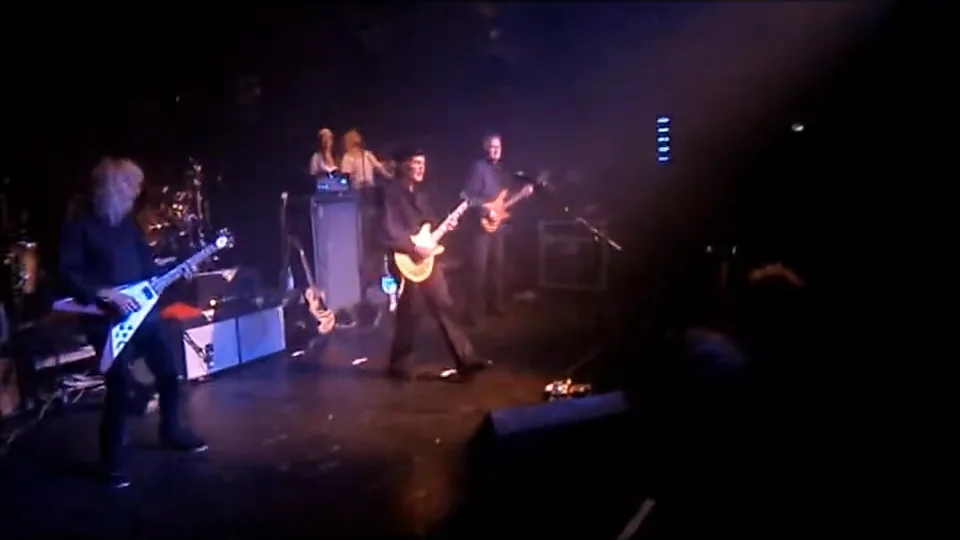
Eloy performing at the Markthalle in Hamburg in 2012.Photo: Erich Heeder - KUNST-OBJEKTE-AUTOR / Hamburg / Wikimedia Commons · Licensed under CC BY 3.0. Converted to WebP for this page.
Formation & History
Bornemann took the name from the Eloi in H. G. Wells's The Time Machine. After a regional band competition led to the 1970 single “Walk Alone” / “Daybreak,” Philips issued the first album in 1971, recorded in Hamburg with engineer Conny Plank. Singer-pianist Erich Schriever then left, Bornemann assumed lead vocals and Manfred Wieczorke moved from guitar to organ. Inside appeared on Harvest in 1973, followed by Floating and the 1975 concept album Power and the Passion.
Managerial conflict then broke the group apart, leaving Bornemann without a band. EMI supported a reconstruction: Schmidtchen, Matziol and Rosenthal joined him for Dawn in 1976. Rosenthal wrote the lyrics as well as playing drums and percussion; a string arrangement added orchestral colour. Ocean followed in 1977, and the official history records a 1995 gold award after 250,000 German sales. Concert recordings from the accompanying period became the 1978 double album Live.
Tensions over Rosenthal's lyrics, the schedule for Silent Cries and Mighty Echoes and plans for Bornemann's Horus Sound Studio preceded another rupture in 1979. Schmidtchen and Rosenthal left; Bornemann and Matziol rebuilt with guitar-keyboard player Hannes Arkona, keyboardist Hannes Folberth and drummer-lyricist Jim McGillivray for Colours in 1980. That lineup continued into the linked science-fiction albums Planets and Time to Turn.
Eloy's first long run ended in 1984. Bornemann later worked with keyboardist Michael Gerlach, Matziol returned, and Ocean 2: The Answer revisited the 1977 concept in 1998. A further active phase began around Visionary in 2009. Bornemann then created a Joan of Arc trilogy: The Vision, the Sword and the Pyre Parts I and II appeared in 2017 and 2019, followed by Echoes from the Past in 2023.
Sound & Style
The early Harvest records build from Wieczorke's organ, Bornemann's guitar and a heavy rhythm section; “Land of Nobody” on Inside stretches that instrumentation across seventeen minutes. By Power and the Passion, synthesizers and a continuous story encourage broader transitions, but the 1976 quartet changes the balance more decisively.
Schmidtchen's keyboards supply organ, synthesizer and Mellotron-scale atmosphere; Matziol's melodic bass and Rosenthal's percussion prevent the longer pieces from becoming static. Bornemann often delays his guitar entrance until a keyboard field and repeated rhythm have established scale, then uses sustained melodic lines rather than constant soloing. Rosenthal's narration and lyrics make Dawn, Ocean and Silent Cries theatrical without requiring rapid British-style virtuoso exchanges.
Colours deliberately contracts the form into eight shorter pieces and gives Arkona's second guitar more room beside Folberth's keyboards. Planets expands again through a science-fiction sequence recorded at Horus Sound Studio. The later Joan of Arc trilogy adds multiple voices, choirs and contemporary production while retaining Bornemann, Matziol and layered keyboards as links to Eloy's established language.
Essential Albums
1977
Ocean
Harvest · Original 1977 release
Ocean uses Greek myth as a frame for a civilisation moving toward catastrophe. Its four long pieces give Bornemann, Matziol, Schmidtchen and Rosenthal room to work at architectural scale: “Poseidon’s Creation” rises from spacious keyboards into a commanding guitar theme, while “Atlantis’ Agony at June 5th – 8498, 13 P.M. Gregorian Earthtime” occupies the closing side. The official band history calls it Eloy’s best-selling album and records a German gold award in 1995 after 250,000 sales. That durability makes it the clearest entry point into the classic quartet’s combination of concept, sound and duration.
Dawn is the first album by Eloy’s reconstructed quartet of Bornemann, Matziol, Schmidtchen and Rosenthal. Short links and longer songs form a continuous dramatic sequence, while strings arranged for the recording extend the palette beyond guitar, keyboards and rhythm section. “Awakening,” “The Sun-Song” and “The Dance in Doubt and Fear” repeatedly change the balance between narration and instrumental space. Eloy’s official history describes it as the band’s greatest success to that point. Start here to hear the celebrated lineup establishing the language that Ocean would enlarge.
Key tracks: Awakening · The Sun-Song · The Midnight-Fight
Silent Cries and Mighty Echoes is the final studio album by the Bornemann–Matziol–Schmidtchen–Rosenthal quartet. “Astral Entrance” and “Master of Sensation” move from suspended synthesizer space into a firm pulse; the multi-part “The Apocalypse” occupies the centre, while “Mighty Echoes” closes with reflective weight. Bornemann’s guitar often emerges from the keyboards instead of competing with them. The controlled studio surface is inseparable from a difficult period: Eloy’s official history documents tensions over Rosenthal’s lyrics, the recording schedule and plans for Horus Sound Studio before Schmidtchen and Rosenthal departed.
Key tracks: Astral Entrance / Master of Sensation · The Apocalypse · Pilot to Paradise
Eloy’s catalogue documents a German route from psychedelic hard rock into symphonic space music without simply reproducing the British model. The commercial life of Ocean is especially revealing: despite the hostility described in the band’s official history, it remained popular enough to receive German gold in 1995, eighteen years after release.
The catalogue also survives because Bornemann repeatedly treated a breakup as an opportunity to redesign the ensemble. The compact, twin-guitar profile of Colours differs materially from the Rosenthal-era epics, while the three Joan of Arc albums issued in 2017, 2019 and 2023 turn a late-career historical project into a substantial final chapter rather than a nostalgic footnote.
RetroForge Records publishes original music and independent editorial guides. This historical band guide is not affiliated with the artist, labels or rights holders. No unlicensed album artwork is reproduced.