Nektar formed in Hamburg in December 1969 when four British musicians—Roye Albrighton, Allan “Taff” Freeman, Derek “Mo” Moore and Ron Howden—built a new group from relationships made on the West German club circuit. Visual artist Mick Brockett soon became a fifth creative member. His projections, liquid lights and later video elements made the Sound and Light Theatre part of the composition rather than decoration around it.
The classic records move well beyond a single space-rock formula. A Tab in the Ocean preserves the weight of the German club band; Remember the Future turns one continuous composition into an unusually melodic American breakthrough; Down to Earth adopts a circus frame; and Recycled connects ecological anxiety to harder, more densely layered progressive rock. Later revivals continued the name, but they should not be mistaken for one uninterrupted lineup running from 1969 to the present.
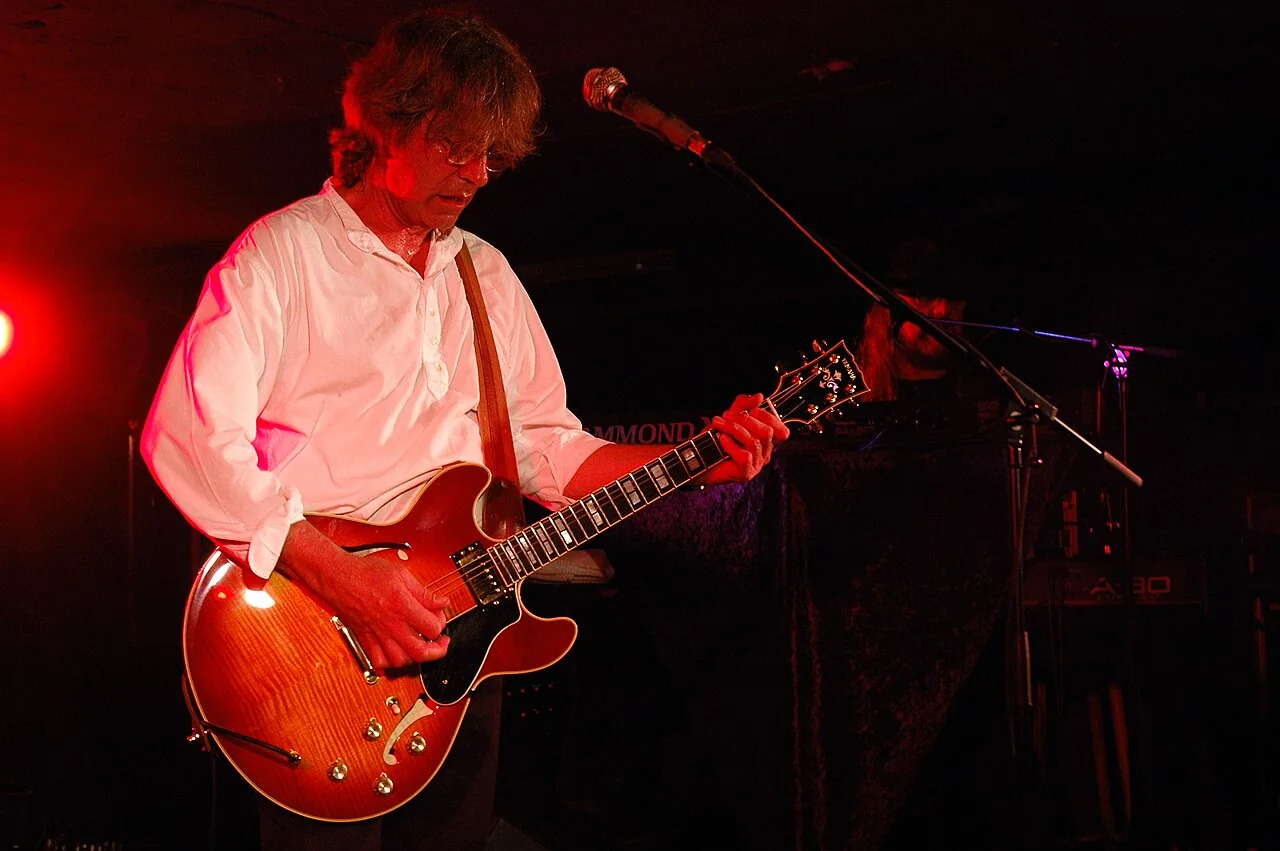
Nektar performing live.Photo: BlueBreezeWiki / Wikimedia Commons · Licensed under CC BY-SA 3.0. Converted to WebP for this page.
Formation & History
Moore and Howden had worked together in Germany before Scottish keyboardist Freeman joined their group Prophesy. They met Albrighton when Prophesy shared the Star-Club stage with his band Rainbows. After Albrighton returned to Hamburg in 1969, the four tested the new combination at a gig and chose the name Nektar. Brockett reconnected with them soon afterward and developed an increasingly elaborate visual environment alongside their music.
The debut Journey to the Centre of the Eye was recorded for Bellaphon’s Bacillus imprint in 1971. A Tab in the Ocean followed in 1972, before the group travelled to Chipping Norton Studios in August 1973 to complete Remember the Future. Passport made that album Nektar’s first American release; it reached number 19 on the Billboard album chart and led to the band’s first major United States tour in 1974. American listeners then encountered a catalogue that had already developed across several European albums.
Larry Fast added Moog and Mellotron to the 1975 Recycled sessions at Château d’Hérouville and AIR Studios. Albrighton played his final show of the classic period in December 1976, Dave Nelson replaced him, and Brockett’s original full light show ended in 1977. Albrighton briefly rejoined in 1978 before that phase ended. He later led new Nektar lineups, and a 2002 reunion brought the original five creative members together again; subsequent versions therefore belong to distinct revival periods.
Sound & Style
Nektar’s original quartet plays with the directness of a hard-rock band even inside side-long structures. Albrighton’s guitar and lead voice carry clear melodic themes; Freeman moves between Hammond, piano, Mellotron and synthesizer; Moore and Howden provide a rhythm section capable of abrupt changes without losing weight. Shared vocals from Albrighton, Moore and Freeman give recurring refrains an immediacy that makes the long forms easier to follow.
The records were designed with performance in mind. Themes return, tempos change and suites break into episodes that can be coordinated with Brockett’s projected images. The original Sound and Light Theatre used liquid lights, slides, lasers and, eventually, video backgrounds. That spatial thinking does not make the music shapeless: the band usually preserves riffs, songs and ensemble transitions, distinguishing it from both the more open improvisation associated with some krautrock and the orchestral imitation of symphonic prog.
Essential Albums
1973
Remember the Future
Bacillus/Bellaphon · Released 1973 · BLPS 19164
Remember the Future is one composition divided across two LP sides. The Bluebird and a blind boy provide its hopeful narrative, but the musical clarity explains the album’s reach: vocal refrains return in transformed settings, guitar and organ exchange the lead, and the rhythm section carries transitions without obvious seams. The official credits assign the music to Albrighton, Freeman, Moore and Howden, with lyrics by Albrighton, Moore and Brockett and production by Peter Hauke. Passport’s American release reached number 19 on Billboard. Hear both parts together; shorter edits preserve hooks but remove the balance of memory, recognition and return.
Key tracks: Remember the Future, Part One · Remember the Future, Part Two
A Tab in the Ocean gives Nektar’s early sound a darker, heavier frame. The seventeen-minute title piece fills the first side, moving from an imposing keyboard-and-guitar theme through quieter vocal sections and back toward full-band force. “Desolation Valley/Waves,” “Crying in the Dark” and “King of Twilight” complete the original four-track German sequence. The 1972 mix captures the band’s European club weight; a brighter American remix followed in 1976, so later editions may contain two audibly different versions of the album. Start with the original mix to hear how the long-form writing sounded before the American breakthrough.
Key tracks: A Tab in the Ocean · Desolation Valley / Waves · King of Twilight
Recycled turns resource depletion, automation and environmental damage into two continuous LP sides. “Recycle,” “Cybernetic Consumption” and “Automation Horrorscope” drive the first half through hard guitar and rapid ensemble changes. The second side moves from “Unendless Imaginations” and “São Paulo Sunrise” toward “It’s All Over.” Larry Fast’s Moog and Mellotron add an electronic layer, while the English Chorale enlarges selected passages without replacing the original quartet. Recorded at Château d’Hérouville and AIR Studios, this is the band’s densest studio construction and its clearest union of technical ambition with a social subject.
Key tracks: Recycle · Cybernetic Consumption · It’s All Over
Nektar complicates any national map of progressive rock. The musicians were British, the group formed and first recorded in West Germany, and its largest chart breakthrough came in the United States. The Bacillus catalogue, Passport releases and touring history show how progressive music circulated across borders rather than developing in isolated British and German scenes.
The original lineup also proved that side-long composition could remain melodic, heavy and playable, while Brockett treated projected visuals as the work of a fifth member. Those two achievements belong together: recurring musical themes and recurring images helped a large structure remain legible in concert. Later lineups preserved parts of that method, but the 1969–1976 creative unit remains the clearest reason Nektar still connects with space-rock, heavy-prog and concept-album audiences.
RetroForge Records publishes original music and independent editorial guides. This historical band guide is not affiliated with the artist, labels or rights holders. No unlicensed album artwork is reproduced.