Triumvirat emerged in Cologne in 1969 and built their identity around a keyboard-led trio: Jürgen Fritz on piano, Hammond organ and synthesizers, Hans Bathelt on drums and lyrics, and a succession of bassists and singers. Their most focused period runs from Mediterranean Tales through Spartacus, when long-form writing, disciplined ensemble playing and increasingly ambitious studio production developed in parallel.
The comparison with Emerson, Lake & Palmer is historically justified—Bathelt recalled that the early group played material by The Nice and admired Keith Emerson—but it does not explain everything. Triumvirat’s strongest suites rely less on open display than on recurring themes, quick transitions and vocal episodes that keep large structures moving.
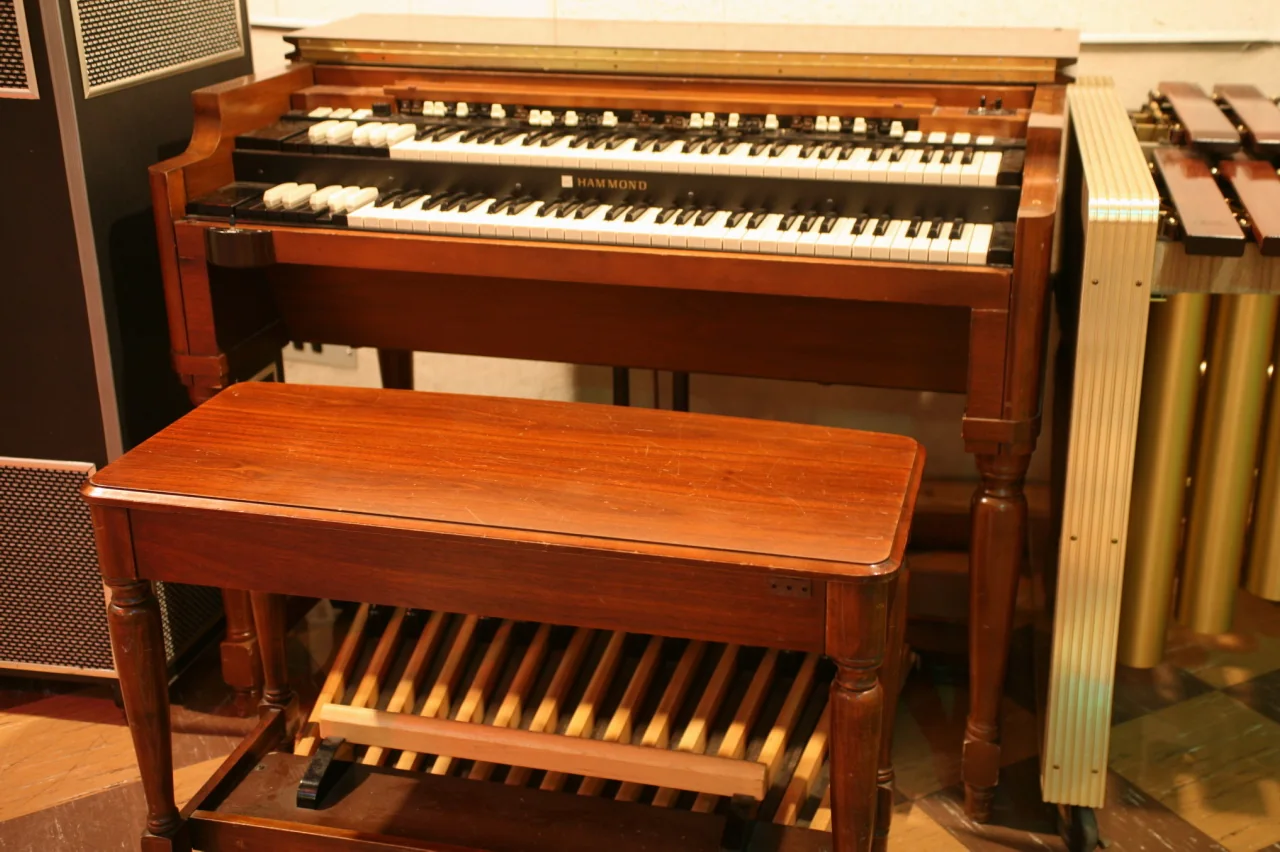
A Hammond organ at RCA Studio B, representing the keyboard-led architecture at the centre of Triumvirat’s sound.Photo: Cliff from I now live in Arlington, VA (Outside Washington DC), USA / Wikimedia Commons · Licensed under CC BY 2.0. Converted to WebP for this page.
Formation & History
Fritz and Bathelt founded Triumvirat with bassist Werner “Dick” Frangenberg. When Frangenberg could no longer devote enough time to rehearsals, Hans-Georg Pape replaced him in 1970 and played and sang on the 1972 debut Mediterranean Tales. Pape left during work on Illusions on a Double Dimple; Fritz’s cousin Helmut Köllen completed the record, singing throughout and playing bass and guitar on the second suite. The resulting album combined the group with orchestral, brass, choral and saxophone parts.
Capitol released Illusions in the United States, where the band opened about forty dates for Fleetwood Mac. Fritz, Bathelt and Köllen then recorded Spartacus in 1975 with engineer Geoff Emerick. Köllen left after the subsequent tour to pursue his own work. Frangenberg returned and British singer Barry Palmer joined for Old Loves Die Hard in 1976. Bathelt departed in 1977; Pompeii appeared as New Triumvirat amid a dispute over the name, and later records increasingly became Fritz-led studio projects. The run ended with Russian Roulette in 1980.
Sound & Style
Fritz assigns different structural jobs to his keyboards. Grand piano often establishes a rhythmic pattern, Hammond organ thickens climaxes, and synthesizer lines carry melodies across sectional breaks. Bathelt’s precise accents make abrupt tempo and metre changes readable rather than merely complicated. The bass-and-vocal role changes with each phase: Pape gives the debut a rougher trio character, while Köllen brings a clearer melodic centre to the 1974–75 records.
The arrangements also distinguish the albums. Mediterranean Tales exposes the mechanics of the trio; Illusions on a Double Dimple expands them with orchestra, brass, chorus and studio voices; Spartacus compresses the method into shorter narrative units. Triumvirat borrowed the keyboard-trio vocabulary of The Nice and ELP, but their characteristic strength is architectural: themes return in altered settings, and instrumental virtuosity serves a planned dramatic sequence.
Essential Albums
1974
Illusions on a Double Dimple
Harvest · Original 1974 release
Illusions on a Double Dimple contains two side-long suites. Hans-Georg Pape plays most of the bass on the first, while Helmut Köllen sings across the album and takes bass and guitar on “Mister Ten Percent.” That change is audible: the first suite presents episodes of economic pressure and office life; the second gains a warmer vocal centre as its protagonist moves through sudden fortune and its consequences. Orchestra, Kurt Edelhagen’s brass players, chorus and Karl Drewo’s saxophone enlarge Fritz and Bathelt’s framework without obscuring its rhythmic detail.
Key tracks: Illusions on a Double Dimple · Mister Ten Percent
Spartacus turns the revolt against Rome into a nine-track historical concept album. “The Capital of Power” establishes the imperial setting; the three-part “School of Instant Pain” compresses training, resistance and escape; “The March to the Eternal City” drives the campaign toward defeat; and the title track closes on the cost of rebellion. Geoff Emerick’s engineering gives Fritz’s keyboards, Köllen’s bass and voice, and Bathelt’s drums a more unified scale than the layered forces of Illusions.
Key tracks: The Capital of Power · The School of Instant Pain · Spartacus
Mediterranean Tales documents Fritz, Bathelt and Hans-Georg Pape before the better-known Köllen line-up. The side-long “Across the Waters” already uses recurring piano and organ ideas to connect multiple episodes, while “Eleven Kids” and “E Minor 5/9 Minor/5” show a group still moving between song form, blues-derived rhythm and instrumental construction. Its leaner production leaves more air around Pape’s bass and Bathelt’s drums, making the trio’s division of labour especially clear.
Key tracks: Across the Waters · Eleven Kids · E Minor 5/9 Minor/5
Triumvirat show that the keyboard-trio format was not confined to Britain. A Cologne group could begin by playing The Nice material, absorb the example of ELP, and then develop a recognisable approach through German studio resources, Fritz and Bathelt’s suite writing, and Köllen’s distinctive voice. Their strongest records are evidence of influence becoming a working method rather than a disguise.
Their international route matters too. Capitol’s support, American FM airplay and tours with British, German and American acts carried Illusions and Spartacus beyond a national progressive-rock circuit. The later line-up instability reduced the sense of a fixed trio, but the 1972–75 sequence remains a precise study in how arrangement, personnel and production can transform the same basic instrumental architecture.
RetroForge Records publishes original music and independent editorial guides. This historical band guide is not affiliated with the artist, labels or rights holders. No unlicensed album artwork is reproduced.