National Health formed in July 1975 when keyboardists Dave Stewart of Hatfield and the North and Alan Gowen of Gilgamesh brought musicians from their overlapping London-based circles into one project. The band belongs to the Canterbury scene through personnel and musical language, not because it was a local Canterbury group.
Its two 1978 studio albums compress the original plan for a double-keyboard, double-guitar rock orchestra into changing, more practical lineups. Long-form writing, jazz harmony, interlocking electric keyboards and carefully placed voices matter more than solo display. After the regular band split in March 1980, a 1981 reunion recorded Gowen’s compositions as the memorial album D.S. Al Coda; two final Edinburgh performances followed in 1983.
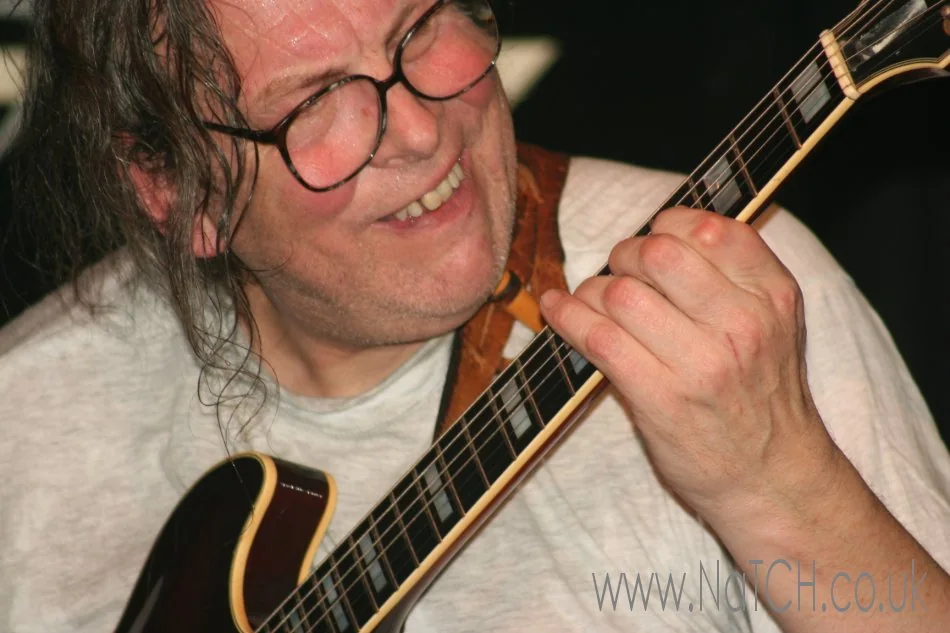
National Health guitarist Phil Miller performing at the Pip Pyle memorial concert in London in 2006.Photo: Natcheng at English Wikipedia / Wikimedia Commons · Licensed under CC BY-SA 3.0. Converted to WebP for this page.
Formation & History
The idea grew from combined Hatfield and the North–Gilgamesh concerts in 1973. Stewart and Gowen’s initial 1975 lineup paired their keyboards with guitarists Phil Miller and Phil Lee, bassist Mont Campbell, vocalist Amanda Parsons and, after an extended search, drummer Bill Bruford. The goal was still larger—three female singers had been considered—but even this seven-member version proved difficult to finance and keep together.
Lee left before the first British tour; Campbell and Bruford followed during 1976. Neil Murray took over bass, Pip Pyle became the regular drummer, and both Parsons and Gowen departed in early 1977. They nevertheless returned as guests when recording finally began, preserving parts of the original two-keyboard conception on the self-titled debut. Murray left for Whitesnake in January 1978 and John Greaves joined before the summer sessions for Of Queues and Cures.
Stewart departed in late 1978 after cancelled dates and continuing financial pressure. Gowen returned in January 1979 to join Miller, Greaves and Pyle; this quartet toured Europe and the United States but made no studio album before splitting in March 1980. After Gowen died from leukaemia in May 1981, Miller, Stewart, Greaves and Pyle reassembled for a memorial concert and an album of his compositions, released as D.S. Al Coda in 1982.
Sound & Style
Stewart’s organ and electric piano work through tightly voiced counterpoint rather than broad symphonic chords. On the debut, Gowen’s piano, electric piano and synthesizer can answer or overlap Stewart while Miller’s guitar threads a drier melodic line between them. Amanda Parsons’s largely wordless vocals, Jimmy Hastings’s woodwinds and Pyle’s detailed percussion enlarge the ensemble without turning every passage into a massed tutti.
Of Queues and Cures changes the centre of gravity. Greaves’s bass and vocals create a firmer low end, while Georgie Born’s cello and guest winds add chamber-like friction. Irregular metres rarely feel like demonstrations: Pyle keeps subdivisions elastic, and the written parts continually redistribute melody and rhythm. The 1979 Gowen lineup became looser in performance, but its greater improvisational emphasis survives on the later live release Play Time, not on a contemporary studio LP.
Essential Albums
1978
Of Queues and Cures
Charly · Released December 1978
Of Queues and Cures is the most concentrated National Health album. John Greaves’s bass and Georgie Born’s cello give the ensemble a firmer, darker centre, while “The Collapso” turns Pip Pyle’s compact rhythmic idea into an agile opener. Phil Miller’s “Dreams Wide Awake” balances a memorable guitar theme with exact ensemble movement; Greaves’s “Squarer for Maud” makes room for Peter Blegvad’s oblique recitation. Stewart’s “The Bryden 2-Step” divides its amphibian dance across the record. The playing is formidable, yet every guest colour and rhythmic turn serves the composition rather than a fusion showcase.
Key tracks: The Collapso · Dreams Wide Awake · Squarer for Maud
The self-titled debut preserves the scale of National Health’s first conception despite almost two years of personnel changes before recording began. Stewart’s “Tenemos Roads” unfolds through Amanda Parsons’s wordless voice, keyboards, woodwinds and Phil Miller’s searching guitar. Gowen returned as a guest for “Brujo” and for parts of the large “Elephants” sequence he had co-written with Stewart. Neil Murray anchors the core quartet on fretless bass, while Pyle’s percussion keeps the long harmonic curves in motion. The album is best followed as a continuous design rather than as isolated virtuoso moments.
D.S. Al Coda is both a memorial to Alan Gowen and a practical act of preservation. Stewart, Miller, Pyle and Greaves returned to record previously unrecorded or newly arranged Gowen compositions, along with two pieces associated with Gilgamesh. Guests including Elton Dean, Jimmy Hastings and Richard Sinclair broaden the palette without obscuring the writing. “Portrait of a Shrinking Man,” “Black Hat” and “Shining Water” retain Gowen’s angular harmony and understated melancholy. Rather than imitate the exact sound of either 1978 album, the musicians let his concise themes determine the shape of the tribute.
Key tracks: Portrait of a Shrinking Man · Black Hat · Shining Water
National Health demonstrates that the Canterbury vocabulary could survive the mid-1970s collapse of the infrastructure that had supported it. The band did not simplify its writing to fit a changing market: it found compact recorded forms for counterpoint, jazz harmony, dry humour and unusual combinations of electric and acoustic colour.
The catalogue also documents three genuinely different situations: the remnants of an ambitious rock orchestra on the debut, a tighter quartet with chamber guests on Of Queues and Cures, and an act of collective remembrance on D.S. Al Coda. Later archival releases add the missing early demos and the more improvisational 1979 quartet, allowing listeners to hear change rather than treating “the Canterbury sound” as one fixed arrangement.
RetroForge Records publishes original music and independent editorial guides. This historical band guide is not affiliated with the artist, labels or rights holders. No unlicensed album artwork is reproduced.