The Moody Blues transformed themselves from a Birmingham rhythm-and-blues group into one of the principal architects of album-oriented symphonic and psychedelic rock. Their classic records joined concise songwriting to recurring themes, spoken poetry, Mellotron and studio transitions, creating journeys that could still yield memorable standalone singles. The combination made ambitious rock accessible without making it slight.
The band’s importance lies not only in Days of Future Passed. From 1967 through Seventh Sojourn, Justin Hayward, John Lodge, Mike Pinder, Ray Thomas and Graeme Edge sustained a sequence built from shared authorship and sharply contrasting roles. Hayward and Lodge supplied much of its melodic drive, Pinder brought gravity and keyboard architecture, Thomas added pastoral and psychedelic colour, and Edge’s drumming and framing poems helped the separate voices belong to one recognisable sound.
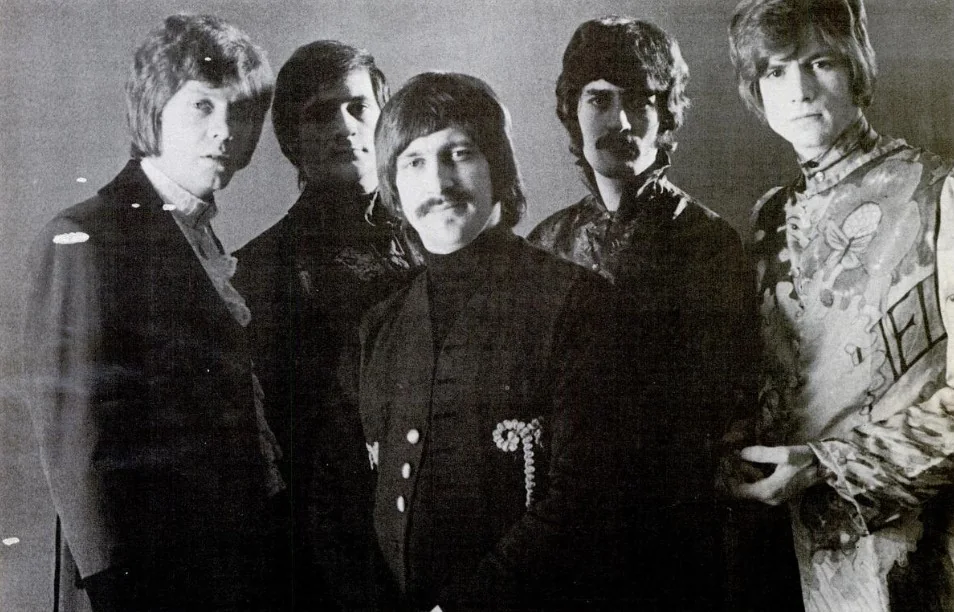
The Moody Blues in a 1968 Billboard publicity photograph.Photo: Deram Records / Wikimedia Commons · Licensed under Public domain. Converted to WebP for this page.
Formation & History
The Moody Blues formed in Birmingham in May 1964 with Graeme Edge, Denny Laine, Mike Pinder, Ray Thomas and Clint Warwick, initially playing R&B-oriented pop. Laine sang their early hit “Go Now,” but he and Warwick left in 1966. Guitarist and singer Justin Hayward and bassist and singer John Lodge joined Edge, Pinder and Thomas that October, creating the five-man formation associated with the classic albums.
Days of Future Passed began in the context of Decca’s Deram sound experiments and used arrangements by Peter Knight with the London Festival Orchestra. The band’s own songs, however, became the real project: a day-in-the-life sequence joined by orchestral interludes. On In Search of the Lost Chord the five musicians supplied the expanded instrumentation themselves, incorporating sitar, tabla, flute, Mellotron and studio effects.
The group established Threshold Records and carried its classic seven-album sequence through Seventh Sojourn in 1972. Concert activity paused after 1974, and the five reunited to record Octave, released in 1978. Pinder left after that album; later lineups developed a more streamlined, synthesizer-aware sound. The band’s final concerts took place in 2018, the same year it entered the Rock & Roll Hall of Fame.
Sound & Style
Mike Pinder’s Mellotron is the most immediately recognisable texture, but the Moody Blues sound depends equally on vocal harmony and contrasting songwriters. Hayward’s acoustic and electric guitars carry clear melodic shapes; Lodge treats bass as a driving counter-melody; Thomas adds flute and a gentler psychedelic colour; Edge’s drumming and poetry help bind separate songs into album-scale arcs.
Their arrangements rarely pursue virtuosity for its own sake. Instead, crossfades, reprises and spoken links change how a simple song is heard in context. Orchestral grandeur, Indian instrumentation, folk-like melody and early electronic effects appear as tools for atmosphere and continuity rather than badges of complexity.
Essential Albums
1967
Days of Future Passed
Deram · Original 1967 release
Days of Future Passed follows a single day from dawn to night, alternating the band’s songs with Peter Knight’s orchestral links. The concept is simple enough to remain legible, yet the emotional movement is sophisticated: “Tuesday Afternoon” turns ordinary time into suspended wonder, and “Nights in White Satin” closes the cycle with unresolved longing rather than a triumphant finale. The London Festival Orchestra and the band were recorded as distinct forces, while Mellotron helped the rock sections carry their own symphonic colour. This is the historical starting point, but it is also still effective as a complete sequence rather than merely the home of two famous songs.
Key tracks: The Day Begins · Tuesday Afternoon · Nights in White Satin
In Search of the Lost Chord removes the external orchestra and asks the five band members to create an expanded world themselves. Sitar, tambura, tabla, flute, cello, Mellotron and layered voices serve a loose search through knowledge, identity, music and altered consciousness. “Ride My See-Saw” supplies forward motion, “Legend of a Mind” stretches into psychedelic tribute and satire, and “The Actor” brings the scale back to private uncertainty. The record is more colourful and less formally symmetrical than its predecessor. It captures the Moody Blues as studio experimenters who could move between compact pop craft and immersive sound without treating those aims as opposites.
Key tracks: Departure / Ride My See-Saw · Legend of a Mind · The Actor
To Our Children’s Children’s Children imagines departure from Earth at the moment human spaceflight had become immediate reality. “Higher and Higher” begins with launch effects and spoken urgency; “Gypsy” turns travel into relentless motion, while “Watching and Waiting” ends in isolation and fragile hope. Dense Mellotron, reverberant voices and compressed transitions make the album feel sealed inside its own atmosphere. The production was difficult to reproduce onstage, but that studio-bound quality is part of its identity. Among the classic albums, this is the most sustained cosmic environment and the clearest choice for listeners drawn to space, distance and generational perspective.
Key tracks: Higher and Higher · Gypsy · Watching and Waiting
The Moody Blues helped normalise the idea that a rock album could sustain a theme, atmosphere and emotional journey while remaining melodically direct. Their work sits on the border between psychedelic pop, art rock and progressive rock, which makes it more historically useful than forcing it into only one category.
They also showed that shared songwriting need not fracture a band’s identity. Five distinct voices repeatedly converged through harmony, instrumentation and sequencing. Later symphonic groups expanded the technical scale, but few matched the Moody Blues’ ability to make metaphysical or cosmic subjects feel personal enough for radio and large enough for uninterrupted album listening.
RetroForge Records publishes original music and independent editorial guides. This historical band guide is not affiliated with the artist, labels or rights holders. No unlicensed album artwork is reproduced.