

Overview
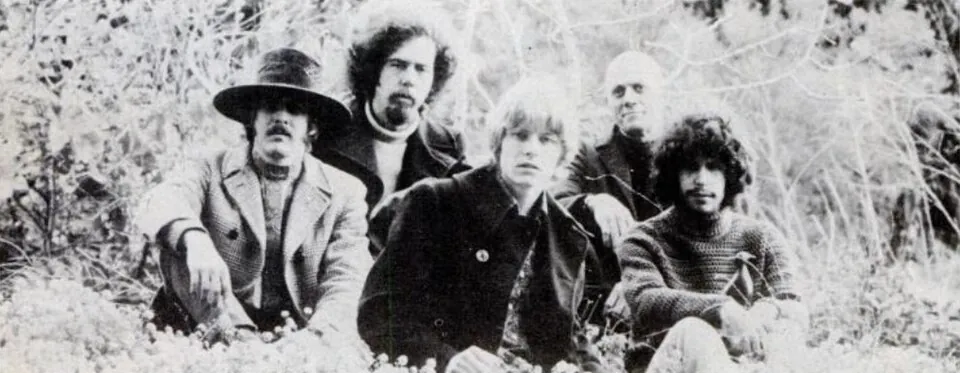
Spirit's original lineup joined five distinct musical functions: Randy California's economical guitar and songs, Jay Ferguson's lead voice and writing, John Locke's keyboards, Mark Andes's bass and Ed Cassidy's jazz-trained drumming. Formed in Los Angeles in 1967, the quintet made four studio albums before Ferguson and Andes departed in 1971. Those records move from short psychedelic songs and instrumentals to the deliberately connected programme of Twelve Dreams of Dr. Sardonicus.
The name continued through several very different lineups. California and Cassidy remained the central partnership during later reunions, but Feedback was recorded without California, Ferguson or Andes. Treating every Spirit record as the work of one stable band obscures the changes that shaped the catalogue.
Formation & History
California, Ferguson and Andes had played in the Red Roosters before California spent part of 1966 in New York, where Jimi Hendrix gave Randy Wolfe the professional name Randy California. Back in Los Angeles, California and his stepfather Cassidy joined Ferguson, Andes and Locke. Spirit signed a recording contract in August 1967; Lou Adler produced the self-titled debut, released in 1968, and its follow-ups The Family That Plays Together and Clear.
David Briggs produced the fourth album, Twelve Dreams of Dr. Sardonicus. Ferguson and Andes then left and formed Jo Jo Gunne. The 1972 Feedback lineup retained Cassidy and Locke but added Al and John Staehely; it did not feature California. California and Cassidy re-established Spirit in 1974, and later versions continued recording and touring until California's death in January 1997.
Spirit's connection with Led Zeppelin belongs to documented legal history, not to an established plagiarism finding. The bands appeared at the same venues and Led Zeppelin performed Spirit's “Fresh Garbage”. California's trust later alleged that “Stairway to Heaven” infringed his instrumental “Taurus”; in 2020 the Ninth Circuit affirmed the judgment in Led Zeppelin's favour.
Sound & Style
Spirit's range comes from the interaction of the original five players rather than from a single genre label. Ferguson's compact songs can sit beside California's guitar instrumentals; Locke moves between piano, organ and arranged keyboard colour; Andes keeps changing metres grounded; Cassidy brings cymbal detail and a jazz musician's responsiveness instead of treating the drums as a fixed backbeat.
The debut makes those contrasts audible inside individual tracks: the stop-start social satire of “Fresh Garbage”, California's acoustic instrumental “Taurus” and the long group performance “Elijah” do not use the same template. Clear separates hard-edged songs from soundtrack-derived instrumentals, while Twelve Dreams of Dr. Sardonicus uses recurring transitions and studio arrangement to make twelve short pieces function as an album-length sequence.
Essential Albums
Produced by David Briggs, the original quintet's fourth album links twelve pieces without making them musically uniform. California's “Nature's Way”, Ferguson's “Animal Zoo” and Cassidy's showcase “Mr. Skin” move through ecological warning, urban satire and character study; short transitions and returning studio textures make the sequence feel designed rather than compiled.
Key tracks: Prelude – Nothin' to Hide · Mr. Skin · Soldier
Open album guide → View on Amazon →Clear
1969The third album was made while the band was also supplying music for Jacques Demy's film Model Shop. Its song side includes the compressed hard rock of “Dark Eyed Woman” and Ferguson's “New Dope in Town”; the instrumental material, including “Ice” and “Clear”, gives Locke, California and the rhythm section room to work with atmosphere rather than verse-chorus form.
Key tracks: Dark Eyed Woman · Clear · Ice
Open album guide → View on Amazon →Spirit
1968Lou Adler's production places orchestral arrangement around a band already comfortable with abrupt formal changes. Ferguson's “Fresh Garbage” and “Uncle Jack”, California's instrumental “Taurus” and Locke's extended “Elijah” establish separate writing voices, while Cassidy and Andes make the movement between song, jazz phrasing and psychedelia sound coherent.
Key tracks: Fresh Garbage · Straight Arrow · Elijah
Open album guide → View on Amazon →Affiliate note: Amazon links on this page may earn RetroForge Records a small commission, at no extra cost to you.
Deeper Cuts
Feedback
1972The catalogue's sharpest lineup break, not a Randy California solo record. Cassidy and Locke work with Al Staehely on bass and vocals and John Staehely on guitar; David Briggs produces a tougher, more conventional rock album whose country inflections and Staehely songwriting distinguish it from the original quartet of LPs.
Open album guide → View on Amazon →This two-disc anthology follows the Ode and Epic years from the 1968 debut through Feedback. Its value is chronological: album tracks, singles and period material let the listener hear the original quintet's development and then the abrupt personnel change, rather than reducing Spirit to one familiar song.
Open album guide → View on Amazon →Why They Still Matter
Spirit's first four albums document an unusually democratic Los Angeles band: Ferguson and California supply contrasting songs, Locke and Cassidy bring experience from outside conventional rock, and the arrangements allow short radio-minded material to coexist with instrumentals and extended ensemble playing. That combination helps explain why the group fits psychedelic, progressive and jazz-rock histories without being fully contained by any one of them.
The later catalogue matters for a different reason. It records California and Cassidy repeatedly rebuilding the group after the original lineup dissolved. California died off Molokai in January 1997 after pushing his twelve-year-old son toward shore when both were caught in a rip current. The final legal ruling concerning “Taurus” should be stated accurately, but it need not dominate Spirit's legacy: the en banc Ninth Circuit affirmed that “Stairway to Heaven” did not infringe the protected composition.
Sources & Further Reading
Connected archive routes
Explore This Band
Continue through the RetroForge knowledge graph
Curated paths into the people, records, events and ideas that give this subject its wider musical context.