Fifty Foot Hose formed around a specific argument: rock was already electronic music, so electronic sound did not need to remain a studio effect placed behind a band. Cork Marcheschi, David Blossom and Nancy Blossom built the project in the San Francisco Bay Area, then added Larry Evans, Kim Kimsey and—on Cauldron—bassist Terry Hansley.
Their only album from the original period joins eleven sharply different pieces. David Blossom's songs and Nancy Blossom's voice occupy the same sequence as Marcheschi's short electronic studies, an altered Billie Holiday standard, the ten-minute “Fantasy” and the closing tone poem “Cauldron.” The record is not simply psychedelic rock decorated with unusual noises: the handmade devices interrupt, reshape and sometimes replace the band.
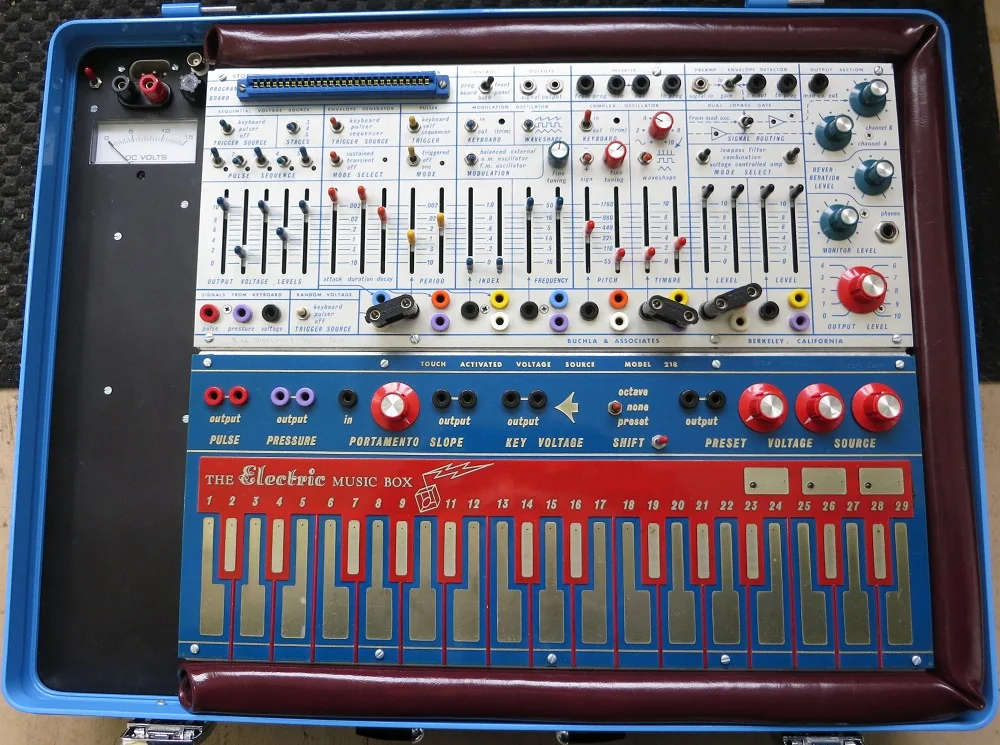
A 1973 Buchla Music Easel, illustrating the West Coast electronic-instrument culture developing alongside Fifty Foot Hose.Photo: Captnapalm / Wikimedia Commons · Licensed under CC BY-SA 3.0. Converted to WebP for this page.
Formation & History
Marcheschi met guitarist David Blossom on a casual job in 1966. Both had experience in working bands, but their discussions turned toward electronic music, free jazz and the possibility of bringing avant-garde practice into rock performance. Nancy Blossom became the singer; Larry Evans joined on guitar and vocals, and Jerome “Kim” Kimsey on drums. Marcheschi initially played bass as well as electronics, but the expanding electronic setup became a full-time role and required a separate bassist.
A demo reached music lawyer Brian Rohan, who connected the group with Mercury executive Robin McBride. Basic tracks for Cauldron were recorded at Sierra Sound and additional work was completed at Trident Studios in North Beach. Dan Healy engineered and produced. The album lineup credits Terry Hansley on electric bass alongside Marcheschi, both Blossoms, Evans and Kimsey.
Limelight released Cauldron at the end of 1967. Its eleven-track programme remained the original group's only album. The band ended by 1969; several members moved into the San Francisco production of Hair, while Marcheschi developed his career in sculpture, public art and teaching.
Marcheschi revived Fifty Foot Hose in 1994 with new collaborators. A 1995 San Francisco performance appeared as Live & Unreleased on Captain Trip in 1997, followed by the new studio album Sing Like Scaffold on Weasel Disc in 1998. These are revival records rather than continuations by the six-person Cauldron lineup.
Sound & Style
Marcheschi's equipment was an assembly rather than one commercial synthesizer: tube-type theremin, fuzz devices, three tone generators, Echolette, electric siren, microphones, saw blades, spark gap, cardboard tube and a speaker adapted from military surplus. Marbles and ball bearings placed on the upward-facing speaker turned low frequencies into both sound and visible movement.
The studio extended those devices. Marcheschi recalls off-centre tape reels used to create pitch wobble and a signal broadcast by FM to a tuner before being recorded out of phase. Dan Healy's engineering preserved the difference between David Blossom's structured writing and Marcheschi's Dada- and musique-concrète-based interventions instead of forcing them into one smooth texture.
The album's sequence makes that contrast audible. “And After” begins with a low-frequency event, the brief “Opus” pieces work as electronic sketches, “If Not This Time” sets Nancy Blossom against an angular song structure, and “Fantasy” expands the band format across ten minutes. The title track finally approaches a tone poem, with ensemble playing and electronic sound treated as one composition.
Essential Albums
1967
Cauldron
Limelight · Original 1967 release
The original six-person lineup's only album moves through eleven pieces rather than repeating one formula. David Blossom's “If Not This Time” and Larry Evans's “The Things That Concern You” establish song form; Marcheschi's miniature electronic studies break that continuity; “Fantasy” stretches past ten minutes; and the title track closes the record as a jointly shaped tone poem. Dan Healy's production keeps voice, fuzz guitar, percussion and homemade electronics in active tension.
Key tracks: If Not This Time · The Things That Concern You · Cauldron
Captain Trip · 1997 release · recorded live in 1995
This eight-track Captain Trip disc documents the 1995 San Francisco revival rather than an unreleased concert by the original lineup. Marcheschi leads a new group through material including “If Not This Time,” “The Rose,” “God Bless the Child,” “Cauldron” and “Red the Sign Post,” alongside pieces from the revived ensemble. It records how the electronic apparatus and older repertoire were rebuilt for a different set of musicians.
1998
Sing Like Scaffold
Weasel Disc · Original 1998 release
Sing Like Scaffold is the revival lineup's studio statement, not a missing second chapter by the 1967 group. Marcheschi combines his electronic devices with Walter Funk III, Reid Johnston, Lenny Bove, Elizabeth Perry and Dean Cook. Its importance lies in the changed personnel and late-1990s production context: the album applies the original method of handmade sound and rock instrumentation to new material.
Cauldron is the complete original-period album and the starting point. The expanded Big Beat edition adds pre-album demos, useful for hearing how the songs existed before the final studio treatments. Live & Unreleased and Sing Like Scaffold belong to the 1990s revival and should be heard as a new ensemble returning to Marcheschi's method, not as recovered work by the 1967 sextet.
Fifty Foot Hose document a moment when live electronic rock had no standard equipment list. Marcheschi's setup had to be designed, adapted and physically performed; the sounds could not be reduced to a preset or reproduced by simply buying the same keyboard. That material fact distinguishes Cauldron from both conventional Bay Area rock and purely tape-based studio composition.
The band's small catalogue also makes chronology important. One original album, a later expanded reissue, a documented 1995 revival concert and a 1998 studio record tell different stories. Keeping those phases separate reveals the lasting idea more clearly: electronic sound can act as an equal, disruptive member of a rock ensemble.
RetroForge Records publishes original music and independent editorial guides. This historical band guide is not affiliated with the artist, labels or rights holders. No unlicensed album artwork is reproduced.