

Overview
The United States of America formed in Los Angeles in 1967 and left one Columbia album before breaking apart in 1968. Composer Joseph Byrd and singer-lyricist Dorothy Moskowitz placed a rock rhythm section beneath electric violin, keyboards, tape and electronic processing, deliberately omitting a guitarist. That combination matters more than the usual claim that the group was simply “ahead of its time”: the record belongs to a precise meeting of West Coast rock, New York experimental practice and late-1960s political theatre.
The self-titled LP moves between satire, sensuality, anti-war feeling and quieter dream states. Its effects are not decoration added to conventional songs. Ring modulation can reshape Gordon Marron's violin or Moskowitz's voice; tape fragments interrupt transitions; Byrd's written parts make rhythm and electronics behave as parts of the composition. The album's later reputation grew through reissues, but its original identity remains specific to this short-lived ensemble.
Formation & History
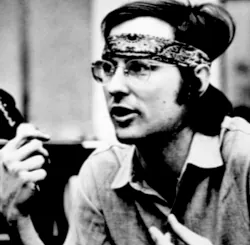
Before the band, Byrd had studied at Stanford, worked in New York's experimental-music circle and helped establish the New Music Workshop with trumpeter Don Ellis in Los Angeles while attending UCLA. The rock project began with composer Michael Agnello and drew on musicians connected to experimental music and ethnomusicology. Moskowitz joined Byrd as singer and co-lyricist; Gordon Marron played electric violin, Rand Forbes fretless bass and Craig Woodson drums and percussion. Ed Bogas contributed organ, piano and calliope to the album.
Producer David Rubinson brought the group to Columbia during its early demo and Ash Grove period. Moskowitz recalls that the main sessions used eight-track recording at Columbia's Los Angeles studios, with extensive track bouncing; Byrd and Rubinson completed final mixing and additional electronics in New York. Columbia issued the LP in March 1968 as CS 9614. Disagreements about leadership, touring and producer support intensified after the recording, and the group ended within the year. Byrd then made The American Metaphysical Circus for Columbia Masterworks with a different studio ensemble.
Sound & Style
The absence of guitar is structural. Forbes's fretless bass and Woodson's percussion carry the low and rhythmic centre, while Marron's violin provides sustained tone, attack and, through a ring modulator, distorted weight. Byrd plays electric harpsichord, organ, piano, calliope and a Durrett electronic music synthesizer. Tom Oberheim built purpose-made ring-modulation equipment that could process instruments and Moskowitz's voice; onstage the group also used tape decks rather than trying to reproduce every collage element acoustically.
“The American Metaphysical Circus” opens with calliope and marching-band memory before Moskowitz enters a gradually destabilised electronic space. “Hard Coming Love” makes bass and percussion physical while the processed violin occupies the role a fuzz guitar might otherwise fill. Byrd described “Cloud Song” as being written in seven without advertising its metre, and “Love Song for the Dead Ché” removes much of the harsher attack for a restrained ballad. The closing “American Way of Love” suite brings song fragments, satire and tape collage together instead of resolving the record into a single style.
Essential Albums
The only original LP by this line-up is a deliberately sequenced studio construction rather than a collection of interchangeable experiments. Side one moves from the processed pageantry of The American Metaphysical Circus through the bodily pulse of Hard Coming Love and the suspended metre of Cloud Song. Side two contrasts the ensemble writing of Where Is Yesterday with Love Song for the Dead Ché before the three-part American Way of Love closes in quotation and collage. Its unity comes from the return of voices, tape and transformed instrumental timbres across very different songs.
Key tracks: The American Metaphysical Circus · Where Is Yesterday · The American Way of Love
Open album guide → View on Amazon →Affiliate note: Amazon links on this page may earn RetroForge Records a small commission, at no extra cost to you.
Deeper Cuts
Byrd's 1969 Columbia Masterworks follow-up uses a different studio ensemble, including singers Victoria Bond, Susan de Lange and Christie Thompson. It continues his interest in electronics, collage and political theatre, but it is not a second United States of America album and should not be used to extend that band's line-up or history.
Open album guide → View on Amazon →The expanded CD adds ten recordings after the complete original LP, including Osamu's Birthday, No Love to Give and alternate versions. Hear the 1968 sequence first: the supplementary material is valuable for studying arrangements and abandoned paths, but it is not the album's original running order.
Why They Still Matter
The group's historical importance rests on a documented working method, not on an unverifiable roll-call of later influence. Electronic sound was already well established in experimental composition, and other rock musicians were exploring tape and studio processing. What distinguishes this album is how consistently those methods enter a performing rock ensemble: the group processed voices and violin live, travelled with tape machines and designed written songs around electronic transformation.
The record also preserves the tension between Byrd's tightly controlled arrangements and the identities of the players interpreting them. Moskowitz can sound intimate, ironic or severe; Marron's violin alternates between chamber line and distorted mass; the rhythm section prevents the collages from becoming demonstrations. Reissues have made the sessions easier to study, but the concise original LP remains the clearest statement of what this particular band achieved.
Sources & Further Reading
Connected archive routes
Explore This Band
Continue through the RetroForge knowledge graph
Curated paths into the people, records, events and ideas that give this subject its wider musical context.