The West Coast Pop Art Experimental Band joined precise folk-rock songwriting to fuzz guitar, orchestration, electric sitar and studio collage. Their three Reprise albums move from the compact songs of Part One through the sharper contrasts of Vol. 2 to the sustained unease of A Child’s Guide to Good and Evil.
The records were created by an unusually divided partnership. Michael Lloyd and brothers Shaun and Danny Harris built much of the early musical framework; Ron Morgan later became the principal lead guitarist; Bob Markley financed the project, controlled its name and publishing, and wrote many of its lyrics. The tension is audible, but the musicians’ craft — not the mythology around Markley — is what gives the catalogue its lasting force.
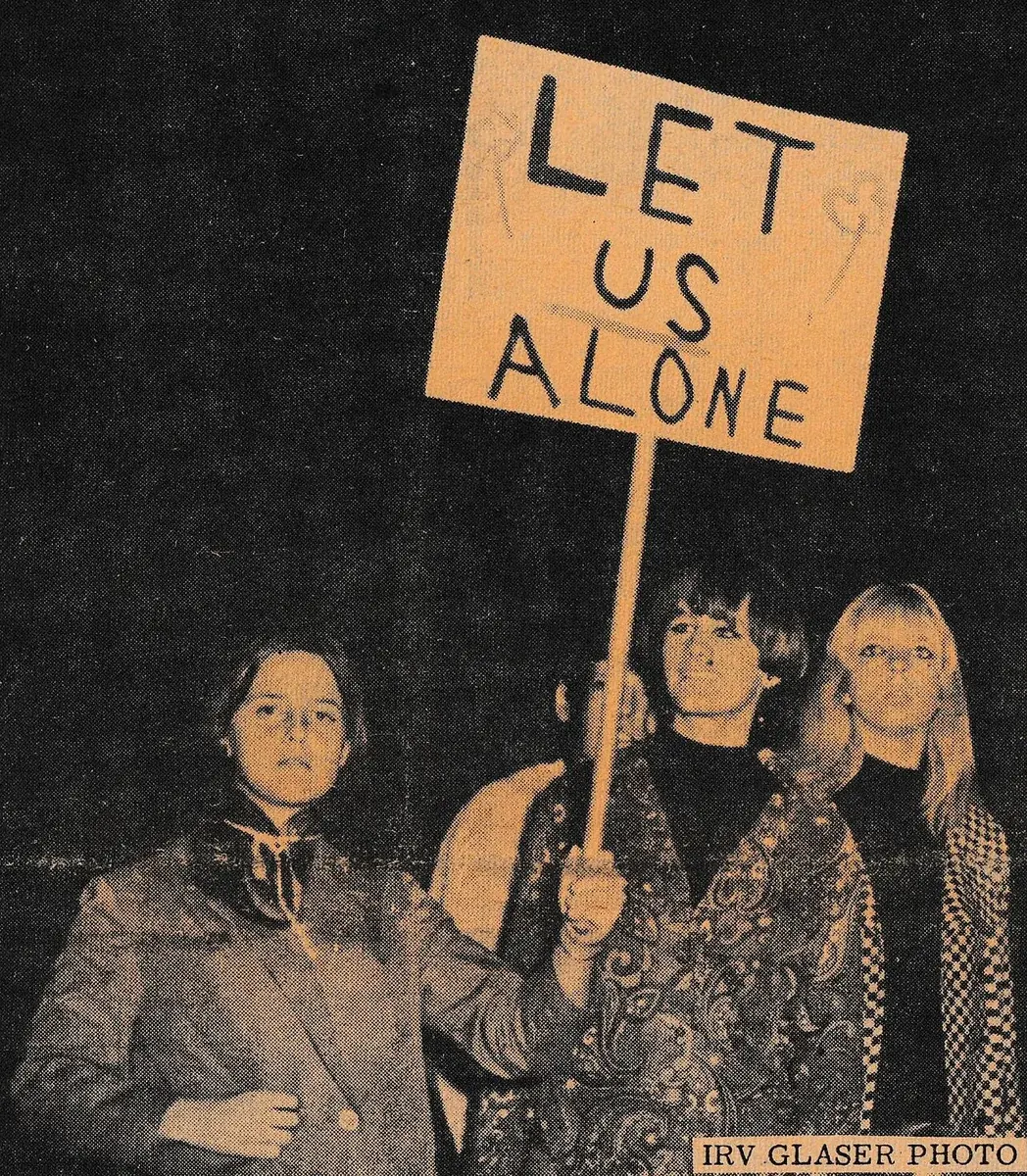
The Sunset Strip curfew riot in November 1966, part of the Los Angeles counterculture surrounding the West Coast Pop Art Experimental Band.Photo: Irv Glaser, Lou Blackburn, William Warren / Wikimedia Commons · Licensed under Public domain. Converted to WebP for this page.
Formation & History
Before the long name existed, Michael Lloyd, Shaun Harris, Danny Harris and drummer John Ware recorded as the Laughing Wind in a home studio at Lloyd’s house. Producer and scenester Kim Fowley introduced them to Bob Markley in 1965. Markley offered equipment, touring support and a light show in return for joining as singer and lyricist; the agreement also left him owning the band name and publishing.
The 1966 Fifo LP Volume One was a transitional document: it combined covers and earlier recordings with several Markley-associated songs. A Reprise contract then produced three distinct albums — Part One and Vol. 2 in 1967, followed by Volume 3: A Child’s Guide to Good and Evil in 1968. Ron Morgan joined for the Reprise period, while Lloyd, Ware and Danny Harris departed at different points as the lineup fractured.
After Reprise dropped the group, Where’s My Daddy? appeared on Amos in 1969 with Markley and the Harris brothers credited on the sleeve, though Lloyd and Morgan also contributed. The final album, Markley, A Group, was issued by Forward in 1970 under Markley’s name but again involved WCPAEB musicians. The project ended soon afterward.
Sound & Style
The early Reprise recordings balance close harmony, acoustic rhythm guitar and short pop forms against deliberately abrasive details. “I Won’t Hurt You” uses a muffled pulse and fragile vocal blend; “Transparent Day” is brisk folk-rock; “Help, I’m a Rock” interrupts the songcraft with repetition and noise. The contrast is structural rather than decorative: a polished surface can give way without warning.
On Vol. 2, Morgan’s fuzz guitar and electric sitar make the attack harder, while Shaun Harris’s bass and the vocal arrangements keep the songs anchored. Volume 3 widens the palette further through spoken voices, orchestration, stereo movement and recurring “Ritual” passages. “In the Country” drives on distorted guitar; “Eighteen Is Over the Hill” remains airy and melodic; the silent “Anniversary of World War III” turns absence itself into the closing gesture.
Essential Albums
1967
Part One
Reprise · Original 1967 release
The first Reprise LP is the band’s most concise and song-led record. “Shifting Sands” opens with clipped fuzz and vocal counterpoint, while the heartbeat-like rhythm and filtered texture of “I Won’t Hurt You” make tenderness sound uncertain. “Transparent Day” and P. F. Sloan’s “Here’s Where You Belong” show the group’s folk-rock fluency; “Will You Walk with Me” adds baroque orchestration; the Frank Zappa cover “Help, I’m a Rock” supplies the disruptive centre. The breadth never overwhelms the short, carefully sequenced songs.
Key tracks: Shifting Sands · I Won’t Hurt You · Transparent Day
With Lloyd absent, the second Reprise album leans more heavily on the Markley–Shaun Harris writing partnership and Ron Morgan’s sharper guitar work. The anti-war refrain of “Suppose They Give a War and No One Comes” sits beside the sustained electric-sitar colour of “Smell of Incense,” the fuzz pressure of “In the Arena” and the uneasy nursery-song manner of “Unfree Child.” It is less unified than Part One, but its collisions between protest, satire, melody and menace define the band’s divided character.
Key tracks: In the Arena · Smell of Incense · Suppose They Give a War and No One Comes
The last Reprise album is the most fully realised expression of the group’s experimental side. “Eighteen Is Over the Hill” begins in luminous folk-pop, “In the Country” answers with heavy fuzz, and the two “Ritual” pieces use electric sitar and studio effects as recurring markers. Spoken interludes and the title track turn the sequence into a fractured meditation on innocence, power and war. The closing silence of “Anniversary of World War III” completes the design instead of offering release.
Key tracks: Eighteen Is Over the Hill · Ritual #1 · A Child’s Guide to Good and Evil
Start before Reprise with Volume One (1966), whose covers and early Laughing Wind material reveal the musicians’ garage and R&B foundations. After the three Reprise LPs, Where’s My Daddy? (1969) offers a darker, looser continuation; several songs centre young female characters in ways that require critical distance rather than nostalgic excuse.
Markley, A Group (1970) is best approached as the final WCPAEB-adjacent record: it bears Markley’s name, appeared on Forward and contains compositions by Danny Harris, Michael Lloyd and Shaun Harris. For the central period, Grapefruit’s 2023 four-CD set A Door Inside Your Mind collects mono and stereo mixes of all three Reprise albums, plus outtakes and an alternate Volume 3.
The band’s best records resist the idea that Los Angeles psychedelia had one settled sound. Folk-rock hooks, garage attack, baroque arrangement and tape-based disruption coexist without being smoothed into a single style. That volatility made the group a useful reference point for later psychedelic pop and indie listeners attracted to beauty with damaged edges.
The catalogue also demands an adult historical reading. Its achievement belongs to a group of skilled, often very young musicians working inside an unequal partnership, while some of Markley’s lyrics remain troubling. Grapefruit’s complete Reprise archive has made the musical evidence easier to hear in detail: alternate and mono mixes underline how much arrangement, guitar tone and studio construction shaped these records.
RetroForge Records publishes original music and independent editorial guides. This historical band guide is not affiliated with the artist, labels or rights holders. No unlicensed album artwork is reproduced.