

Why this event matters
Altamont is usually asked to carry too much symbolism. It is described as the day the sixties ended, the dark twin of Woodstock or proof that an entire counterculture was fraudulent. Those formulas are memorable but historically lazy. A decade did not end beside a California raceway, and the hundreds of thousands who attended did not share one motive or one experience. What happened is serious enough without turning it into a supernatural verdict on an era.
The concert matters because a chain of practical failures became lethal. A major free event was moved between proposed sites, confirmed at Altamont only shortly before the date, built around a stage that offered little separation from the crowd and policed through an arrangement with members of the Hells Angels that did not amount to a professional security plan. Violence occurred throughout the day. Meredith Hunter was killed in front of the stage during the Rolling Stones' performance after he drew a gun; Alan Passaro, a Hells Angel seen stabbing him in film footage, was later acquitted on grounds of self-defence. Three other people died in separate accidents. These are facts about organisation, risk and human lives, not material for theatrical copy.

Before the gates opened
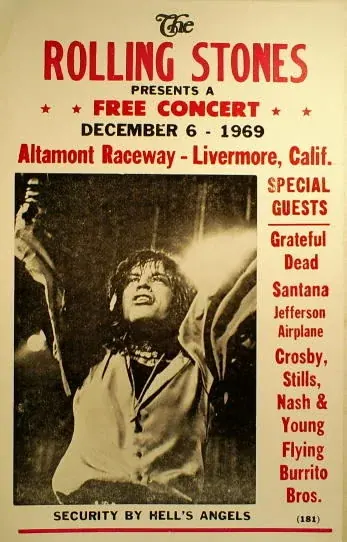
The Rolling Stones' 1969 American tour had drawn criticism for high ticket prices, and a free final concert was discussed as a public gesture. The idea borrowed from San Francisco's established free-concert culture, where groups including the Grateful Dead and Jefferson Airplane had played in parks with local networks around them. Scale changed the problem. A Rolling Stones event announced through radio and press could attract a regional mass audience faster than any informal coalition could build a safe site.
Golden Gate Park was unavailable. Plans then centred on Sears Point Raceway, but negotiations over film rights, money and site conditions failed. Altamont Speedway entered the picture at the end, leaving roughly a day to transform a motor-racing venue into a concert ground. Equipment, performers, workers and an already-moving audience converged on a place that had not been tested for this purpose. The problem was not merely that people were disorganised. Decisions with consequences for access, medical support, sanitation, stage geometry and authority had been compressed into an impossible timetable.
The place and the people
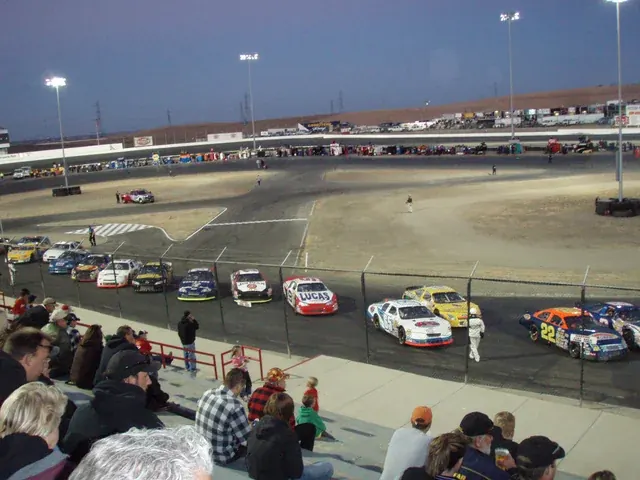
Altamont's dry, treeless landscape offered little of the natural containment associated with Bethel's bowl-shaped field. Roads clogged as cars approached. People abandoned vehicles and walked. The stage was low, close to the audience and vulnerable to pressure from the front. There was no robust barrier creating a controlled working area. Every movement near the performers therefore became a negotiation conducted at arm's length.
The audience was not inherently violent, and the event should not be explained through vague claims about bad energy or a corrupted generation. Conditions concentrated conflict. Crowd density, intoxication, fatigue, uncertain lines of authority and the visible use of force interacted. Some attendees watched music at a distance; others encountered repeated fights near the stage. Any single photograph or testimony captures only one position inside an enormous, uneven field.

The musical programme
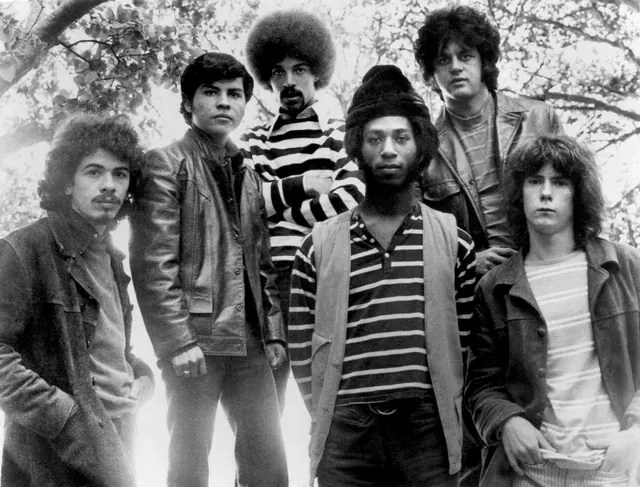
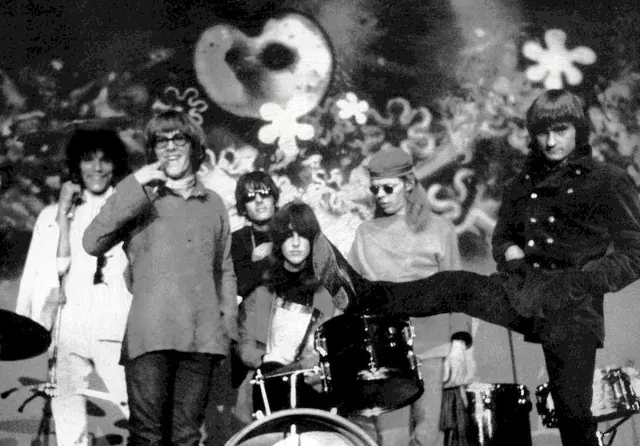
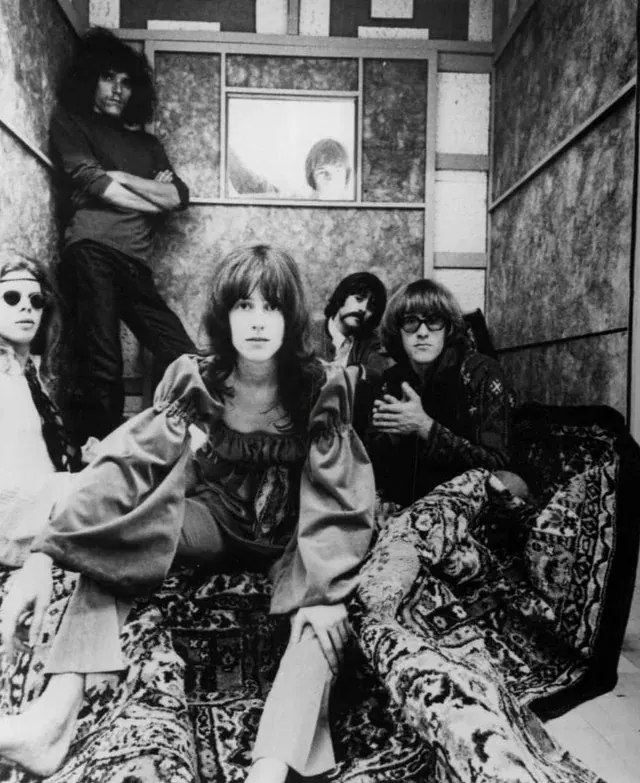
Santana played early, followed by Jefferson Airplane, the Flying Burrito Brothers and Crosby, Stills, Nash & Young before the Rolling Stones appeared after dark. The Grateful Dead, closely involved in the San Francisco free-concert world and present at the site, chose not to perform after learning how dangerous the situation had become. That absence is part of the programme's history: the running order was being shaped by immediate risk rather than artistic design.
Music continued inside circumstances that made ordinary performance almost impossible. Jefferson Airplane's Marty Balin was struck during an altercation. Stephen Stills was reportedly attacked while playing. The Rolling Stones repeatedly stopped and addressed the crowd. Discussing the performances solely as set lists misses the essential point. The stage was no longer a protected platform from which musicians could control time and attention; it had become the front edge of a physical struggle.
Security, force and responsibility
Accounts differ over the language used when the Hells Angels were engaged and over what payment or understanding existed. The documentary record supports a clearer conclusion than the folklore: men associated with the club occupied the stage area, used motorcycles as part of the boundary and carried improvised weapons including weighted pool cues. They were not a trained, accountable security operation with a command structure integrated into event production.
Responsibility cannot be reduced to one conversation about beer. Artists, managers, local contacts and site operators participated in an arrangement whose authority remained unclear. Once violence began, there was no capable system able to replace it. The lesson is structural. A crowd cannot be kept safe by attitude, reputation or an informal promise. Security requires defined roles, communication, proportional methods, medical coordination and the ability to stop a show.

Meredith Hunter and the deaths at Altamont
Meredith Hunter was an eighteen-year-old Black man attending with his girlfriend, Patti Bredehoft. Film footage shows a confrontation near the stage and Hunter holding a revolver before he was stabbed by Alan Passaro. A jury acquitted Passaro in 1971 after accepting a self-defence argument. The footage is evidence, but repeated slow-motion presentation can create a false sense that the whole sequence is transparent. It does not explain every preceding action, and it should never turn Hunter's death into festival spectacle.
Three other deaths occurred in separate incidents: two people were killed in a hit-and-run accident while sleeping, and another drowned in an irrigation canal. Their relative absence from the standard Altamont story reveals how documentary visibility shapes memory. Hunter's death was caught by professional cameras and became central to Gimme Shelter. The others remain less visually present but are no less part of the event's human cost.
Film, media and the symbolic opposite of Woodstock
Gimme Shelter follows the Rolling Stones' tour and the decisions leading to Altamont, then shows the filmmakers and musicians reviewing footage afterward. That reflexive structure is crucial. Viewers see an event and also see people trying to understand the evidence. The film remains an extraordinary source, but it is edited cinema rather than a neutral surveillance record. Its concentration on the Stones and the fatal confrontation inevitably narrows a day experienced by hundreds of thousands.
Woodstock had already been converted into a story of communal endurance through reporting, photography and then a major film. Altamont offered editors a ready negative image: East against West, peace against violence, successful improvisation against disastrous improvisation. The comparison contains truth—one event ended without the feared mass violence, the other did not—but it can hide important similarities. Both depended on commercial production, overwhelmed plans and large networks of unpaid or under-recognised labour.

What happened afterward
Altamont did not end free concerts, outdoor festivals or the Rolling Stones. It did make organisers, authorities, insurers and performers more conscious of the liability contained in loosely defined mass gatherings. Barriers, professional security, emergency planning and clearer chains of command became part of the industry's developing language, although later disasters prove that professionalisation alone does not eliminate risk.
The event also generated decades of testimony, accusation and revision. Memories recorded long afterward are valuable, especially when compared with contemporary audio, film and documents, but they are not interchangeable with evidence made on the day. The archive works best when uncertainty remains visible rather than being flattened into one definitive villain-and-victim screenplay.
Legacy
Altamont's lasting value is not as a curse placed on the sixties. It is a warning about magical thinking in event production. Music, goodwill and cultural prestige cannot substitute for time, infrastructure and accountable authority. A free ticket does not remove the obligations created when hundreds of thousands of people are invited to one place.
Remembering the concert responsibly means resisting both romance and horror-film treatment. There were performances, ordinary attendees and moments not captured by the famous footage. There were also preventable conditions, repeated violence and four deaths. The historical task is to hold those facts together without making suffering serve a neat generational slogan.
Follow the festival beyond the field
Timeline
Related genres
Related band guides
Explore by sound
Essential listening
RetroForge Echo
Hear a Fictional Archive Response
These modern RetroForge releases echo part of the festival’s musical vocabulary; they are not historical festival recordings.
Sources and further reading
- Rolling Stones at Altamont—home movieLibrary of Congress · accessed 23 July 2026
- The Rolling Stones, Hell’s Angels and Altamont: A New ViewLibrary of Congress · accessed 23 July 2026
- Gimme ShelterThe Criterion Collection · accessed 23 July 2026
- The Daydream of the 1960s Ended 50 Years Ago at AltamontTIME · accessed 23 July 2026
- Altamont and the end of the sixtiesEncyclopaedia Britannica · accessed 23 July 2026
Image credits5 licensed images
Santana in 1969 — Distributed by Columbia Records — Wikimedia Commons — Public domain · source record · Public domain
Converted to WebP and resized; no generative or compositional alterations.
A surviving advertisement for the free concert at Altamont Raceway — Unknown photographer — Wikimedia Commons — Public domain · source record · Public domain
Converted to WebP and resized; no generative or compositional alterations.
Altamont Motorsports Park in 2007 — Gateman1997 at English Wikipedia — Wikimedia Commons — CC BY-SA 3.0 · source record · CC BY-SA 3.0
Converted to WebP and resized; no generative or compositional alterations.
Jefferson Airplane in a publicity photograph from around 1970 — RCA Records — Wikimedia Commons — Public domain · source record · Public domain
Converted to WebP and resized; no generative or compositional alterations.
Jefferson Airplane in 1967, before Altamont — RCA Records/photographer: Herb Greene — Wikimedia Commons — Public domain · source record · Public domain
Converted to WebP and resized; no generative or compositional alterations.