
Edition timeline
The first California Jam proves the speedway model
Ontario Motor Speedway, television and movable staging establish a reference point for scale.
A more expensive temporary city is designed
Promoters assume responsibility for water, sanitation, medicine, lighting, traffic and security.
Roughly 300,000 people are estimated on site
A late-1970s arena-rock bill is recorded for live and television audiences.
The package travels
Overlapping organisers apply branded mega-festival logic to Texxas Jam and Canada Jam.
Why this event matters
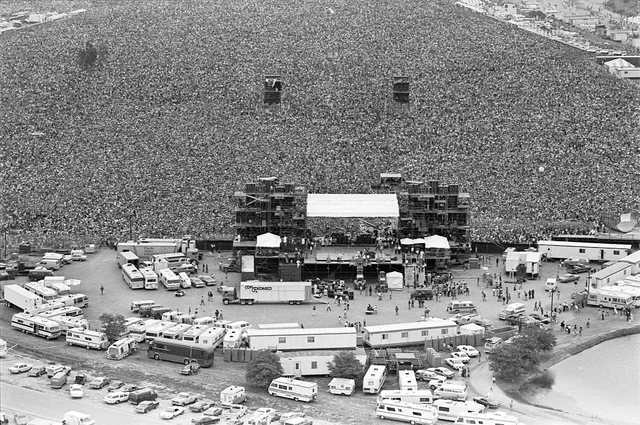
California Jam II shows the festival transformed into late-1970s industrial rock spectacle. Its central questions are not communal camping or porous free access but whether a speedway, mature promoter network and broadcast production could process hundreds of thousands of people in one day. Contemporary reporting separates roughly 300,000 people estimated on site from about 220,000 paid admissions. That distinction preserves the scale without turning publicity numbers into an audited count. The 1974 California Jam supplied a powerful brand and proof that Ontario Motor Speedway could become a rock venue. Four years later producers Lenny Stogel and Sandy Feldman, executive coordinator Don E. Branker and co-promoters Wolf & Rissmiller operated in a more professional Southern California concert market. Billboard described plans for a temporary city costing more than one million dollars in basic production. The sequel inherited the site and media ambition, but not the same musical moment. Ontario Motor Speedway offered roads, parking and immense enclosed ground, yet motorsport infrastructure did not automatically supply a concert city. Promoters told Billboard they had to provide water, sanitation, food, medical facilities, a temporary hospital, ambulances, lighting and security. The aerial photograph shows the result more reliably than superlatives: a crowd distributed across a vast infield, with many spectators far from the performance. Scale became an engineering condition rather than an atmosphere alone. Aerosmith, Ted Nugent and Frank Marino & Mahogany Rush supplied hard-rock force; Heart and Foreigner represented the polished power of FM radio; Santana connected the bill to the late 1960s; Dave Mason and Bob Welch carried longer career histories into contemporary pop-rock. Rubicon completed a programme shaped more by arena touring than by the progressive and countercultural crossover of 1974. Reading the bill this way reveals four years of industry change without ranking one festival above the other.

What the audience experienced
California Jam II was an all-day endurance spectacle. Heat, walking distance, queues, food, water and the difficulty of seeing a remote stage remained real even inside a carefully planned operation. A one-day schedule concentrated arrival and departure pressures that a camping festival could distribute over several mornings. Contemporary press praised efficiency, but professionalism did not eliminate physical limits. The audience experienced a managed mass event whose comfort varied sharply by location within the speedway. Cameras, sound, lighting and stage changeovers served two audiences: the people in Ontario and viewers of later television. Billboard reported that twelve hours of videotaped performances fed an ABC special and a later four-part Metromedia series. This changes how production should be read. Performances were not only delivered and lost; they were framed as reusable media. The festival field increasingly resembled an outdoor extension of arena-rock and television workflows rather than a gathering accidentally captured by film. A large security force, medical planning and site lighting reduced some known risks, but no production system could make distance, heat or mass movement disappear. Attendance estimates also show the limits of measurement: paid admissions and overall site population answered different questions. Contemporary and retrospective reports sometimes collapse them into one record claim. Keeping those figures separate is part of the event’s operational history, because gate control and unofficial presence were themselves production variables. The branded mega-festival package did not remain in Ontario. Overlapping producers and promoters developed Texxas Jam and Canada Jam, applying one-day scale, arena-rock bills and sponsor-ready presentation in other markets. California Jam II therefore belongs to a network rather than a single sequel. Its methods could travel because they depended on professional relationships, touring acts, broadcast knowledge and repeatable service planning—even when each venue required a different physical solution.

Films, recordings and surviving documents
The archive includes professional television footage, press reporting, programme material, artist recordings and Los Angeles Times photography. The aerial image and newspaper coverage used here have explicit Commons licences; most performance footage remains commercially controlled. A surviving programme can reconstruct maps, artist presentation and visitor instructions, but possession of a scan is not reuse permission. Combining trade press with licensed photographs lets the page examine media production while respecting the boundaries of that unusually rich archive. California Jam II retained the visual drama of a field filled with people, but its operating logic was industrial. A specialised promoter team built services, coordinated a mainstream touring bill and manufactured television content from the same day. Countercultural language was no longer required to justify scale. The important continuity with earlier festivals was the temporary city; the important change was that this city had become a planned media product whose components could be reproduced in other markets. The original California Jam provides the essential 1974 comparison, while Texxas Jam and Canada Jam show the sequel’s travelling promoter logic. Ontario’s movable-stage and broadcast history also links backward to technically ambitious events such as Goose Lake and forward to the genre-segmented US Festival. Artist routes through Santana, Heart, Aerosmith and Foreigner connect the outdoor field to arena touring and FM radio. These internal paths make the sequel part of an evolving production system rather than an isolated giant crowd. California Jam II helped normalise the branded one-day mega-festival: a repeatable package of arena-rock programming, temporary-city logistics, professional security and broadcast afterlife. It did not solve every problem of mass attendance, nor did it prove that the largest retrospective crowd figure was correct. Its legacy is more concrete. By 1978, an outdoor audience of several hundred thousand could be planned, filmed and marketed through established industry machinery, pointing directly toward the stadium festival culture that followed.


Follow the festival beyond the field
Timeline
Related genres
More routes will be connected as the archive grows.
Related band guides
More routes will be connected as the archive grows.
Explore by sound
More routes will be connected as the archive grows.
Essential listening
Sources and further reading
- “Jam II” Costliest All-Time ConcertBillboard, 11 March 1978 / World Radio History · accessed 23 July 2026
- California Jam II contemporary reviewSounds, 8 April 1978 / World Radio History · accessed 23 July 2026
- Ontario Motor Speedway Collection, 1963–1980Online Archive of California / UC Libraries · accessed 23 July 2026
- California Jam II media categoryWikimedia Commons · accessed 23 July 2026
- California Jam II aerial photographLos Angeles Times / Wikimedia Commons · accessed 23 July 2026
Image credits5 licensed images
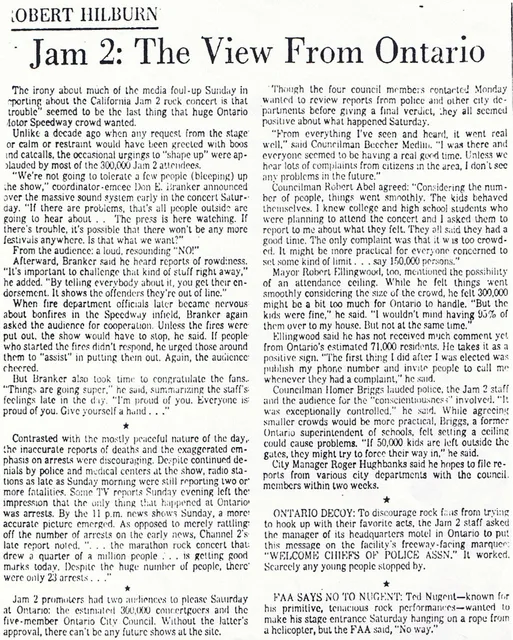
Los Angeles Times coverage published the day after California Jam II, preserving the event's immediate media framing as well as its scale — Robert Hilburn, Los Angeles Times — Wikimedia Commons — CC BY-SA 3.0 · source record · CC BY-SA 3.0
Converted to WebP and resized; no generative or compositional alterations.
California Jam II from the air on 18 March 1978. The photograph shows the speedway converted into a highly organized mass-media rock site — George Rose, Los Angeles Times — Wikimedia Commons — CC BY 4.0 · source record · CC BY 4.0
Converted to WebP and resized; no generative or compositional alterations.
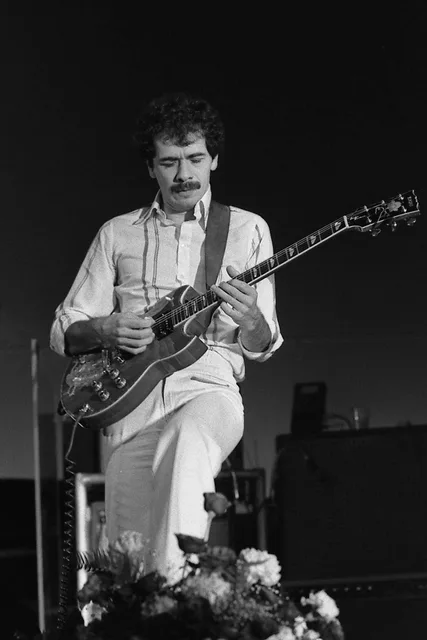
Carlos Santana performing in Leiden in 1978. The period photograph provides artist context and is not presented as a California Jam II stage image — Chris Hakkens — Wikimedia Commons — CC BY-SA 2.0 · source record · CC BY-SA 2.0
Converted to WebP and resized; no generative or compositional alterations.
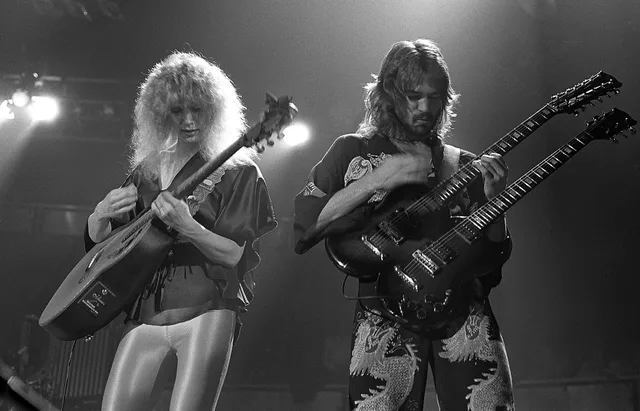
Nancy Wilson and Roger Fisher of Heart in 1978. This period artist photograph provides lineup context without implying that it was taken at Ontario Motor Speedway — Jim Summaria, http://jimsummariaphoto.com — Wikimedia Commons — CC BY-SA 3.0 · source record · CC BY-SA 3.0
Converted to WebP and resized; no generative or compositional alterations.
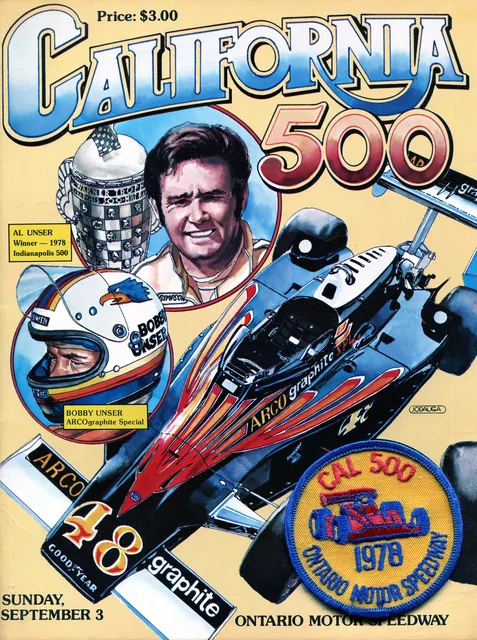
The 1978 California 500 program cover. It documents the permanent motorsport identity of Ontario Motor Speedway, the infrastructure temporarily repurposed by California Jam II — Ontario Motor Speedway — Wikimedia Commons — Public domain · source record · Public domain
Converted to WebP and resized; no generative or compositional alterations.