

Edition timeline
The Bucolic Frolic
The first Knebworth rock concert, headlined by the Allman Brothers Band, established the estate as a festival site.
Pink Floyd
Pink Floyd headlined a bill that included the Steve Miller Band, Captain Beefheart and Roy Harper.
The Rolling Stones
A vast all-day bill and an elaborate stage made the Stones edition one of Knebworth’s defining spectacles.
Genesis
Genesis brought the “And Then There Were Three” era to Knebworth with Jefferson Starship, Tom Petty and Brand X among the supporting acts.
Not Another Boring Old Knebworth!
Frank Zappa, Peter Gabriel, The Tubes and others gave the site a more deliberately eclectic identity.
Led Zeppelin
Two shows marked the group’s return to British stages after a long absence.
The Beach Boys
The programme shifted toward a broad summer audience while retaining the estate-concert format.
Capital Jazz Festivals
Dedicated jazz programmes widened the site’s history beyond the standard classic-rock narrative.
Why Knebworth matters
Knebworth is not one festival with a stable annual identity. It is a landscape repeatedly converted into a concert venue, with each edition shaped around different headliners, promoters and audiences. That distinction explains its historical range. Between 1974 and 1982, the park hosted southern rock, progressive spectacle, the Rolling Stones, an eclectic bill led by Frank Zappa, Led Zeppelin’s British return, a Beach Boys programme and two Capital Jazz Festivals. The estate was the constant; the cultural proposition changed.
For progressive-rock history, Knebworth documents the moment album-scale ambition became outdoor infrastructure. Extended compositions, quadraphonic effects, films, large keyboard rigs and theatrical staging had to work across a park filled with people rather than inside a controlled theatre. The site rewarded scale while exposing delay, weather, sound coverage and crowd management. It was where the artistic language of the 1970s met the physical problem of making tens of thousands experience the same event.

The estate as venue
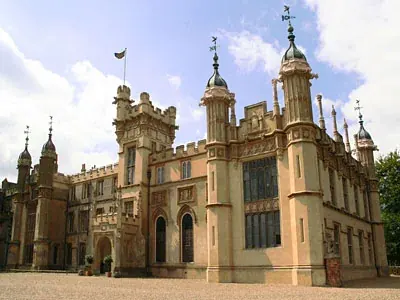
Knebworth House and its surrounding park gave concerts a visual identity unlike a speedway or municipal showground. Audiences travelled into a historic estate temporarily reorganised around camping, parking, food, sanitation, stage access and emergency routes. The house remained an architectural presence even when the performance field operated as a self-contained city. This contrast between inherited landscape and temporary technology became part of Knebworth’s mythology.
An estate also imposed limits. Roads serving a rural area could be overwhelmed. Rain or heavy footfall changed the ground. The distance between transport, camps and stage turned arrival into an expedition. These conditions encouraged all-day programmes: once people had reached the park, the event needed to sustain them. Knebworth therefore developed through long bills and headline performances expected to justify the journey.
1974: the Bucolic Frolic
The first concert on 20 July 1974 was billed as the Bucolic Frolic and headlined by the Allman Brothers Band. Original promoter Freddy Bannister helped create the concert legacy that began with this edition. The name deliberately joined rural leisure to amplified rock. Other performers included the Doobie Brothers, Mahavishnu Orchestra, the Sensational Alex Harvey Band and Van Morrison, although running orders and participation details should be checked against contemporary programmes when reconstructing the full day. The mixture already established Knebworth’s preference for breadth over a single narrow genre.
Mahavishnu Orchestra’s presence is especially revealing. Jazz-rock virtuosity could appear beside southern rock, singer-songwriter material and theatrical hard rock because large 1970s audiences did not always divide these forms as strictly as later classifications do. The first edition demonstrated that the estate could hold an ambitious bill and attract a travelling audience. It also created the organisational memory required for larger productions.

1975: Pink Floyd and technological expectation
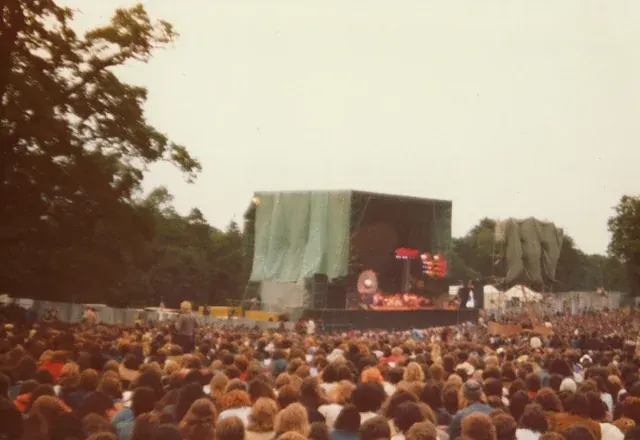
Pink Floyd headlined on 5 July 1975, with the Steve Miller Band, Captain Beefheart and Roy Harper among the supporting performers. The concert occurred while the group was developing material associated with Wish You Were Here. A large outdoor Floyd performance involved more than playing songs loudly. Sound placement, projected imagery, effects and the pacing of long pieces had to function in daylight, changing weather and a crowd distributed across uneven ground.
The edition helped bind Knebworth to progressive rock even though its bill resisted stylistic purity. Captain Beefheart represented a more abrasive experimental line; Roy Harper’s relationship with Floyd crossed guest vocals, friendship and shared audiences. The day showed how a headline act could organise the meaning of a festival while support artists complicated it. Knebworth was a Pink Floyd event and also a meeting of incompatible approaches.
1976: the Rolling Stones and maximum scale
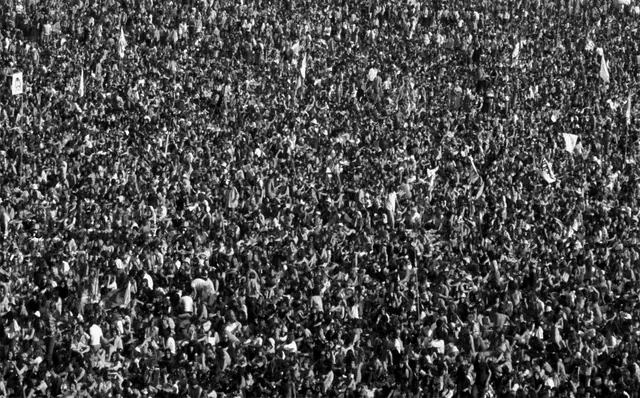
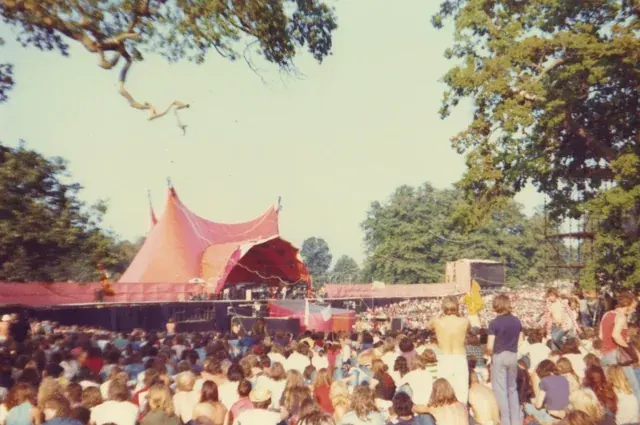
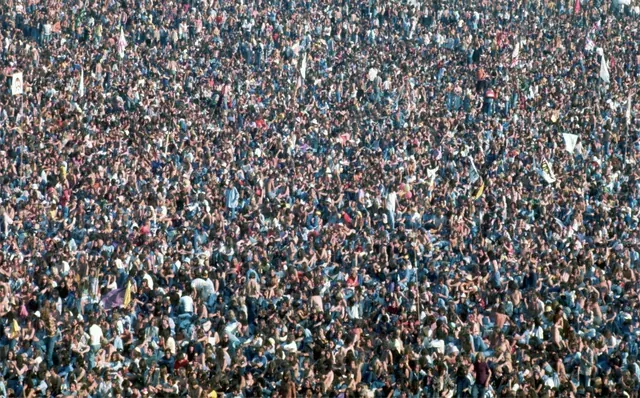
The Rolling Stones concert on 21 August 1976 expanded the estate spectacle. The supporting bill included artists such as 10cc, Lynyrd Skynyrd, Todd Rundgren’s Utopia, Hot Tuna and the Don Harrison Band. The Stones used a large stage and played a long set after a day in which scheduling and audience endurance were already under pressure. Photographs of the crowd show a field functioning at metropolitan scale.
Attendance claims vary and should not be repeated as precise census data. The more reliable conclusion is that Knebworth had become capable of attracting one of the largest audiences in British concert culture. Size brought prestige and vulnerability. A delayed headline appearance, distant sound and basic conditions affected people differently depending on where they stood. The event’s memory is therefore split between the triumph of scale and the exhaustion required to inhabit it.

1978: two versions of progressive culture
Genesis headlined on 24 June 1978 during the And Then There Were Three period. Jefferson Starship, Tom Petty and the Heartbreakers, Brand X and others created a programme that connected progressive history to contemporary American rock and jazz-fusion musicianship. Genesis was adapting to the departure of guitarist Steve Hackett while learning how more concise material and older extended works could share an enormous stage.
A second 1978 event, advertised as Not Another Boring Old Knebworth!, placed Frank Zappa, Peter Gabriel, The Tubes, Wilko Johnson and others in a more confrontational frame. The title itself acknowledged anxiety that the festival form and progressive rock had become predictable. Together, the two dates show a culture debating its future: one version consolidated a major band’s new identity; the other advertised eclecticism as an answer to stagnation.
1979–1982: returns, broadening and jazz
Led Zeppelin’s concerts on 4 and 11 August 1979 were their first British shows in four years and carried the weight of a national return. The performances have been argued over ever since, partly because expectations were almost impossible to satisfy. For Knebworth, the two dates confirmed the park as a place where a major group could make an event of reappearance rather than simply add another tour stop.
The Beach Boys headlined in 1980, shifting the mood toward a broad summer programme. The Capital Jazz Festivals of 1981 and 1982 brought artists from jazz and fusion to the estate and prevent the early history from being told only through white British album rock. Weather Report’s electronic textures and improvisation belonged to the same wider live culture of technical ambition, even when marketed under a different festival name.

Recording and remembering separate editions
Knebworth’s archive is distributed among estate records, artist archives, professional film, audience recordings, press photography and memorabilia. Famous headliners generate abundant material, while support acts and ordinary labour remain less visible. A later “Live at Knebworth” title may refer to one artist, one year or an anthology rather than the entire site history. Every object must therefore be tied to a date and production context.
Photographs are particularly powerful and potentially misleading. A tightly framed stage can conceal the audience’s distance; a crowd panorama can make one moment stand for an entire day. The licensed images on this page identify their edition and source so that 1975 Pink Floyd, the 1976 Rolling Stones and a later site view are not merged into one imaginary festival.
Legacy
Knebworth proved that a country estate could become a recurring national concert landmark without adopting one permanent genre or annual timetable. Its name accumulated meaning through exceptional dates. Artists went there to enlarge a tour, return after absence or place a current line-up against their own history. Audiences went expecting not convenience but occasion.
The early sequence also traces the movement from progressive festival culture toward the mega-concert. Musical variety remained, but headline identity, production scale and media afterlife increasingly controlled public memory. Knebworth’s value is that both models remain visible in one place: the exploratory all-day bill and the enormous branded appearance, each temporarily built on the same grass.
Follow the festival beyond the field
Timeline
Related genres
Related band guides
Explore by sound
Essential listening
RetroForge Echo
Hear a Fictional Archive Response
These modern RetroForge releases echo part of the festival’s musical vocabulary; they are not historical festival recordings.
Sources and further reading
- Knebworth Park concert timelineKnebworth House · accessed 23 July 2026
- 50 Years of the Greatest Rock Venue in the World!Knebworth House · accessed 23 July 2026
- Pink Floyd at Knebworth, 5 July 1975Pink Floyd official archive · accessed 23 July 2026
- Led Zeppelin at Knebworth, August 1979Led Zeppelin official site · accessed 23 July 2026
- Genesis at Knebworth, 24 June 1978Genesis Movement archive · accessed 23 July 2026
- Knebworth Festival photographic archiveWikimedia Commons · accessed 23 July 2026
Image credits5 licensed images
Pink Floyd at Knebworth in 1975 — Richard Humphrey — Wikimedia Commons — CC BY-SA 2.0 · source record · CC BY-SA 2.0
Converted to WebP and resized; no generative or compositional alterations.
The crowd for the Rolling Stones at Knebworth in 1976 — Sérgio Valle Duarte — Wikimedia Commons — CC BY 3.0 · source record · CC BY 3.0
Converted to WebP and resized; no generative or compositional alterations.
The Rolling Stones' Knebworth stage in 1976, when theatrical scale and an exceptionally long bill turned the estate into an all-day endurance event — Richard Humphrey — Wikimedia Commons — CC BY-SA 2.0 · source record · CC BY-SA 2.0
Converted to WebP and resized; no generative or compositional alterations.
A broad view of the 1976 Knebworth audience — Sérgio Valle Duarte — Wikimedia Commons — CC BY 3.0 · source record · CC BY 3.0
Converted to WebP and resized; no generative or compositional alterations.
Knebworth House in a later site photograph — Casanovafly91 — Wikimedia Commons — CC BY-SA 3.0 · source record · CC BY-SA 3.0
Converted to WebP and resized; no generative or compositional alterations.